
By Peter Grear, with AI assistance
December 13, 2025
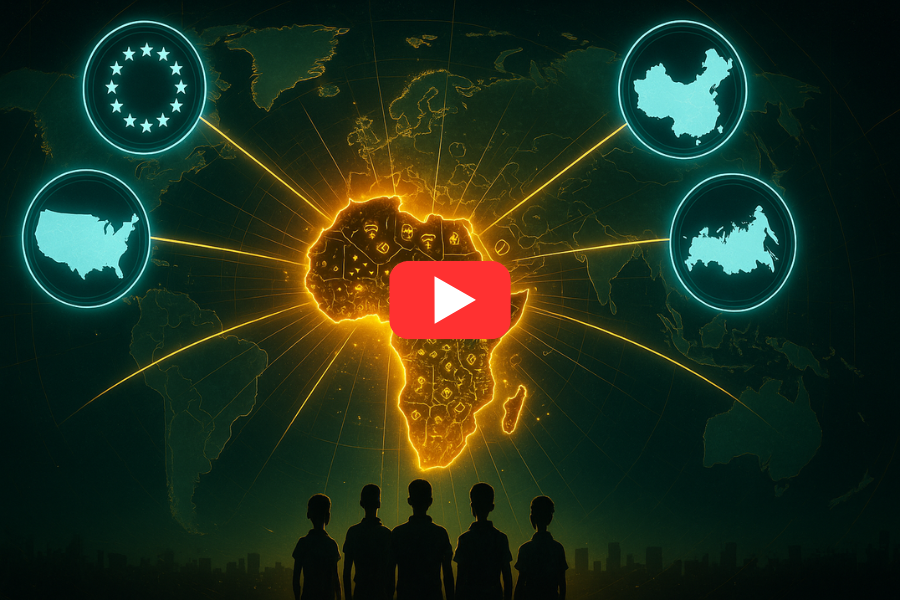
Africa has become the most consequential battleground for 21st-century global power — not because the world suddenly “discovered” its value, but because the continent is now asserting control over the value it has always possessed. With the world’s youngest population, abundant critical minerals, vast arable land, and rapidly growing digital economies, Africa is at the center of geopolitical strategy for the United States, China, Russia, and the European Union. Yet the emerging truth is unmistakable: Africa is no longer the arena. It is the arbiter.
China: Infrastructure, Minerals, and the Long Game
China’s influence in Africa is unmatched in visibility and speed. Through the Belt and Road Initiative, Chinese construction firms have built or financed railways, ports, bridges, highways, telecom networks, and power grids across the continent. These projects serve China’s two strategic interests:
- Securing mineral access for its manufacturing base; and
- Expanding political alliances across the Global South to reshape global governance standards.
African leaders often welcome Chinese partnerships because they produce tangible infrastructure quickly. Yet concerns about debt sustainability, mineral concession terms, and surveillance-embedded technologies continue to animate civil society conversations. Still, China’s approach is transactional, not ideological — and that clarity is part of its appeal.
United States: Democracy Branding Meets Strategic Uncertainty
The U.S. has renewed engagement with Africa, but inconsistently. Washington’s priorities center on countering China, advancing security cooperation, stabilizing the Sahel and Horn of Africa, and protecting access to critical mineral supply chains. Initiatives such as the U.S.–Africa Leaders Summit and development financing through USAID and MCC are meant to demonstrate partnership.
But African nations increasingly reject paternalistic governance conditions and the unpredictable nature of U.S. policy. AGOA remains America’s most influential tool, yet its sporadic suspensions make African economies wary of relying on it. In the eyes of many African youth, U.S. engagement still feels like an extension of Cold War-era posturing rather than a genuine commitment to African priorities.
Russia: Security Partnerships and Anti-Imperial Messaging
Russia lacks China’s economic muscle and America’s development infrastructure, but it wields a potent mix of security support and anti-colonial rhetoric. From Mali and Burkina Faso to the Central African Republic, Russian security contractors have become central players in governments breaking ties with France.
Moscow’s pitch is simple:
- No lectures.
- No political conditions.
- No colonial legacy.
- Immediate regime security.
For leaders facing insurgencies or internal instability, this offer carries weight. For African youth, Russia’s framing of the West as hypocritical resonates — even if Russia’s methods raise their own concerns.
European Union: Proximity, Pressure, and Post-Colonial Tension
Europe sees Africa as both a partner and a pressure point. The EU wants:
- secure access to markets,
- stable migration flows,
- critical mineral partnerships, and
- a buffer against Russia and China’s expanding influence.
Yet the shadow of colonial history — especially France’s — has severely weakened European credibility. Massive youth-led protests, military transitions in the Sahel, and the renegotiation of currency systems like the CFA franc reveal a continent unwilling to accept Europe on old terms.
Even the EU’s Global Gateway, marketed as a cleaner alternative to China’s BRI, is viewed skeptically when trade agreements still limit Africa’s industrialization.
Africa’s Emergence as a Geopolitical Power Center
This era is defined not by foreign competition, but by African agency. Countries are no longer choosing a single partner. They are forcing global powers to compete — and Africans are benefiting from this competition.
Two transformations are driving Africa’s leverage:
- Youth-led Pan-African consciousness rejecting dependency and demanding dignity.
- The AfCFTA, which creates a $3.4 trillion integrated market capable of reshaping continental manufacturing, supply chains, and global trade.
Add to this Africa’s central role in the future of clean energy — lithium, cobalt, rare earths, and copper — and a new geopolitical reality emerges: No major power can achieve its 21st-century ambitions without Africa.
What This Means for the Future
The global competition will intensify. China will push deeper into tech and minerals. The U.S. will emphasize security and governance. Russia will expand its anti-imperialist positioning. The EU will scramble to redefine its neighborhood strategy.
But Africa is charting a different path — one defined by sovereignty, strategic partnership, and the continent’s rising confidence. The next decade may well be remembered not as the period when global powers competed for Africa, but when Africa competed for — and won — its rightful place in the world.
Donate to GDN – Greater Diversity News | Subscribe – Greater Diversity News
Help grow The Economic Liberation of Africa conversation—forward to someone curious about Africa-centered opportunity.
Join the conversation—leave your take or a question.