
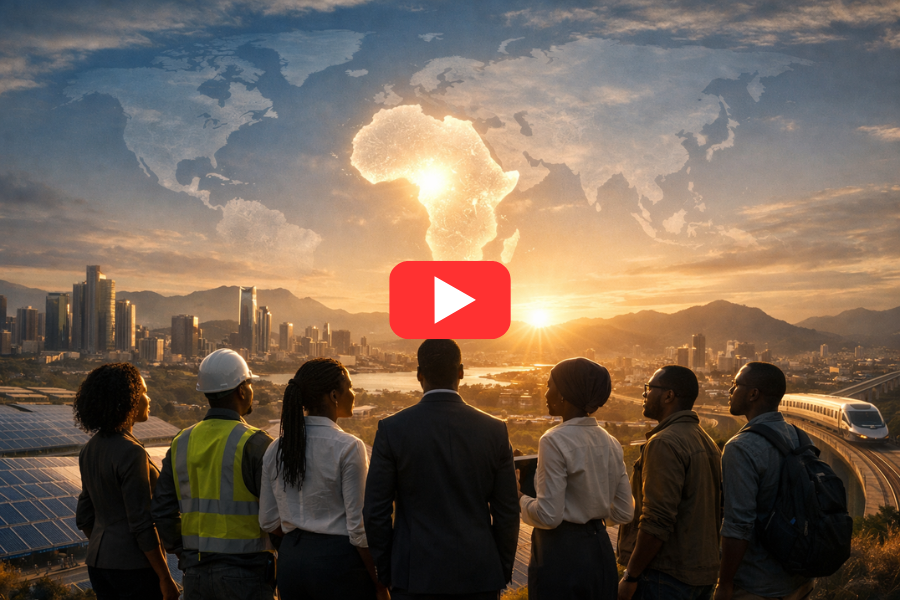
By Peter Grear, with AI assistance
February 9, 2026
When Tucker Carlson sat across from Duma Boko, few expected the exchange to generate one of the most provocative soundbites circulating across African and diaspora media: “Africa is poised to rule the world.” The phrase, clipped and amplified through YouTube titles and social feeds, quickly took on a life of its own. But the real significance of the moment lies not in the headline—rather in what Boko actually meant, and why the statement resonated so powerfully.
At first glance, Carlson’s questioning appears designed to provoke. What would Africa do, he asks, if it truly “ruled the world”? The framing mirrors a long-standing Western anxiety: that global power is a zero-sum game, where one region’s rise must come at another’s expense. Boko’s response quietly dismantles that assumption. His vision is not about domination, conquest, or replacing one hegemon with another. Instead, he points toward a rebalanced global system—one where Africa finally participates as a rule-setter rather than a raw-material supplier.
This distinction matters. For centuries, Africa has been integrated into the global economy primarily as an extractive zone: minerals out, profits elsewhere; labor cheap, value captured abroad. Boko’s assertion flips the script. Africa’s future power, he argues, rests in innovation, governance, demographics, and the ability to shape systems that serve humanity broadly—not a narrow global elite. In other words, Africa’s rise does not threaten the world; it potentially stabilizes it.
The conversation taps into a deeper global shift already underway. Africa is home to the youngest population on the planet, rapidly urbanizing societies, and vast underdeveloped industrial and technological capacity. As Western economies age and stagnate, and as Asia confronts demographic slowdowns, Africa represents the last major frontier of large-scale growth. Boko’s statement reflects a growing confidence among African leaders that the continent’s future is not merely promising—it is structurally inevitable.
Carlson’s visible surprise in the exchange reveals something else: how poorly much of Western political discourse has kept up with Africa’s internal conversations. Across the continent, policymakers, entrepreneurs, and youth movements are no longer debating whether Africa should lead, but how. The emphasis has shifted from aid dependency to industrial policy, from NGO-driven development to state capacity, from symbolic inclusion to economic sovereignty.
Importantly, Boko’s framing rejects revenge politics. He does not call for reversing exploitation through retaliation. Instead, he calls for redesign. Africa’s leadership, in his telling, would focus on building systems that are more humane, more equitable, and more sustainable—precisely because Africa has experienced the failures of the current global order firsthand. This moral authority, born of historical exclusion, may be Africa’s most underrated asset.
The reaction to the clip—particularly among African diaspora audiences—underscores its cultural power. Many viewers heard in Boko’s words a validation of what diaspora communities have long argued: that Africa’s destiny is not to catch up to the world, but to help redefine it. This perspective aligns closely with emerging frameworks like the African Union’s “Sixth Region,” which recognizes the global African diaspora as a strategic partner in development, capital formation, and policy influence.
What makes the exchange especially compelling is that it occurred on a platform not known for amplifying African voices in this way. That irony is instructive. Africa’s rise is becoming difficult to ignore, even in spaces historically indifferent—or hostile—to African self-determination. When such conversations break through, they reveal how outdated many global assumptions have become.
Ultimately, the viral framing of “Africa ruling the world” misses the point. Boko is not predicting an African empire; he is describing a reallocation of relevance. As global challenges—from climate change to labor displacement to resource scarcity—grow more complex, solutions will increasingly come from regions that understand systemic imbalance intimately. Africa’s lived experience positions it uniquely to lead that conversation.
The question, then, is not whether Africa is poised to rule the world. The real question is whether the world is prepared for leadership that prioritizes equity over extraction, partnership over dominance, and long-term sustainability over short-term gain. If Boko’s exchange with Carlson is any indication, that reckoning has already begun.
Join the conversation—leave your take or a question.
Help grow The Economic Liberation of Africa conversation—forward to someone curious about Africa-centered opportunity.
Donate to GDN – Greater Diversity News | Subscribe – Greater Diversity News
Well said!
Great article 👏🏿 the Carlson Tuckers of the world show little respect at this time. However, I believe their fear is that President Boko and other leaders like him will treat them in the same manner as the western world has treated African countries over years. Africa has a bright future ahead 🙌🏿 🙏🏿