
Africa Rising Series — Article 3
By Peter Grear (with AI assistance)
February 23, 2026
Africa didn’t wait for “perfect” banking infrastructure to arrive. In many countries, it built a new financial layer on top of what people already had: a mobile phone, a neighborhood agent, and a daily need to move money safely. That leapfrog—skipping expensive branch networks and going straight to mobile-led finance—has reshaped how households save, merchants sell, families send support, and entrepreneurs scale.
The result is not a niche trend. By 2024, mobile money had surpassed 2 billion registered accounts globally, with 514 million monthly active users, processing roughly 108 billion transactions worth nearly $1.7 trillion in a single year. And Sub-Saharan Africa sits at the center of this story: 1.1 billion of the world’s 2 billion mobile money accounts were in the region as of 2024, according to reporting on GSMA’s industry findings.
Leapfrogging wasn’t luck—it was necessity
The first reason Africa became the global proving ground is simple: traditional banking didn’t reach enough people, fast enough. Large distances, high costs, and limited branch footprints left a gap between the formal financial system and everyday life. Mobile money filled that gap with a model that worked in the real world: cash in, cash out, instant transfers, small-value payments, and growing access to savings and credit.
The second reason is infrastructure. While Africa’s financial branch networks lagged, mobile adoption accelerated—creating a “mobile-first” population that could adopt financial services through USSD menus, SMS, and later smartphones. In other words, the continent didn’t digitize banking; it often digitized money movement itself.
The agent network is Africa’s “branch system”
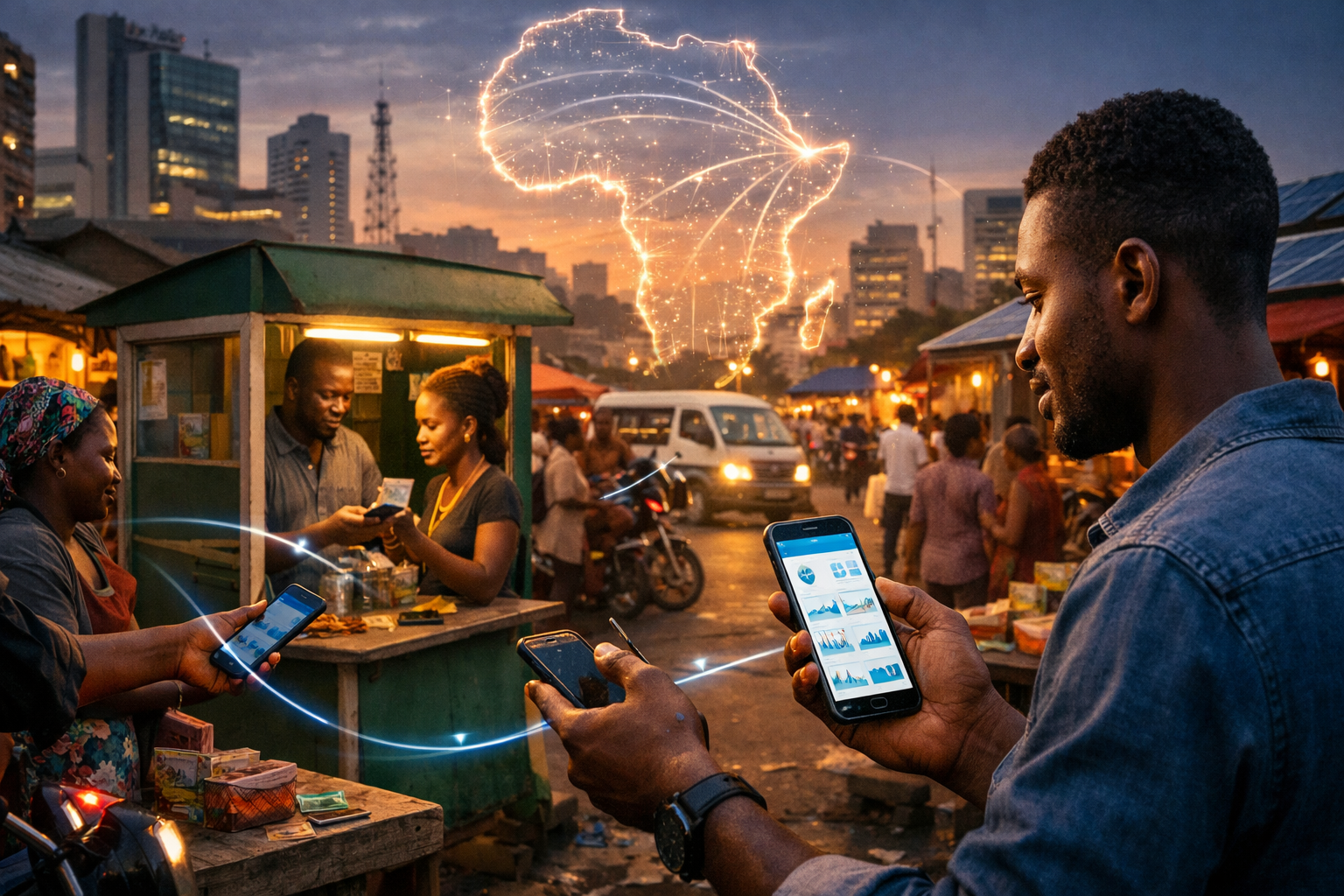
One of the most overlooked innovations is the agent model: local shops and kiosks acting as mini financial nodes. That agent layer made mobile money trustworthy. People could convert cash into digital value and back again—without traveling to a bank. It turned mobile money into something tangible, not abstract.
Vodafone’s retrospective on M-Pesa describes how scaling depended on building and training an agent network—and how quickly usage grew once it hit critical mass. This is the pattern repeated across markets: trust plus convenience beat bureaucracy.
M-Pesa’s spark—and the continent-wide acceleration
Kenya’s M-Pesa is widely credited as the catalyst that proved mobile money could operate at national scale. Vodafone notes M-Pesa launched in March 2007. It didn’t just create a product; it created a blueprint: interoperability ambitions, agent expansion, regulatory engagement, and relentless focus on everyday transactions.
And the evolution hasn’t stopped. In February 2026, Reuters reported that Safaricom launched stock trading via M-Pesa—an example of how mobile money platforms continue expanding from transfers into broader financial services.
Why fintech kept growing after mobile money
Mobile money’s dominance created conditions for a wider fintech boom:
- Payments became a habit. Once consumers and merchants routinely use digital payments, adjacent products follow: credit, savings, insurance, and merchant tools.
- SMEs gained rails. Small businesses could accept payments, pay suppliers, and manage cashflow digitally—often for the first time.
- Diaspora flows became easier. Mobile-led wallets helped make remittances and household support faster and more accessible, tying diaspora capital into local economies.
- A platform effect emerged. Providers moved beyond “send money” into becoming financial ecosystems—payments, lending, savings, and now even investment access in some markets.
This is why Africa’s fintech story is not a copy of Silicon Valley. It’s a response to lived realities—built from the ground up.
The economic footprint is getting harder to ignore
Mobile money’s impact isn’t only personal; it’s macroeconomic. Forbes Africa, summarizing GSMA findings, reported that mobile money contributed about $190 billion to Sub-Saharan Africa’s GDP in 2023, up from about $150 billion in 2022. Even allowing for debate about methodology, the direction is clear: mobile-led finance is now part of the region’s economic engine.
Challenges Africa must solve next
A serious “Africa Rising” assessment includes the hurdles:
- Fraud and cybersecurity: the more money moves digitally, the more criminals try to follow it.
- Fees and affordability: financial inclusion weakens when transactions become too expensive for low-income users.
- Interoperability: closed networks limit competition and raise friction across providers.
- Consumer protections and privacy: users need recourse, transparency, and data safeguards as platforms expand.
The next era of leadership will be defined by how well African countries and innovators handle these governance questions—without losing the speed and accessibility that made mobile money work.
Why this matters for The Economic Liberation of Africa
Mobile money and fintech demonstrate a broader truth: Africa doesn’t need to wait for permission to build the future. It can set standards, scale solutions, and export models the world studies. For the diaspora—especially Black students deciding what skills to learn—this is a living example of why Africa is not just heritage. It is opportunity, strategy, and an economic frontier where competence becomes influence.
Join the conversation—leave your take or a question.
Help grow The Economic Liberation of Africa conversation—forward to someone curious about Africa-centered opportunity.
Donate to GDN – Greater Diversity News | Subscribe – Greater Diversity News.