
By Peter Grear, with AI assistance
March 9, 2026
For generations, the story of Africa’s economic struggle has often been told as if liberation would come from a single breakthrough: one visionary leader, one powerful institution, one sweeping policy, or one grand continental plan. But that framing misses what may be the most important reality now unfolding across the continent.
Africa’s quest for economic liberation is increasingly decentralized.
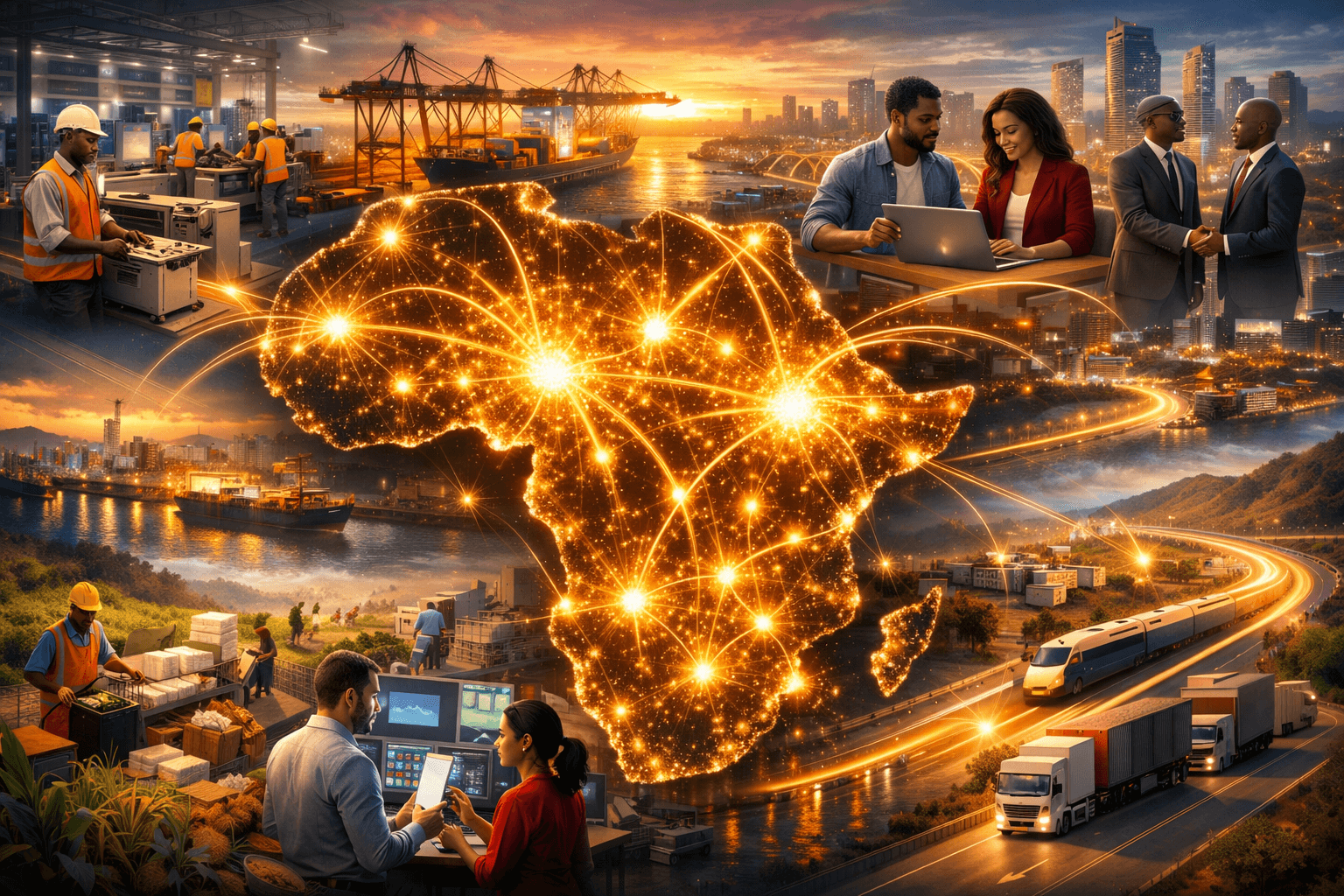
That is not a weakness. It may be one of the clearest signs that the continent is building something more durable than a top-down political slogan. Instead of waiting for one capital city, one foreign benefactor, or one centralized authority to solve Africa’s development crisis, the push for economic freedom is emerging from many centers at once: national governments, regional blocs, industrial zones, local manufacturers, digital entrepreneurs, agricultural processors, transport corridors, city-based innovators, informal traders, and diaspora investors.
In other words, Africa’s future is not being built in only one room. It is being built in thousands of places at the same time.
That matters because the system Africa is trying to escape was never centralized in the first place. Economic dependence was built through multiple pressure points: raw-material extraction, foreign ownership, external finance, imported manufactured goods, shipping dependence, outside-controlled technology, weak local processing, and procurement systems that too often bypass African firms. If dependency is spread across so many sectors, then liberation must also be spread across many sectors.
That is why Africa’s economic awakening now looks less like a single revolution and more like a continent-wide reorganization of power.
One country is trying to move up the value chain in minerals. Another is pushing agro-processing. Another is investing in digital payments. Another is strengthening local-content rules. Another is rethinking trade corridors, ports, and logistics. Another is building industrial parks. Another is inviting the diaspora to bring capital, expertise, and market links back into African economies. None of these moves alone will “free” the continent. But together they point toward a larger pattern: Africa is trying to create many African-controlled nodes of production, ownership, and exchange.
This is where the decentralized nature of liberation becomes strategic.
A centralized model assumes that transformation comes from the top and radiates outward. But Africa’s lived economic reality is far more complex. The continent contains 54 countries, multiple legal traditions, different currencies, different resource endowments, and different political histories. No single formula can do the work everywhere. A decentralized path allows countries and regions to experiment, adapt, and build from their own strengths while still contributing to a broader continental direction.
That broader direction is increasingly visible in the push for regional integration and value chains.
Africa does not need every country to manufacture everything. What it needs is a system in which more value stays on the continent. Raw materials can be sourced in one country, processed in another, assembled in another, and sold across a wider African market. That kind of economic design spreads opportunity across borders and makes the dream of liberation less dependent on any one state becoming an isolated industrial giant. It also makes Africa less vulnerable to the old pattern of exporting cheap raw materials and importing expensive finished goods.
This is why decentralization is not fragmentation. It is distributed capacity.
It also helps explain why small and medium-sized enterprises matter so much. Africa’s economic future will not be won only through mega-projects, presidential summits, or multinational deals. It will also be won through local factories, transport firms, engineering shops, software builders, farmer cooperatives, creative industries, and small businesses that can scale through procurement access and regional markets. When economic power is spread more widely, liberation becomes harder to capture by a narrow elite.
That has major implications for the diaspora as well.
If Africa’s economic liberation is decentralized, then diaspora engagement cannot be reduced to symbolic return, tourism, or feel-good heritage language. The diaspora becomes most powerful when it plugs into decentralized systems of ownership, partnership, procurement, workforce development, and enterprise-building. That is where the Right of First Refusal conversation becomes so important. If African and diaspora communities can build structured pathways into contracts, supply chains, talent pipelines, and investment opportunities, then economic liberation stops being an abstract aspiration and starts becoming a repeatable model.
This is also why youth matter so much in the liberation story.
Young Africans are not simply waiting for inclusion into old systems. In many cases, they are creating new ones through fintech, digital commerce, creative industries, logistics innovation, informal-to-formal enterprise growth, and cross-border entrepreneurial networks. Their work is often decentralized by nature. It is mobile, adaptive, local, digital, and networked. That makes it harder to suppress and harder to monopolize. It also means the future of African economic power may not come dressed only in the language of ministries and state plans, but also in the language of startups, skills, platforms, cooperatives, and local ecosystems.
The same is true in agriculture. Liberation is not just about shiny skylines and corporate towers. It is also about whether farmers, processors, warehouse operators, distributors, and food entrepreneurs can capture more value inside African economies. A rural processing hub, a transport network, or a local packaging plant may do as much for economic sovereignty as a major summit declaration. Decentralized liberation means value creation reaches beyond the capital city.
That is the deeper point.
Africa’s economic liberation is decentralized because the challenge itself is decentralized. The continent is not merely trying to raise GDP. It is trying to change who owns, who produces, who processes, who employs, who finances, and who benefits. That kind of transformation cannot be handed down from a podium alone. It must be built through many centers of action that gradually reinforce one another.
So when observers complain that Africa’s rise looks uneven, incomplete, or scattered, they may be misunderstanding the nature of the project. Yes, it is uneven. Yes, it is incomplete. But it is also real. And its decentralized character may be exactly what gives it resilience.
Africa does not need one door to freedom. It needs many doors swinging open at once.
That is what makes this moment so important. Economic liberation is no longer just a theory of state independence. It is becoming a practical struggle for distributed African power—across borders, sectors, institutions, and communities.
And once enough of those centers begin to connect, the old architecture of dependence becomes much harder to maintain.
Donate to GDN – Greater Diversity News | Subscribe – Greater Diversity News.
Join the conversation—leave your take or a question.
Help grow The Economic Liberation of Africa conversation—forward to someone curious about Africa-centered opportunity.