
By Peter Grear, with AI assistance
April 22, 2026
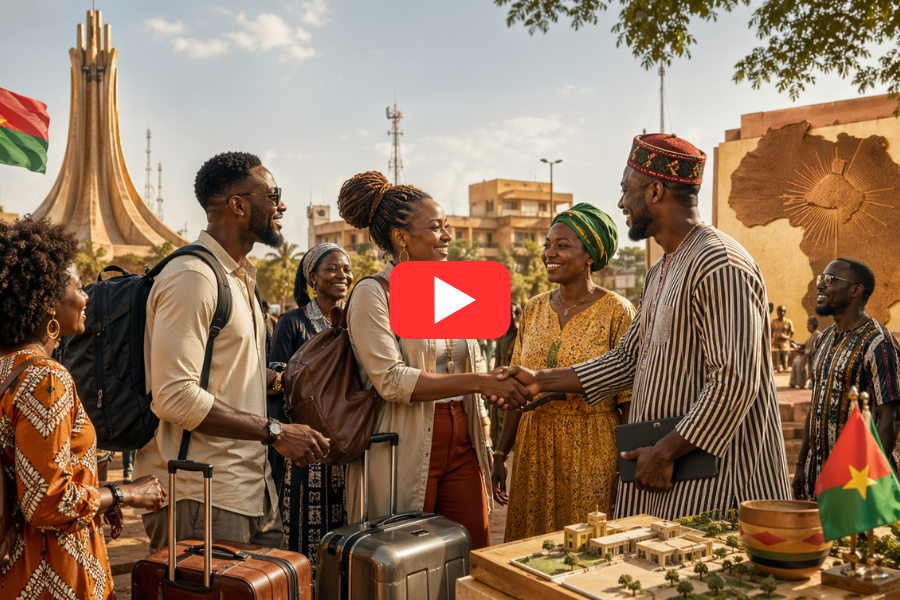
For years, conversations about the African diaspora returning to the continent have often centered on symbolism, tourism, and cultural reconnection. But the story suggested by the video “Year Of Return: The African Americans Returning To Burkina Faso” points to something deeper. Its framing is not simply about visiting Africa. It is about African-descended people considering Burkina Faso as a place to reconnect, settle, invest, and help build. The video itself presents a return movement centered on Burkina Faso and the African diaspora.
That matters because Burkina Faso is beginning to appear, at least in public-facing diaspora narratives, as more than a symbolic homeland. It is being presented as a possible site of economic return, political belonging, and Pan-African participation. In other words, this is not just a heritage story. It is a development story.
A key institution in that story is the African Diaspora Development Institute (ADDI). On its Burkina Faso page, ADDI says it successfully took over 200 African diaspora participants to Burkina Faso in April–May 2024 and over 500 in October–November 2025. The organization also continues to frame Burkina Faso as a destination for diaspora engagement and return-oriented activity.
Those numbers are important because they move the discussion beyond abstract encouragement. They suggest a growing effort to create a real pathway for diaspora engagement. Once return becomes organized, the questions change. The issue is no longer whether people are emotionally interested in reconnecting. The issue becomes whether there are institutions, policies, and economic opportunities strong enough to turn return into lasting participation.
That question became even more visible in November 2025, when reporting on a “Welcome Home” event said 700 African Americans, Afro-Caribbeans, and Afro-Europeans were welcomed in Burkina Faso and expressed a commitment to live and invest in the country. Whether every participant eventually relocates is not the only point. The more important point is that the language surrounding the event moved beyond reunion and toward investment, residence, and contribution.
For a GDN audience, that shift should stand out. Too often, diaspora return is discussed as a personal choice or an emotional aspiration. But Burkina Faso’s story suggests another possibility: that return can be treated as a strategic asset. A country can decide that descendants of Africa living abroad are not merely visitors or donors, but potential co-builders of national development. That changes the meaning of return.
It also expands the stakes. If African-descended people return with skills, capital, media influence, entrepreneurial ambition, and institutional networks, then return is no longer just about identity. It becomes part of a larger debate over who will help shape Africa’s next era of ownership and growth. Will that future be driven primarily by outside powers, multinational firms, and external lenders? Or will the global African diaspora become a more organized force in enterprise creation, infrastructure, policy influence, and wealth building on the continent? The Burkina Faso narrative points toward that second possibility.
There is also a political context that helps explain why this story resonates. Burkina Faso has projected a posture of sovereignty and dignity in its dealings with outside powers. In October 2025, Reuters reported that Burkina Faso rejected a U.S. proposal to receive foreigners being deported from the United States, with officials describing the request as contrary to the country’s dignity and rejecting the idea that Burkina Faso should become a “land of deportation.”
That stance matters in a return narrative. A country that publicly emphasizes dignity, sovereignty, and self-definition can become especially attractive to diaspora audiences looking for more than residency. It can become attractive to people seeking political meaning in their return. In that sense, Burkina Faso’s appeal is not only cultural. It is also ideological. It speaks to the desire of many in the African diaspora to reconnect with an Africa that sees itself not as dependent, but as self-respecting and future-facing.
Still, the excitement around return should be matched with practical questions. A serious return movement requires more than powerful speeches and welcoming ceremonies. It requires pathways to residence, legal clarity, access to land or housing, business formation support, protection for investment, and meaningful channels for civic and economic integration. That is where the long-term test will be. Inspiration can open the door, but only structure can keep it open.
That is why the Burkina Faso story deserves close attention from media platforms like GDN. It may represent an early test case for something larger: whether the African diaspora can move from symbolic reconnection to organized economic participation in Africa’s future. If that happens, Burkina Faso will not simply be part of a return story. It will be part of a blueprint.
And that is the larger lesson. The real “Year of Return” is not just about coming back. It is about coming back with purpose, structure, and a stake in building what comes next.
Donate to GDN – Greater Diversity News | Subscribe – Greater Diversity News.
Join the conversation—leave your take or a question.
Help grow The Economic Liberation of Africa conversation—forward to someone curious about Africa-centered opportunity.