
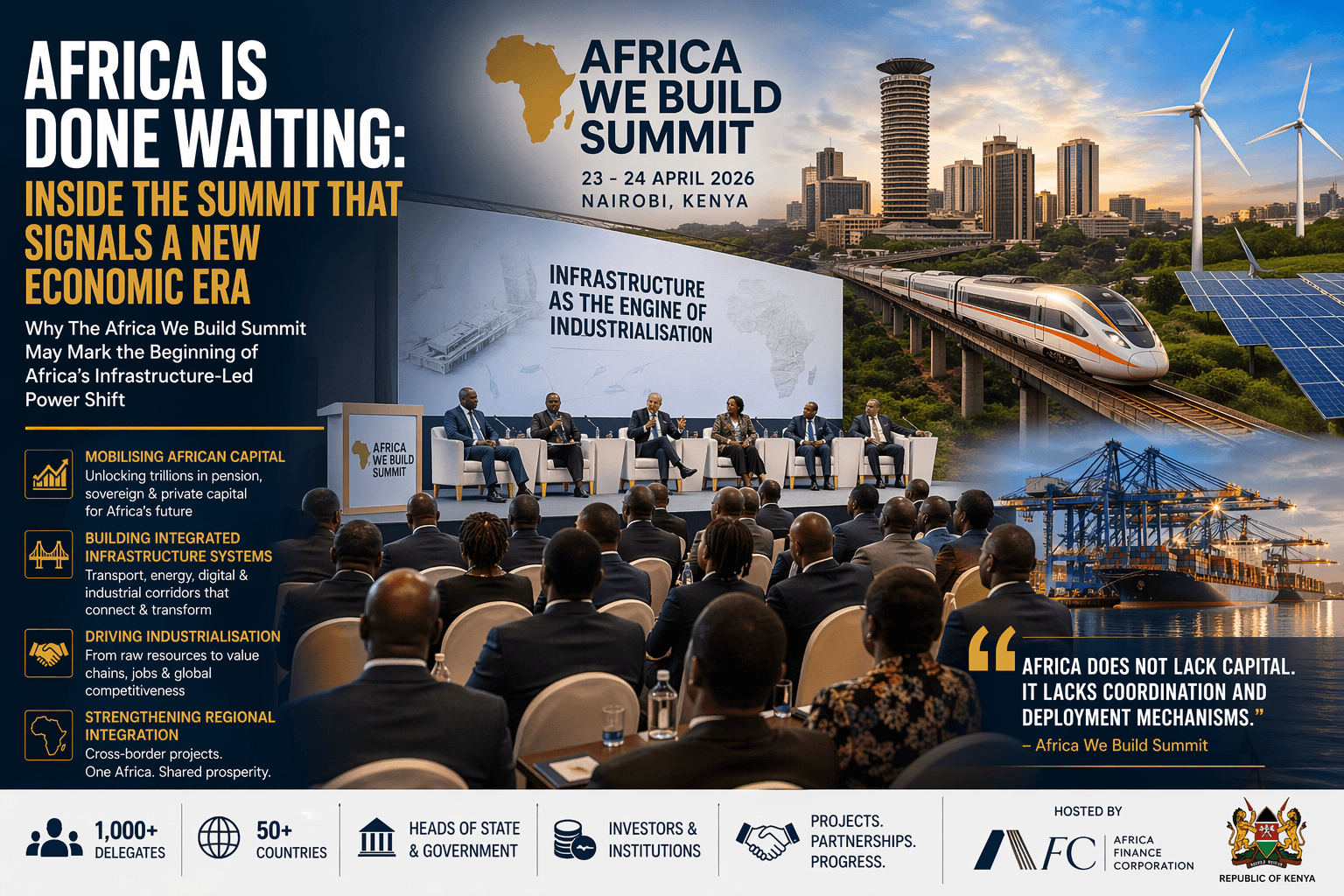
Why The Africa We Build Summit May Mark the Beginning of Africa’s Infrastructure-Led Power Shift
By Peter Grear, with AI assistance
April 27, 2026
For decades, Africa has been described as “rising.” But at the Africa We Build Summit, the message was unmistakable: Africa is no longer waiting to rise—it is preparing to build at scale.
Hosted by the Africa Finance Corporation in partnership with the government of Kenya, this inaugural summit in Nairobi brought together heads of state, institutional investors, and infrastructure leaders with one central goal: turn Africa’s potential into physical, investable reality.
Infrastructure Is the Strategy—Not the Side Conversation
For too long, infrastructure has been treated as a supporting actor in Africa’s development story. Roads, ports, energy grids—these were seen as necessary, but secondary.
The summit flipped that narrative.
Infrastructure is now being positioned as the primary engine of industrialization. Not just roads—but corridors. Not just power plants—but continental energy systems. Not just projects—but integrated economic ecosystems.
This is a critical shift. Because without infrastructure, Africa cannot:
- Scale manufacturing
- Compete globally
- Retain value from its natural resources
Africa Is Not Capital Poor—It Is Capital Misaligned
One of the most powerful ideas emerging from the summit is this:
Africa does not lack capital—it lacks coordination and deployment mechanisms.
Across the continent, trillions sit in:
- Pension funds
- Sovereign wealth funds
- Private African capital pools
Yet much of this capital is either:
- Invested outside the continent
- Locked in low-yield instruments
- Or disconnected from large-scale infrastructure opportunities
The summit aims to change that by creating bankable project pipelines that can absorb and deploy African capital at scale.
From Conversation to Construction
What separates the Africa We Build Summit from many other gatherings is its execution focus.
This is not a talk shop.
It is designed as a deal-making platform, where:
- Governments bring projects
- Investors bring capital
- Institutions structure the deals
The goal is simple:
👉 Move from announcements → financing → construction
Why This Matters for the Diaspora
For the global African diaspora, this summit signals something even bigger:
A shift from emotional connection to economic participation.
For years, diaspora engagement has centered on:
- Remittances
- Tourism (“Year of Return”)
- Cultural reconnection
But the summit introduces a new question:
👉 How does the diaspora participate in building Africa’s infrastructure economy?
This is where frameworks like Right of First Refusal (RoFR) become critical.
Imagine a system where:
- Diaspora investors and firms have structured access to major infrastructure deals
- African capital—both local and global—gets priority positioning
- Youth pipelines feed directly into these projects
That is not just investment. That is economic ownership.
The Missing Link: Talent
Capital and infrastructure are only part of the equation.
The real bottleneck is talent coordination.
Africa has:
- The world’s youngest population
- A rapidly growing educated class
- A global diaspora with skills and capital
What it lacks is a system to connect that talent to opportunity at scale.
This is where movements—especially student-led initiatives—become economic infrastructure themselves.
The Bigger Shift
The Africa We Build Summit is part of a larger transformation:
- From aid → investment
- From fragmentation → integration
- From resource extraction → value creation
But most importantly:
👉 From external dependency → internal agency
The Bottom Line
Africa is entering a phase where:
- Infrastructure is strategy
- Capital is mobilized internally
- Execution is prioritized
The question is no longer whether Africa will rise.
The question is:
👉 Who will participate in building it—and who will be left out?
Donate to GDN – Greater Diversity News | Subscribe – Greater Diversity News
Join the conversation—leave your take or a question.
Help grow The Economic Liberation of Africa conversation—forward to someone curious about Africa-centered opportunity.
