
 Unlocking the forces holding back Africa’s own wealth—and what it will take to turn capital into continental power
By Peter Grear, with AI assistance
Published: April 29, 2026
Africa is not poor.
That statement may sound provocative in a global narrative that has long framed the continent as capital-starved. But beneath the surface, a different reality exists—one that was brought into sharp focus at the Africa We Build Summit.
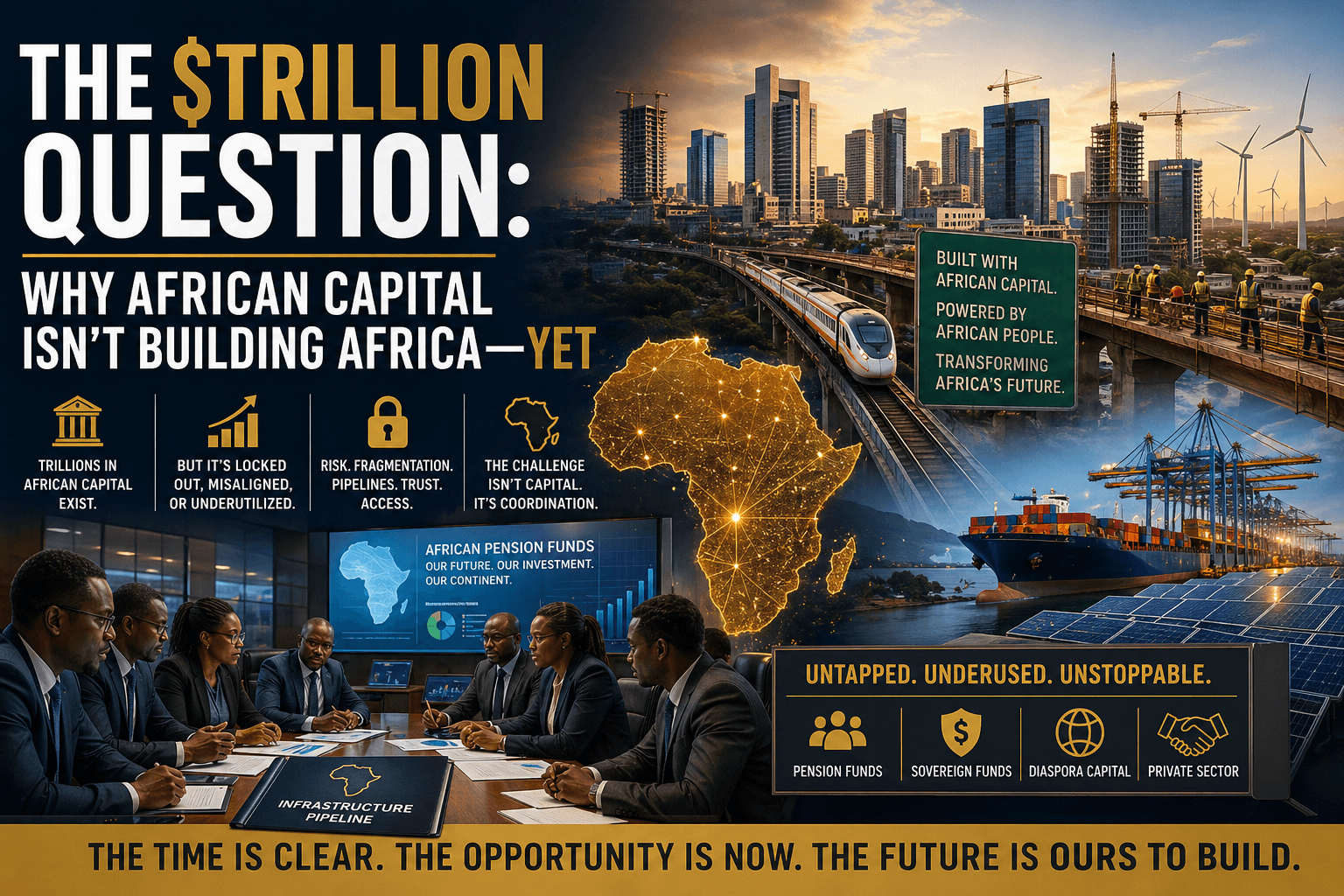
Across Africa and its global diaspora, trillions of dollars in capital exist. The real issue is not absence. It is alignment.
This is the $Trillion Question:
👉 If African capital exists, why isn’t it building Africa at scale?
The Hidden Wealth of Africa
Africa’s capital base is broader than commonly understood. It includes:
- Pension funds managing long-term savings
- Sovereign wealth funds tied to natural resource revenues
- Commercial banks and insurance institutions
- High-net-worth individuals across the continent
- A global diaspora sending over $90 billion annually in remittances
This is not marginal capital. It is strategic capital—the kind that builds nations.
Yet much of it is not financing:
- Rail networks
- Energy systems
- Industrial corridors
- Manufacturing ecosystems
Instead, it is often:
- Invested offshore
- Parked in low-risk government instruments
- Or fragmented across markets with no coordinated deployment
The Risk Problem
At the center of the issue is risk perception.
Large-scale infrastructure projects require:
- Long investment horizons
- Stable regulatory environments
- Predictable returns
Many African financial institutions are structured to prioritize:
- Liquidity
- Capital preservation
- Short-term yield
As a result, infrastructure—despite its long-term value—is often viewed as too complex or too risky.
This creates a paradox:
👉 Africa’s safest investments are often outside Africa
👉 Africa’s most important investments remain underfunded
The Pipeline Problem
Even when capital is available, it struggles to find bankable opportunities.
A “bankable project” requires:
- Clear feasibility studies
- Regulatory approvals
- Defined revenue models
- Risk mitigation structures
Across many African markets, project pipelines are:
- Underdeveloped
- Inconsistently structured
- Difficult to access
This disconnect means investors are often asking:
👉 Where are the projects we can actually invest in?
The Fragmentation Challenge
Africa is not a single market—it is 54 distinct systems.
Each comes with:
- Different legal frameworks
- Different procurement rules
- Different investment climates
For capital providers, this creates:
- High transaction costs
- Regulatory uncertainty
- Limited scalability
Without standardization, even well-capitalized investors face barriers to deploying funds efficiently across borders.
The Trust Gap
Another critical factor is trust.
Investors—both local and diaspora—often worry about:
- Governance transparency
- Contract enforcement
- Political risk
At the same time, governments may hesitate to:
- Open large projects to new entrants
- Restructure procurement systems
This mutual hesitation slows momentum.
The Diaspora Disconnect
The global African diaspora represents one of the largest untapped capital pools in the world.
But today, diaspora engagement is largely limited to:
- Remittances
- Small-scale investments
- Informal economic participation
There is no standardized pathway for diaspora capital to:
- Participate in infrastructure deals
- Access large-scale investment opportunities
- Integrate into national development strategies
This is not a capital issue—it is an access issue.
What Needs to Change
If African capital is to build Africa, three structural shifts must happen:
- Build a Real Project Pipeline
Governments and institutions must:
- Develop investment-ready infrastructure projects
- Package them with clear financial models
- Make them visible and accessible
This is where initiatives like an ADDI Gateway or centralized project registry become critical.
- Standardize Access Through Policy
Frameworks like Right of First Refusal (RoFR) could:
- Prioritize African and diaspora participation
- Reduce entry barriers
- Create a consistent investment environment
Instead of navigating 54 different systems, investors would operate within a coordinated framework.
- Connect Capital to Talent
Capital alone does not build infrastructure—people do.
Africa’s greatest advantage is its:
- Young population
- Expanding educated workforce
- Global diaspora skill base
The missing link is coordination.
This is where movements like your Black Student Movement for African-Centered Opportunity become critical—not as advocacy alone, but as economic infrastructure.
The Strategic Opportunity
What the Africa We Build Summit makes clear is this:
Africa is entering a phase where:
- Capital exists
- Projects are emerging
- Political will is increasing
The next step is integration.
The Bottom Line
The challenge is not raising capital.
The challenge is organizing it.
Until Africa:
- Aligns its capital
- Standardizes its systems
- Builds clear pipelines
The trillions will remain:
👉 Present—but not powerful
👉 Available—but not activated
The Real Question
The $Trillion Question is not just about money.
It is about control, coordination, and ownership.
👉 Who will organize African capital?
👉 Who will connect it to opportunity?
👉 And who will ensure it builds Africa—rather than everything else?
Donate to GDN – Greater Diversity News | Subscribe – Greater Diversity News
Join the conversation—leave your take or a question.
Help grow The Economic Liberation of Africa conversation—forward to someone curious about Africa-centered opportunity.