
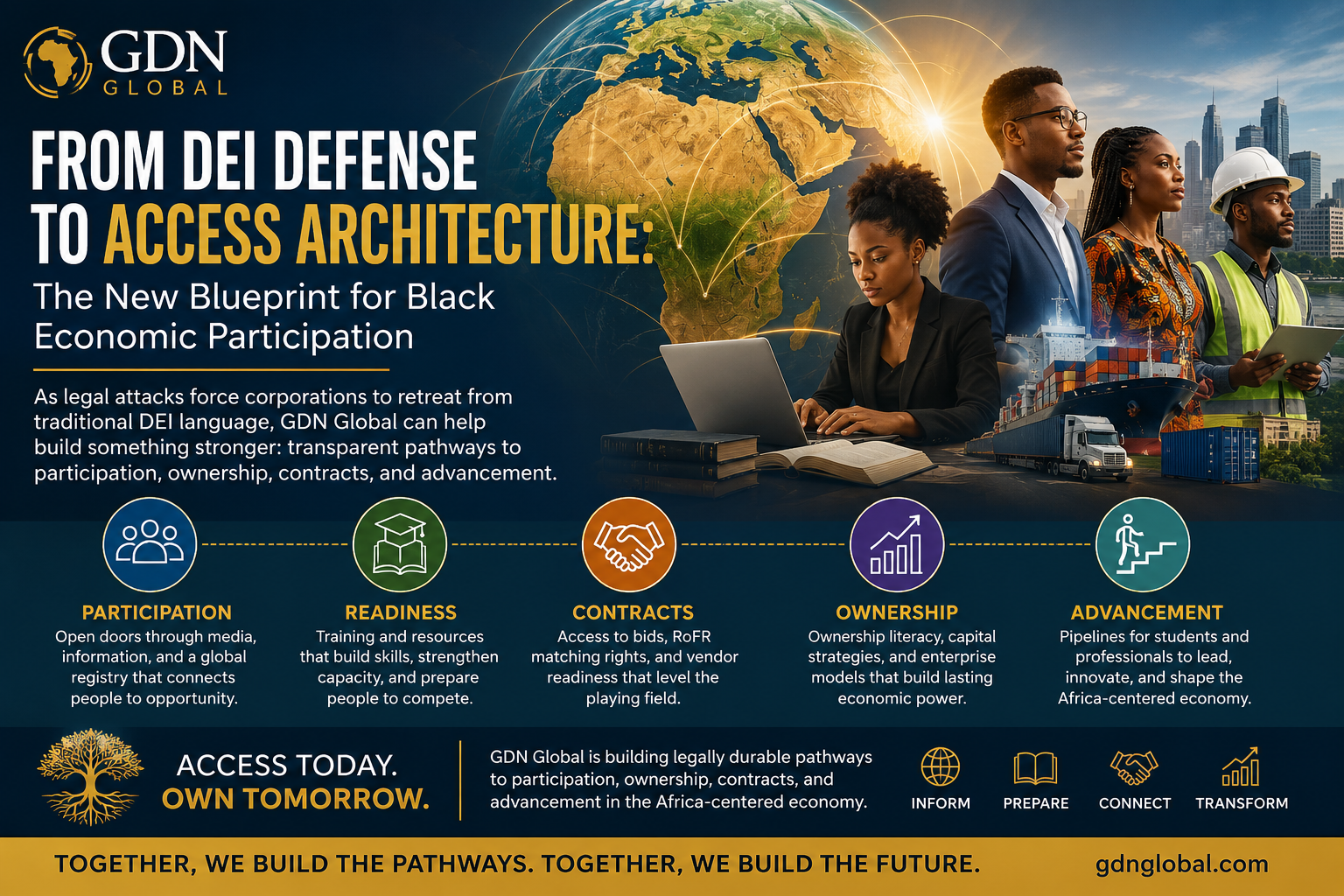
 As legal attacks force corporations to retreat from traditional DEI language, GDN Global can help build something stronger: transparent pathways to participation, ownership, contracts, and advancement.
By Peter Grear, with AI assistance
Publication Date: May 25, 2026
As corporations retreat from traditional DEI language, GDN Global has an opening to lead with a stronger model: access architecture. The next era of equity work must be built around transparent pathways to participation, ownership, contracts, and advancement.
Corporate America is changing the way it talks about diversity, equity, and inclusion. Some companies are retreating publicly. Some are removing DEI language from websites and annual reports. Some are changing executive metrics, supplier language, employee programs, and public commitments. But the deeper lesson is not that equity work is over. The lesson is that the next era must be built differently.
The old model depended heavily on public pledges, demographic goals, identity-based language, and corporate statements of commitment. The new model must depend on something more durable: access architecture.
Access architecture means building systems that help people prepare, compete, participate, partner, contract, own, and advance through clear rules and documented standards. It does not depend on slogans. It depends on pathways.
This is where GDN Global has an opening to lead.
The legal environment shifted sharply after the Supreme Court’s June 29, 2023 decision in Students for Fair Admissions v. Harvard/UNC, which struck down race-conscious admissions programs in higher education. Although that case concerned college admissions, it emboldened broader challenges to corporate DEI programs, especially where critics believed race, sex, or another protected characteristic influenced employment, contracting, or advancement decisions.
The pressure did not stop there. In March 2025, the Equal Employment Opportunity Commission and the U.S. Department of Justice warned that employers’ DEI policies, programs, and practices can violate Title VII if they involve unlawful discrimination. The agencies made clear that a program labeled as DEI is not automatically unlawful, but employment decisions based on protected characteristics can create serious legal risk.
This has forced companies to rethink how equity-related work is structured. Reuters reported in 2025 that major U.S. companies, including Google and Target, dropped or considered altering DEI policies after political and legal pressure. The result is a new landscape: less public DEI language, more legal review, fewer race-explicit goals, and a growing emphasis on fairness, compliance, access, skills, and business performance.
For GDN Global, this moment should not be read as defeat. It should be read as a design challenge.
The question is no longer simply, “How do we defend DEI?” The stronger question is: How do we build pathways that are lawful, measurable, mission-driven, and powerful enough to produce real participation?
The Problem With Symbolic Inclusion
For years, many institutions treated inclusion as a statement. They published commitments. They created councils. They hosted events. They celebrated representation. Some of that work mattered. But too often, symbolic inclusion did not create durable access to contracts, ownership, leadership, capital, global networks, or institutional power.
That weakness is now being exposed.
If a program depends only on language, it can be erased by political pressure. If it depends only on a pledge, it can be quietly withdrawn. If it depends only on a demographic target, it can be attacked as a quota. If it lacks transparent standards, it can be mischaracterized.
But if a program is built around open eligibility, written criteria, training, readiness, fair competition, documented review, and measurable outcomes, it becomes harder to dismiss and harder to dismantle.
That is why GDN Global should advance a new framework: The GDN Global Access Pathways Framework.
Its purpose would be clear: to build legally durable routes to participation, ownership, contracts, and advancement in the Africa-centered economy.
Participation: The Front Door Must Be Open and Organized
Participation begins with access to information. Many students, alumni, small businesses, diaspora professionals, and community institutions do not lack talent. They lack a reliable entry point.
GDN Global can become that entry point.
Through its website, newsletters, print publication, podcasts, YouTube programming, and partner network, GDN Global can organize a public pathway that moves people from awareness to action.
The participation model could follow a simple structure:
Article to newsletter. Newsletter to registration. Registration to orientation. Orientation to training. Training to registry. Registry to project matching. Project matching to measurable outcomes.
This turns media into infrastructure.
Instead of only informing people about Africa-centered economic development, GDN Global can help them find their place inside it.
Readiness: Access Without Preparation Is Not Enough
The second pillar is readiness.
Legal durability improves when programs are designed around preparation rather than preference. GDN Global can create training and orientation tracks that help participants become more competitive in real economic channels.
Students can be trained in research, media production, proposal writing, digital campaigns, policy analysis, and partnership outreach. Small businesses can be trained in capability statements, tender review, RFP responses, compliance documentation, pricing, and joint venture formation. Professionals can be trained to support Africa-centered projects in law, finance, technology, education, media, logistics, healthcare, energy, agriculture, and infrastructure.
This changes the message from “give people a special advantage” to “prepare people to compete and perform.”
That is a stronger position legally, operationally, and morally.
Contracts: From Preference to Performance-Based Access
The third pillar is contracts.
In the post-DEI environment, contract pathways must be designed carefully. Programs that appear to guarantee contracts based only on identity may attract legal scrutiny. But programs that expand access to information, training, vendor readiness, and competitive bidding are more durable.
This is where GDN Global can connect its work to RoFR — the Right of First Refusal.
RoFR should be explained as a matching-right model, not a guaranteed award. Under a properly designed RoFR framework, eligible African or diaspora bidders would have the right to match or beat an outside bid before a contract is awarded. But they would still have to meet the same standards for price, quality, compliance, delivery capacity, ethics, and performance.
That distinction is essential.
A legally durable RoFR model does not say, “Award the contract regardless of readiness.” It says, “Give qualified participants a structured chance to compete before wealth leaves the community.”
This is not charity. It is access with standards.
Ownership: Teaching the Structures That Build Power
The fourth pillar is ownership.
Too many conversations about economic inclusion stop at employment. Jobs matter. Promotions matter. But ownership is where long-term power is built.
GDN Global should create an ownership literacy track that explains the structures people need to understand: joint ventures, cooperatives, vendor partnerships, project finance, community benefit agreements, franchise models, diaspora enterprise partnerships, local content rules, procurement platforms, and cross-border trade channels.
This educational work is legally safer because it does not promise guaranteed ownership outcomes. It teaches the structures that make ownership possible.
That is a major role GDN Global can play: helping Black America, African institutions, HBCU communities, and the global diaspora understand how wealth is organized — and how to enter the systems where value is created.
Advancement: Building Student and Professional Pipelines
The fifth pillar is advancement.
This is where the NHBCUAAF–GDN Global partnership can become especially important.
The partnership can be framed as a student and alumni advancement pipeline built around skills, work products, mentorship, public visibility, and Africa-centered career development. It should not be built as a vague volunteer program. It should be structured as a serious pathway with clear tracks, defined deliverables, and measurable outcomes.
Students could participate in research and policy, media and editorial production, digital content, youth and campus engagement, business development, website development, and contract/tender research. Each participant should leave with a portfolio product: an article, podcast segment, proposal memo, research brief, sponsor list, tender analysis, website module, or campaign package.
This is how GDN Global can help turn interest into advancement.
The Importance of Documentation
In this new environment, documentation matters.
Every GDN Global pathway should have written eligibility rules, application forms, review rubrics, selection criteria, conflict-of-interest policies, anti-fraud standards, training records, deliverables, and outcome reports.
This is not bureaucracy for its own sake. It is protection.
Documentation shows that decisions are based on readiness, skill, capacity, mission fit, completion of training, and ability to deliver — not unlawful preference.
It also builds trust with sponsors, funders, HBCUs, public officials, African partners, and corporate collaborators.
A New Message for the Post-DEI Era
The message for GDN Global should be bold but disciplined:
We are not asking institutions to abandon fairness.
We are asking them to build fair access systems.
We are not asking for symbolic inclusion.
We are building pathways to measurable participation.
We are not asking for guaranteed outcomes.
We are preparing people to compete, partner, own, and advance.
We are not defending an acronym.
We are building infrastructure for economic liberation.
That is the strategic pivot.
The future of DEI-related work will not be won by nostalgia for old language. It will be won by designing better systems.
Why This Matters Now
Black communities, HBCUs, African institutions, diaspora organizations, students, small businesses, and emerging professionals cannot afford to wait for corporations to rediscover courage. The backlash against DEI has shown that public commitments can be fragile when they are not backed by durable structures.
GDN Global can help fill that gap.
It can serve as a media platform, training hub, registry, partnership builder, student pipeline, RoFR educator, and Africa-centered access engine. It can help turn scattered interest into organized participation. It can help move people from awareness to readiness, from readiness to contracts, from contracts to ownership, and from ownership to long-term advancement.
That is the real work ahead.
The next era will not be defined by who uses the word DEI the loudest. It will be defined by who builds systems strong enough to survive attack and practical enough to change lives.
GDN Global’s answer should be clear: build the pathways.
Standard CTA
Join the conversation—leave your take or a question.
Help grow The Economic Liberation of Africa conversation—forward to someone curious about Africa-centered pathways.
Donate to GDN – Greater Diversity News | Subscribe – Greater Diversity News