
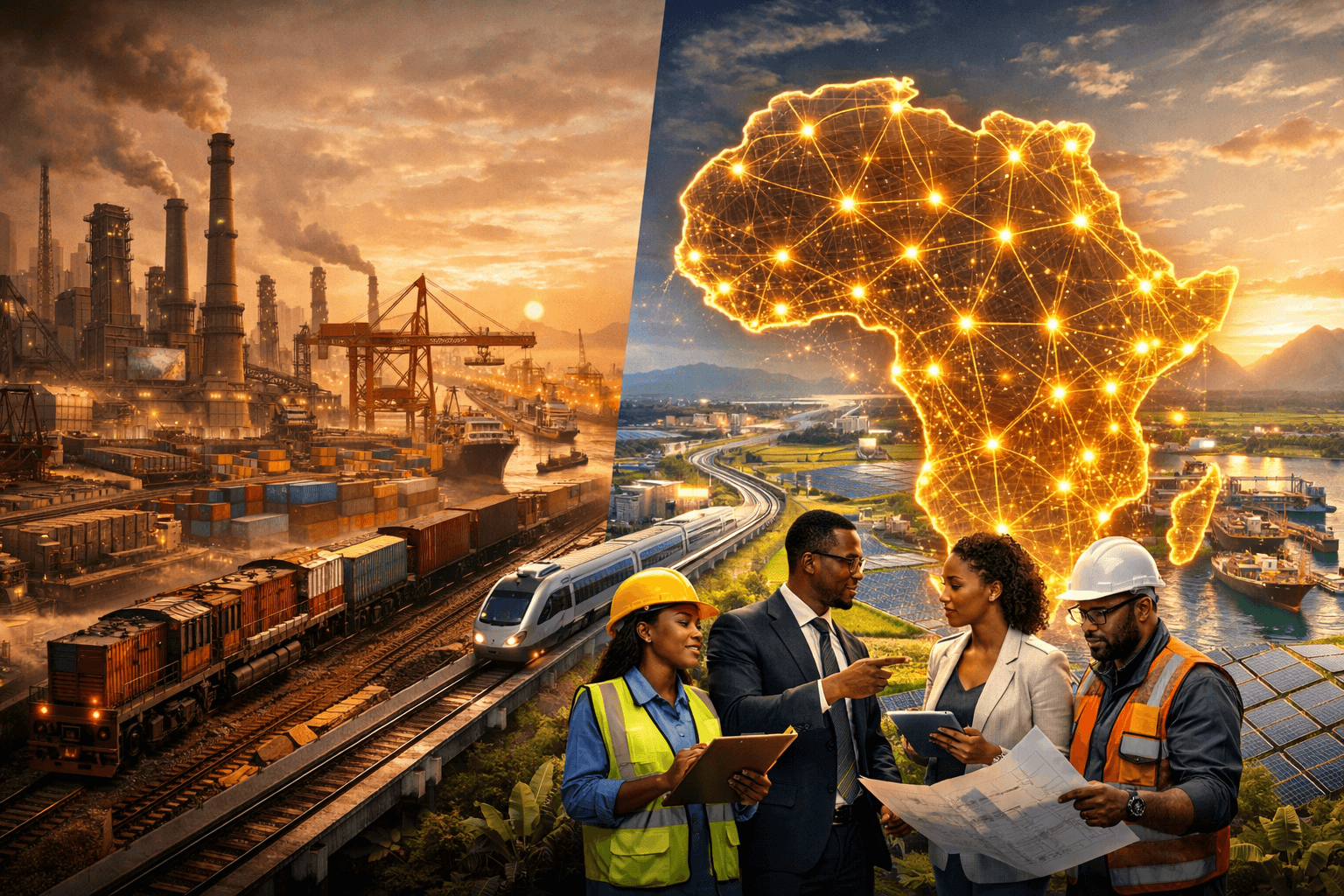
Africa’s industrial moment will not be a replay of China’s rise—but it could become one of the defining economic stories of this century.
March 18, 2026
By Peter Grear with AI assistance
For decades, the global economy treated China as the great manufacturing story of the modern age. It took a country once associated with low-cost labor and turned it into the world’s dominant industrial platform—one built on infrastructure, export manufacturing, state-backed planning, and relentless expansion of productive capacity. The comparison now raising a larger question is whether Africa could become the next major industrial story of the 21st century. Not by copying China exactly, but by learning from its rise while building a model rooted in Africa’s own geography, politics, markets, and future. The World Bank’s long-running work on China describes that rise as “meteoric,” a transformation built through decades of structural change and industrial scaling.
China’s industrialization was powered by concentration. One state. One broad national direction. Large-scale infrastructure. Special economic zones. Export discipline. Domestic firms growing alongside foreign capital. Manufacturing was not a side effect of growth—it was a core strategy of development. That strategy helped turn China into the world’s largest manufacturing economy and a central player in global supply chains.
Africa’s industrial future will likely be built differently. It will not emerge from a single state directing one integrated national machine. It will more likely come through linked regional hubs, cross-border trade corridors, industrial clusters, energy investments, and strategic coordination under the African Continental Free Trade Area. In that sense, Africa may not become “the next China.” It may become something more decentralized: a continental production network with multiple centers of industrial growth. UNECA’s Economic Report on Africa 2025 argues that AfCFTA can help address structural challenges by fostering cross-border trade, encouraging renewable energy adoption, and spurring industrialization and agro-processing while helping Africa move up global value chains.
That difference matters. China rose in an era when globalization rewarded large-scale export platforms and foreign firms were actively moving production offshore. Africa is rising in a world shaped by supply-chain diversification, geopolitical competition, energy transition, and digital trade. That makes the path harder in some ways, but it also creates openings that did not exist before. Countries and corporations are now rethinking where supply chains should sit, where processing should happen, and how strategic materials should be sourced. Africa enters that moment with resources the world wants, a young population the world cannot ignore, and a continental trade framework that—if fully activated—could help turn scale from a weakness into a strength. UNECA says Africa must double down on diversification and structural transformation, while the World Bank projects Sub-Saharan Africa’s growth to strengthen further in 2026–2027.
But Africa’s opportunity cannot be reduced to growth projections and market headlines. China’s rise was not built simply on having labor or land. It was built on turning economic position into industrial leverage. That meant building roads, ports, factories, supplier networks, export systems, and firms that could scale. It also meant turning production into power.
That is the lesson Africa must absorb now.
Africa has spent too long supplying the raw materials of other people’s industrial victories. Minerals leave. Agricultural commodities leave. Energy inputs leave. The value is added elsewhere. The brands are built elsewhere. The financing is arranged elsewhere. The logistics chains are often controlled elsewhere. Even when Africa is central to the resource story, it is too often peripheral to the ownership story.
That is why Africa’s industrial future must be about more than factories. It must also be about position.
This is where RoFR—Right of First Refusal—could become more than a policy phrase. In an African industrial context, RoFR could mean creating structured first-position access for African states, African firms, and diaspora-linked enterprises in procurement, concessions, processing rights, supply contracts, industrial parks, logistics platforms, and strategic partnerships. Put plainly, it means Africans should not always discover opportunity only after it has already been packaged, priced, and assigned to someone else.
If China’s rise teaches anything, it is that industrial transformation works best when a country or region does not merely host economic activity but shapes who benefits from it. Africa’s version of that principle may not come through one central command system. It may come through AfCFTA, national industrial policies, regional value chains, and tools like RoFR that help secure first rights to build, supply, process, and own.
That is especially important for the diaspora. China’s development story benefited from global Chinese networks, outside capital, and commercial ties that helped reinforce national growth. Africa and its diaspora have the potential to develop a similar relationship, but only if participation is structured. Without mechanisms such as RoFR, diaspora investment can remain scattered—strong in sentiment, weak in industrial consequence. With structured access, however, diaspora capital, expertise, and networks could help build manufacturing, logistics, technology services, and trade platforms tied to Africa’s industrial future.
Africa does not need to become China. But it does need to study the underlying lesson of China’s rise: industrialization changes nations when production, infrastructure, policy, and ownership are aligned. Africa now has a chance to align its own version of that formula around continental trade, regional production, strategic sectors, youth development, and diaspora engagement.
The real question is not whether Africa can industrialize.
The real question is who will be first in line to build from it.
Donate and Subscribe
Donate to GDN – Greater Diversity News | Subscribe – Greater Diversity News
Join the conversation—leave your take or a question.
Help grow The Economic Liberation of Africa conversation—forward to someone curious about Africa-centered opportunity.