
By Peter Grear, with AI assistance
Published: December 10, 2025
For more than three decades, the struggle for reparatory justice has been steadily advancing across the African continent. But the past two years have brought a historic acceleration—one driven in large part by Ghana’s unapologetic leadership and the African Union’s willingness to finally institutionalize what earlier generations could only declare. The modern reparations movement did not begin in 2023, nor with Ghana’s recent calls at the United Nations. Its roots reach back to 1993, when the Abuja Proclamation first framed the transatlantic slave trade and colonialism as crimes against humanity for which reparations were not only justified but required.
That proclamation, issued under the former Organization of African Unity (OAU), established a principle that would take years to mature: African nations and people of African descent across the globe have a legal, moral, and historical right to reparations for centuries of exploitation. Abuja was not a passing moment—it set the intellectual and political foundation for everything unfolding today.
In 2001, the World Conference Against Racism in Durban pushed the conversation onto the global stage. The Durban Declaration acknowledged slavery and colonialism as crimes against humanity, creating rare international validation for Africa’s claim. But for nearly two decades afterward, the movement struggled to gain continental momentum. It was diaspora organizations, Caribbean governments, African scholars, and civil society who kept the pressure alive while African governments largely moved cautiously.
Then came 2020. The global reckoning with racial injustice reignited the call for structural solutions, not symbolic gestures. Suddenly conversations about restitution, resource theft, cultural repatriation, and systemic inequality were no longer academic—they were urgent. And Ghana stepped into the center of the conversation.
In 2022, Ghana hosted the Accra Summit on Reparations and Racial Healing, the first major Africa-based gathering since the global racial justice wave. Its outcome—the Accra Declaration—made two key shifts. First, it moved the discussion beyond emotional and moral narratives into the sphere of structural economics: reparations must address systemic injustice, not merely acknowledge historical wrongdoing. Second, it cemented unity between Africa and the diaspora as a strategic necessity rather than a symbolic gesture.
A year later, in November 2023, Ghana and the African Union co-hosted the Accra Reparations Conference, the most consequential gathering since Abuja. Heads of state, legal scholars, economists, youth leaders, and global diaspora representatives met to craft a continental agenda. The resulting Accra Proclamation called for a Global Reparation Fund—a coordinated financial, legal, and diplomatic mechanism capable of pressing former colonial powers for full reparatory justice. It was a monumental step. For the first time, reparations were no longer an idea waiting for validation; they were a policy platform embedded in the AU’s governance structure.
By early 2024, the AU had formally adopted the conference recommendations, establishing committees of experts, legal working groups, and political champions charged with giving teeth to the movement. The AU’s 2025 theme—“Justice for Africans and People of African Descent through Reparations”—marked the most official endorsement yet.
Ghana’s president reinforced the message at the AU Assembly: the legacy of slavery and colonialism lives in the modern structures that shape global trade, wealth distribution, and geopolitical influence. Reparations, he argued, are not a backward-looking demand—they are a forward-looking framework for correcting the global economic order.
This contemporary movement links the past with the present. It recognizes that Africa continues to lose billions annually through illicit financial flows, underpriced resource extraction, and the long shadow of colonial economic design. It also affirms that diaspora communities continue to bear the psychological, political, and socioeconomic consequences of stolen labor, stolen lands, and stolen futures.
Ghana’s boldness has inspired new coalitions. CARICOM states have aligned their own reparations agenda with Africa’s. Diaspora scholars and activists are collaborating with AU committees. Youth networks across Africa are reframing reparations as a tool for development, not victimhood. And for the first time, former colonial powers are facing coordinated, continent-wide diplomatic pressure rather than isolated demands.
Yet challenges remain. There is no global consensus on how reparations should be measured, who should pay, or how restitution should be administered. Some critics argue that African nations must also confront internal inequities and governance failures. Others warn that powerful nations will resist these claims vigorously.
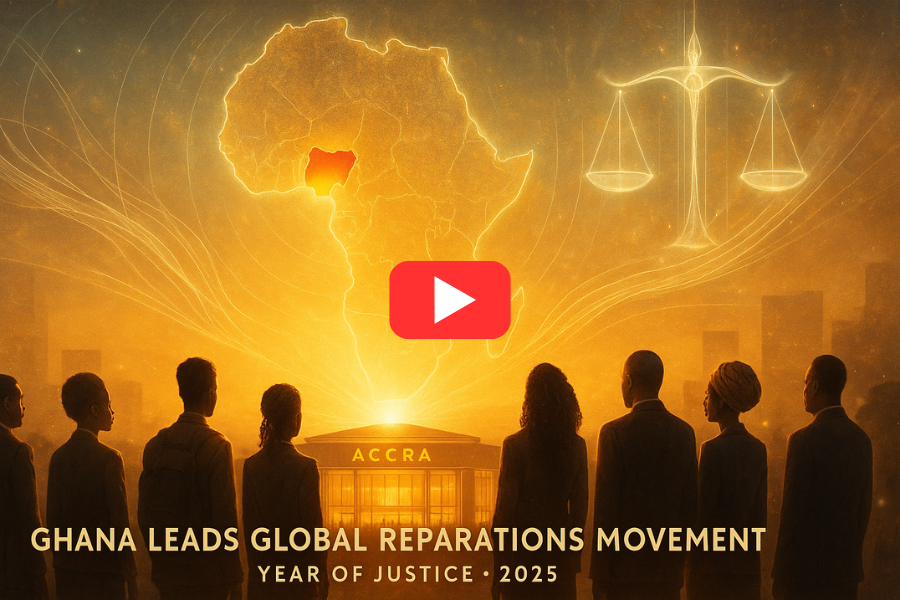
But what cannot be denied is this: the reparations movement is no longer theoretical. It now has institutions, declarations, expert bodies, international alliances, and the weight of continental policy behind it. From Abuja in 1993 to Accra in 2023 and Africa’s 2025 “Year of Justice,” the project for reparations has become a central pillar in Africa’s fight for global equity.
Ghana has transformed the conversation from a moral plea into a geopolitical demand. And the world is finally being forced to listen.
Donate to GDN – Greater Diversity News | Subscribe – Greater Diversity News
Join the conversation—leave your take or a question.
Help grow The Economic Liberation of Africa conversation—forward to someone curious about Africa-centered opportunity.