
By Peter Grear (with AI assistance)
December 15, 2025
The “post-racial” myth meets a global audience
For decades, America sold a powerful export: not just Hollywood and tech, but an idea—pluralism, upward mobility, civil rights progress, and the promise that democracy can self-correct. In Africa and across the diaspora, that story has never been naïve. People remember Jim Crow, COINTELPRO, redlining, and the long fight for Black citizenship. But they also saw Black mayors, Black generals, a Black president, and a constant stream of diaspora success stories that suggested the U.S. could bend—however slowly—toward inclusion.
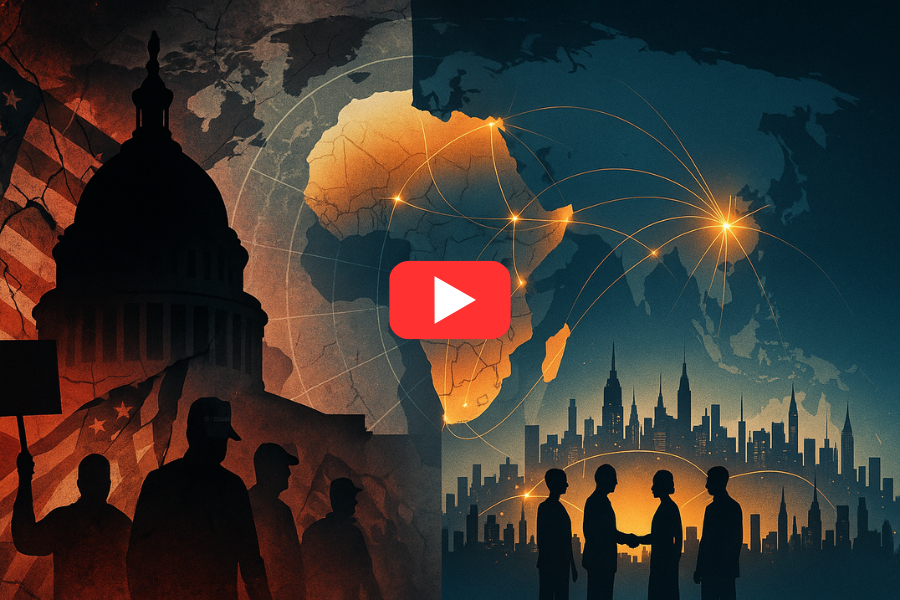
MAGA America disrupts that narrative in a way international audiences instantly recognize. The movement is often perceived abroad less as “conservatism” and more as identity politics with state power—a politics that openly contests multiculturalism, reframes civil rights as “wokeness,” and treats demographic change as a threat rather than a reality to govern with dignity.
That perception isn’t driven by one speech or one election cycle. It’s reinforced by recurring headlines and language—especially when prominent MAGA figures disparage immigrants from Black-majority regions. In December 2025, major outlets reported Donald Trump publicly confirming and boasting about his 2018 “shithole countries” remark—an episode that landed globally as more than insult. For many Africans and diaspora communities, it signaled how MAGA ranks nations and people in a hierarchy of worth. AP News+1
International confidence is a currency—and MAGA spends it fast
In global politics, credibility is capital. Pew Research Center’s 2025 international polling shows a median 34% confidence in Trump across 24 nations, with 62% expressing no confidence—a stark indicator of how MAGA leadership is read abroad. Pew Research Center That doesn’t mean “the world hates America.” It means large global publics question whether MAGA-led America is predictable, fair, and cooperative—especially on diplomacy, migration, conflict, and climate.
And yet, America remains a soft-power superpower. The U.S. still tops Brand Finance’s Global Soft Power Index 2025, leading in familiarity and influence and ranking high in pillars like international relations, education, and media. Brand Finance+1 This is the paradox Africa and the diaspora live with: America’s cultural and institutional gravity remains immense, even as MAGA politics creates a reputational drag that can undercut trust.
What Africa notices: instability, racial signaling, and transactional diplomacy
African governments and publics are pragmatic. They ask: Will the U.S. keep its word? Will rules change overnight? Are visas and trade preferences tools of partnership—or punishment? When MAGA rhetoric suggests narrower definitions of belonging, it inevitably shapes expectations about student visas, family migration, refugee protections, and the dignity of African travelers and professionals.
At the public-opinion level, Afrobarometer findings illustrate that perceptions of external powers can shift—and can shift sharply. In South Africa, for example, Afrobarometer reporting found declining positive perceptions of foreign influence between 2021 and 2022, with U.S. influence viewed positively by a smaller share than China in that snapshot. Afrobarometer+1 The point isn’t “China wins.” The point is: U.S. image is contestable, and MAGA-style politics can make it easier for competitors to say, “America lectures you while mistreating its own minorities.”
What the diaspora notices: a narrowing of the American promise
For the African diaspora—especially Black Americans and Afro-descended communities globally—MAGA America often reads as a referendum on the legitimacy of Black presence in the West. Attacks on DEI and “anti-woke” campaigns don’t stay domestic; they travel through social media into Lagos, Accra, Nairobi, London, Paris, Kingston, and São Paulo. Diaspora audiences interpret these battles as signals about whether Western institutions are retreating from inclusion—and whether Black mobility will be constrained socially, economically, and politically.
This matters because diaspora strategy is increasingly institutional: building chambers of commerce, cross-border investment vehicles, talent pipelines, and Sixth Region advocacy that treats the diaspora as a stakeholder in African development. That work requires moral credibility—especially when the diaspora asks African states to adopt reforms like Right of First Refusal-style local preference mechanisms, diaspora contracting pathways, or AU-level representation.
Sixth Region framing: credibility is the new infrastructure
If the Sixth Region project is to mature from aspiration into policy, it must be positioned as Africa-centered, values-grounded, and internationally coherent—not as an extension of U.S. domestic polarization.
A practical Sixth Region response to MAGA-era perceptions looks like this:
- Define the diaspora’s legitimacy independently of U.S. politics. The Sixth Region is about African peoplehood, development capacity, and transnational wealth-building—not American party identity.
- Lead with governance credibility. Pro-democracy, anti-corruption, rule of law, and development transparency are the language of international trust—especially when U.S. trust is contested.
- Build “people-to-people diplomacy” infrastructure. Universities, professional associations, municipal partnerships, and diaspora business councils can be stabilizers when state-to-state relations wobble.
- Make narrative discipline non-negotiable. The diaspora must speak in a register that African youth, AU institutions, and global partners can respect: dignity, reciprocity, and measurable outcomes.
MAGA America may continue to generate heat, headlines, and polarization. But the Sixth Region cannot afford to be reactive. In a multipolar world, credibility is infrastructure—and the diaspora’s job is to build it where U.S. politics may be burning it down.
Donate to GDN – Greater Diversity News | Subscribe – Greater Diversity News.
Join the conversation—leave your take or a question.
Help grow The Economic Liberation of Africa conversation—forward to someone curious about Africa-centered opportunity.