
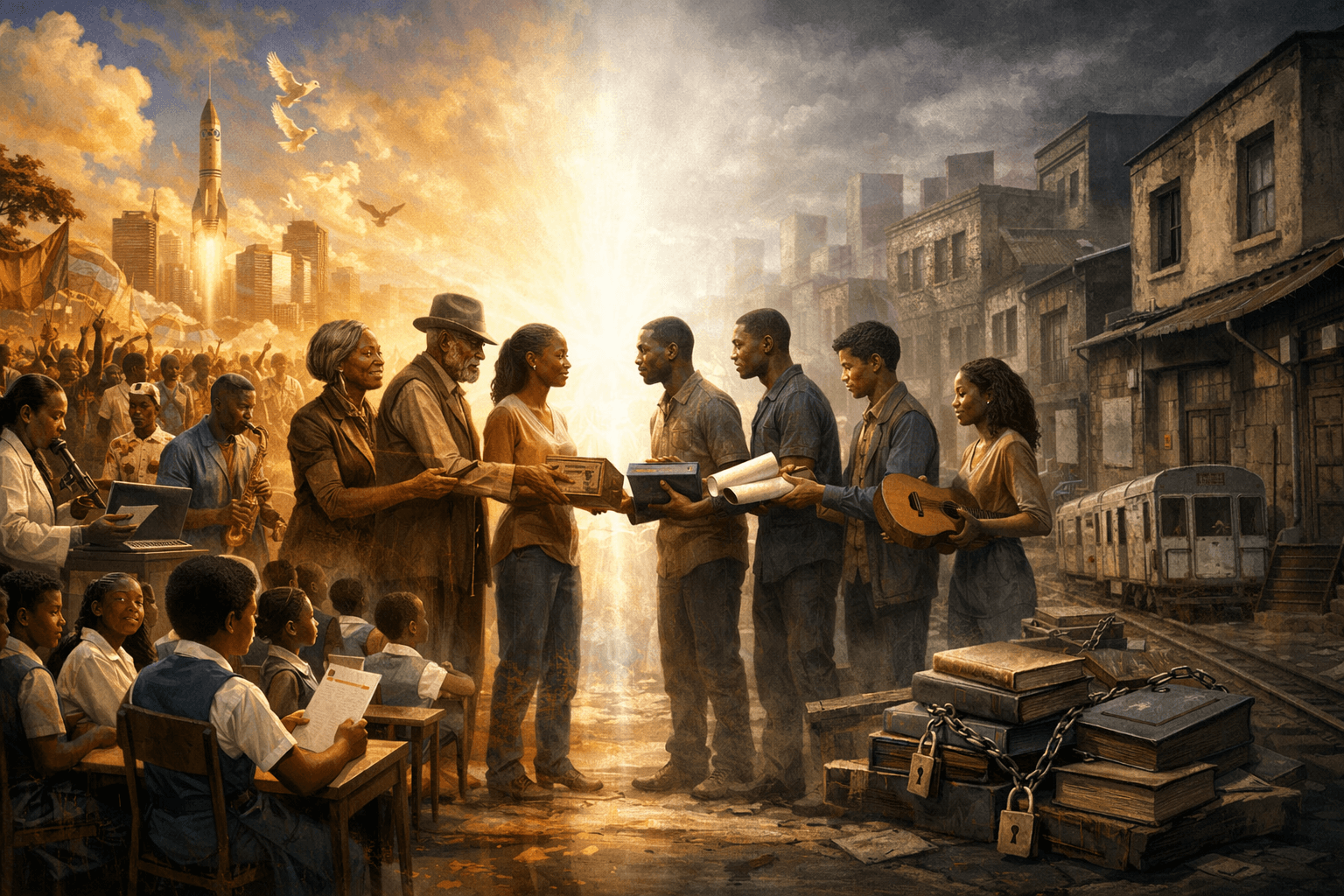
By Peter Grear, with AI assistance
January 12, 2026
History often pretends progress is inevitable. It is not. Progress exists because someone refused to stop pushing when quitting would have been easier.
If Black people had given up—at any stage of history—the modern world would not resemble what we know today. Democracy would be narrower, colonialism more entrenched, culture less vibrant, and justice an underdeveloped idea rather than a universal aspiration.
Slavery Would Have Become Permanent Policy
Enslavement did not end because enslavers grew a conscience. It ended because enslaved Africans resisted relentlessly—through revolts, escapes, sabotage, spiritual resistance, literacy, and the transmission of memory.
Without that resistance, slavery would not have collapsed. It would have adapted, legalized itself further, and hardened into an unchallenged global labor caste system.
Abolition was not granted. It was extracted—at great cost—by people who refused to surrender their humanity.
Democracy Would Be Conditional, Not Universal
The expansion of democracy was inseparable from Black resistance.
Voting rights, civil liberties, equal protection under the law—these did not emerge because democratic systems were generous. They emerged because Black communities forced contradictions into the open and demanded resolution.
Without Black insistence, democracy would likely remain restricted by race, class, property, and lineage. Many protections now framed as “human rights” were first articulated through Black struggle and then adopted globally.
Colonialism Might Still Be the World’s Default Order
Across Africa and the Caribbean, Black-led independence movements shattered the myth that empire was permanent or benevolent.
Leaders like Kwame Nkrumah and Patrice Lumumba understood that colonialism survived not by strength alone, but by convincing the colonized that resistance was futile.
Their refusal to accept that narrative reshaped the 20th century and inspired liberation movements across Asia and Latin America. If Black people had yielded, global self-determination would still be an exception, not a principle.
Culture and Innovation Would Be Severely Diminished
Modern music, language, fashion, storytelling, and entire schools of artistic expression trace directly to Black creativity forged under constraint.
Black innovation emerged not because conditions were favorable, but because expression became survival.
Without that persistence, global culture would be flatter, less dynamic, and far less human.
The Moral Language of Justice Would Be Smaller
Concepts like civil rights, equality before the law, nonviolent resistance, and collective dignity were not theoretical abstractions. They were sharpened through lived struggle.
Figures such as Martin Luther King Jr., Malcolm X, and Nelson Mandela did not merely challenge systems—they expanded humanity’s understanding of justice itself.
Why This Matters Now
Every generation inherits unfinished work. Giving up has never been neutral—it has always been a decision that shapes the future.
The world we inhabit exists because Black people did not quit when quitting made sense.
The question facing this generation is simple and urgent:
What disappears if we stop now?
Donate to GDN – Greater Diversity News | Subscribe – Greater Diversity News
Join the conversation—leave your take or a question.
Help grow The Economic Liberation of Africa conversation—forward to someone curious about Africa-centered opportunity.