
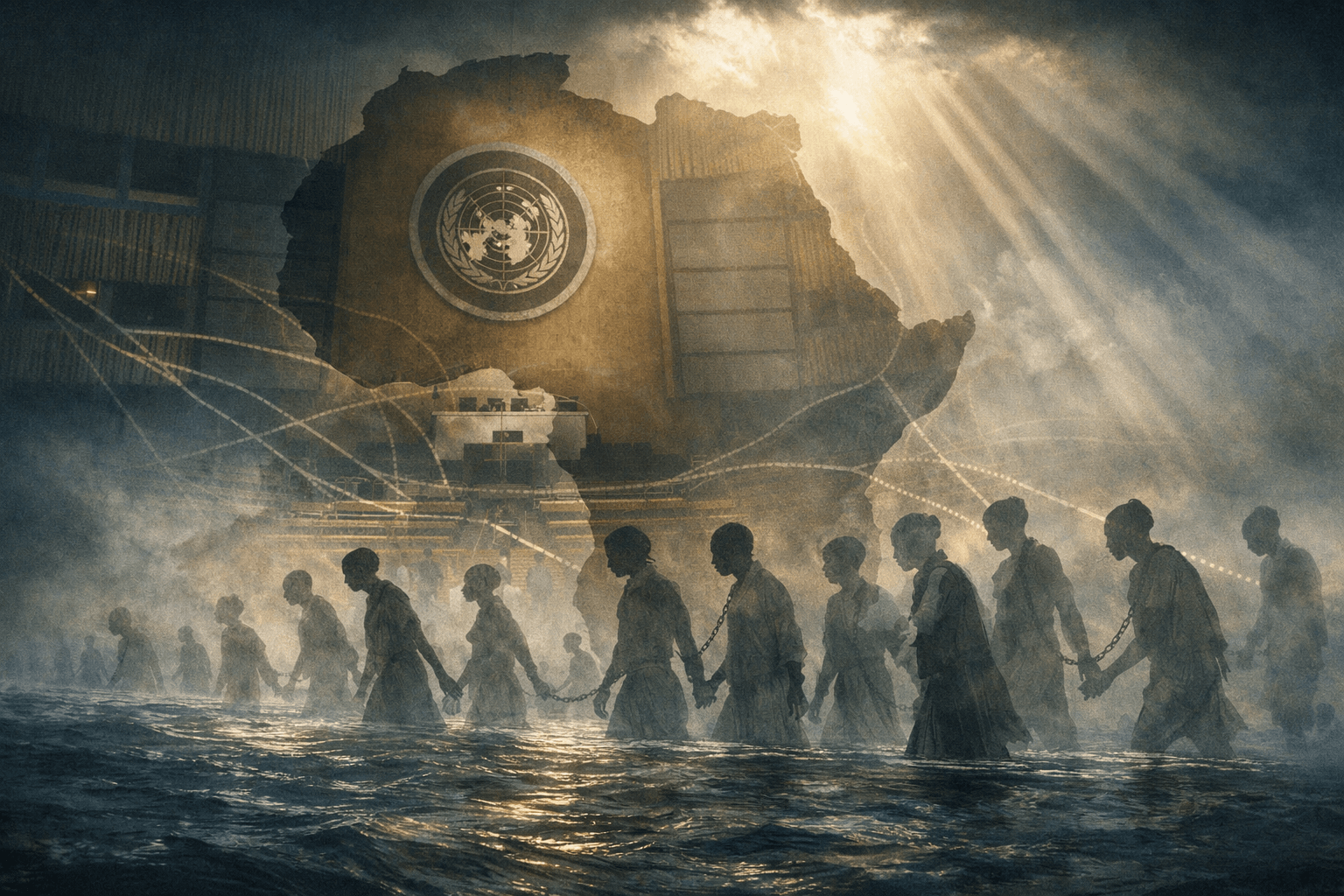
The United Nations observance is not only about mourning the past. It is about confronting the economic, political, and moral systems that slavery built—and the inequalities they still sustain.
By Peter Grear, with AI assistance
March 27, 2026
Each year on March 25, the United Nations marks the International Day of Remembrance of the Victims of Slavery and the Transatlantic Slave Trade. The observance was established to honor the millions of Africans and people of African descent who were brutalized, displaced, exploited, and killed in one of history’s largest systems of organized human theft. The UN also uses the day to educate the world about the continuing legacy of slavery and its connection to racism and inequality today.
That matters because the transatlantic slave trade was not a side note in world history. It was a foundation stone of the modern global economy. European empires, commercial ports, insurance markets, shipping networks, plantation systems, and financial institutions grew rich through the buying, transporting, and forced labor of Africans. The wealth extracted from African bodies helped build national fortunes while Africa itself was depopulated, destabilized, and systematically weakened. The UN’s remembrance framework explicitly links this history to present-day racial injustice and structural inequality.
At the 2026 UN observance, Secretary-General António Guterres said the day is a call to remember the victims and to confront the enduring consequences of slavery and the slave trade. He also warned against attempts to sanitize or erase this history. That emphasis is important. Remembrance without truth becomes ceremony. Truth without action becomes performance. The UN’s own framing makes clear that March 25 is meant to do more than inspire sympathy. It is meant to sharpen public memory and public responsibility.
This is especially relevant for people concerned with The Economic Liberation of Africa. If slavery helped transfer wealth out of Africa and into global power centers, then remembrance cannot stop at sorrow. It has to raise harder questions. What does justice look like when the aftereffects of that extraction still shape African development, global trade, access to capital, education, labor markets, and political influence? What does remembrance require from institutions whose prosperity was tied to the destruction of African autonomy? Those questions are not outside the spirit of the day. They are part of its logic.
The UN’s Remember Slavery Program reinforces this broader purpose. It is designed not only to commemorate victims, but also to promote education, research, exhibitions, and public awareness about slavery’s legacy. In other words, the observance is meant to shape how people understand the modern world. It invites nations, schools, media platforms, and civic institutions to tell the truth about where power came from, who paid the human price, and why the consequences remain visible across generations.
For African and diaspora communities, March 25 can also be understood as a day of historical alignment. It connects memory to dignity, dignity to policy, and policy to economic vision. It reminds us that Black history is not merely a story of suffering. It is also a story of stolen value, interrupted nationhood, broken inheritance, and unfinished claims. That is one reason this observance should resonate far beyond memorial language. It should help frame modern conversations about reparative justice, diaspora engagement, African-centered development, and the right of African people worldwide to participate in rebuilding what centuries of exploitation helped destroy. This is an inference drawn from the UN’s focus on slavery’s legacy and the present-day struggle against racism and exclusion.
In practical terms, the day serves at least three functions. First, it honors the victims by refusing to let their suffering disappear into abstraction. Second, it educates the public by insisting that slavery was not accidental or peripheral, but central to the making of the modern Atlantic world. Third, it warns the present by showing how systems of dehumanization evolve rather than simply vanish. The forms may change, but the underlying habits of exploitation, exclusion, and racial hierarchy can persist unless they are directly challenged.
That is why March 25 should not be treated as a symbolic pause alone. It should be used as a platform for a larger public reckoning. For media institutions, it is a chance to connect history to present economic structures. For educators, it is a chance to deepen literacy about Africa, empire, and global capitalism. For advocates, it is a chance to argue that remembrance without repair leaves the moral task unfinished. And for Africa and the global African diaspora, it is a chance to insist that memory must point toward restoration, participation, and power.
The International Day of Remembrance is therefore not only about what happened. It is about what the world does with that knowledge now.
This movement is for students and supporters who want more than awareness—they want a role in shaping opportunity.
Join the Movement
.
Get updates on internships, opportunities, and ways to participate in the Students, RoFR, and Jobs Pipeline initiative.
Help grow The Economic Liberation of Africa conversation—forward this article to someone ready to build.