
By Peter Grear, with AI assistance
January 30, 2026
Across media, politics, and academia, a familiar accusation is being leveled at Black youth and diaspora movements: radicalization. Demands for structural change are framed as dangerous, unrealistic, or extreme. Calls for economic sovereignty are labeled destabilizing. Organizing around land, labor, procurement, and ownership is treated as a break from the past rather than a continuation of it.
This framing is not only misleading—it is historically illiterate.
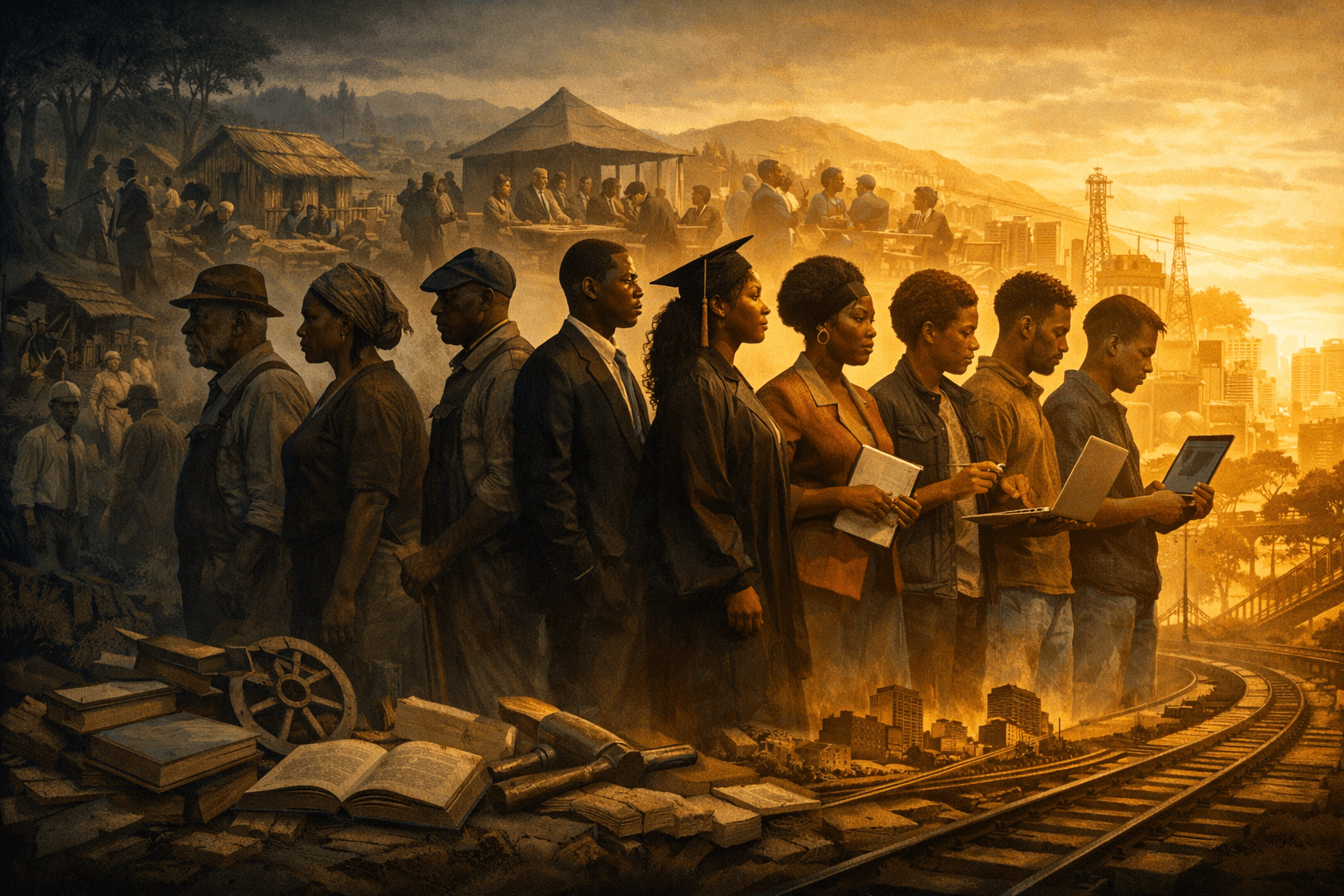
What is often described as “radicalization” is, in reality, a return to tradition. This generation is not inventing a new politics. It is recovering an older one that was deliberately disrupted.
Radical Compared to What?
The idea that today’s Black political and economic responses are unusually radical assumes a false baseline: that moderation, inclusion, and gradual reform have always been the norm.
They have not.
Historically, Black resistance—on the continent and in the diaspora—was structural, collective, and unapologetic. It centered land reclamation, control of labor, independent institutions, mutual aid, and self-determination. From maroon communities to cooperative economics, from Pan-African congresses to anti-colonial liberation movements, the tradition was not symbolic inclusion—it was material power.
What is new is the brief post–civil rights period in which access, representation, and diversity initiatives were presented as substitutes for ownership and control. That era shaped how older generations were trained to think about progress. Younger generations, facing different material conditions, are no longer persuaded.
Why the Language of “Radicalization” Persists
The label persists because it performs a function.
Calling a movement radical shifts attention away from its content and toward its tone. It avoids engaging with the underlying grievances—economic precarity, political exclusion, wealth extraction—and instead questions the legitimacy of the response.
Historically, this tactic has been used whenever Black movements challenged foundational systems rather than requesting accommodation within them. Abolition was radical. Reconstruction was radical. Anti-colonial independence movements were radical. Labor organizing was radical.
In hindsight, these movements are recognized as necessary corrections—not dangerous deviations.
A Generation Formed by Structural Reality
Today’s generation is coming of age amid conditions that make incrementalism untenable.
They face:
Declining access to stable employment
Student debt without corresponding asset growth
Housing markets priced beyond reach
Rollbacks of diversity and inclusion infrastructure
Growing surveillance and political repression
Against this backdrop, calls for structural redesign are not ideological indulgences. They are rational responses to lived experience.
This generation understands something clearly: systems that do not produce ownership will not produce security. And systems that have historically excluded Black people will not self-correct through patience alone.
Tradition, Not Extremism
What critics call radicalization closely mirrors historical Black traditions that emphasized:
Collective economic action
Transnational solidarity
Institutional self-reliance
Strategic engagement with power, not appeals to morality
Pan-Africanism, cooperative economics, diaspora organizing, and political education were never fringe ideas within Black movements. They were central—until they were sidelined in favor of inclusion narratives that proved fragile and reversible.
The current turn toward structural frameworks—whether in governance, procurement, labor, or capital flows—is a reassertion of that lineage.
Why Youth Are Unmoved by Old Warnings
Warnings about going “too far” ring hollow to a generation that has watched moderation fail to protect even its limited gains.
They have seen:
Voting rights weakened
Wealth gaps widen
Representation increase without power shifting
Diversity framed as expendable
As a result, their organizing is less concerned with appearing acceptable and more focused on designing outcomes. They are asking different questions—not how do we get invited? but who controls the rules?
That shift is not a rejection of history. It is a reclamation of it.
The Cost of Misunderstanding
Mislabeling this return to tradition as radicalization carries consequences.
It alienates young leaders who are acting with historical clarity. It discourages serious engagement with structural solutions. And it repeats a familiar pattern: dismissing Black political maturity as danger rather than recognizing it as strategy.
Understanding this moment requires reframing the narrative. The question is not whether this generation has gone too far—but whether previous generations were pushed too far toward compromise.
What This Moment Demands
This generation is not asking for chaos. It is asking for coherence between labor, value, and ownership. It is not rejecting democracy—it is interrogating who democracy actually serves. It is not abandoning tradition—it is restoring one that predates its erasure.
History suggests that such moments are not anomalies. They are turning points.
The misunderstanding lies not with the generation responding—but with those still measuring legitimacy by standards that no longer apply.
Join the conversation—leave your take or a question.
Help grow The Economic Liberation of Africa conversation—forward to someone curious about Africa-centered opportunity.
Donate to GDN – Greater Diversity News | Subscribe – Greater Diversity News