
By Peter Grear, with AI assistance
Published: December 8, 2025
For more than four centuries, Africans and their descendants have fueled the rise of Western nations. From the plantations that seeded the American economy to the modern institutions shaped by Black innovators, artists, workers, and professionals, the global West has been built—in no small part—on African labor, creativity, and resilience. Yet the most profound question raised today is not about the past but the future: What would happen if the African diaspora redirected even a fraction of that brilliance, capital, and human power toward building Africa itself?
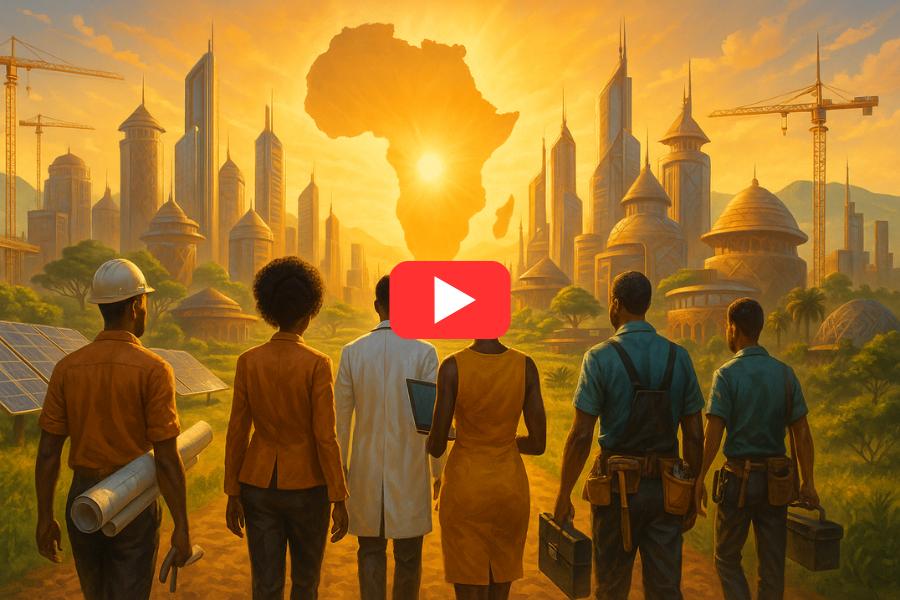
Recent discussions across Pan-African spaces, including the popular video “What If Black People Returned Home to Build Africa — The Way We Helped Build the West?”, explore this transformative possibility. The video does not merely imagine migration; it imagines a global power shift—one in which the descendants of the enslaved invest in creating the kind of thriving, self-determined societies denied to their ancestors.
Africa today stands at a turning point. The continent holds some of the world’s richest natural resources, the youngest population, and rapidly expanding urban centers. Its growth potential is vast, but what remains underdeveloped is the very asset stolen during the transatlantic slave trade: human capital. For centuries, the West captured Africa’s bodies, skills, and knowledge. Today, the West benefits from the diaspora’s expertise in technology, finance, logistics, medicine, engineering, governance, entertainment, and entrepreneurship. The question raised in the video is simple but seismic: What if that expertise became Africa’s advantage instead of the West’s?
If diaspora professionals, investors, and innovators mobilized in even modest numbers, the ripple effects could reshape nearly every sector of the continent. The video outlines several pathways. Technology transfer could accelerate Africa’s digital revolution. Diaspora access to global capital markets could expand local entrepreneurship. Governance and institutional-model experience could strengthen public-sector systems. Strategic partnerships could transform infrastructure, agriculture, and manufacturing. These are not hypothetical abilities—they are real assets already being deployed in the West.
The video also highlights the powerful cultural and psychological implications of such a return. For many in the diaspora, the Western world has offered opportunity but not belonging. Anti-Black racism, economic exclusion, and political marginalization continue to limit access to generational wealth and systemic power. Reimagining a future rooted in Africa presents a dual benefit: Africa gains expertise, while diaspora communities gain access to land, ownership, markets, and the ability to build without ceilings.
This vision aligns closely with the African Union’s designation of the diaspora as the Sixth Region, recognizing that global African populations are essential stakeholders in the continent’s development. Official acknowledgment of the diaspora as part of Africa’s political and economic architecture makes the scenario presented in the video not only possible, but increasingly practical.
Yet the video is not naïve. It acknowledges real challenges: bureaucratic barriers, citizenship limitations, corruption in some states, security concerns, and uneven infrastructure. It also notes that the diaspora itself is not monolithic. Pan-African cooperation requires trust-building, regional policy coordination, and intentional frameworks—such as the Right of First Refusal (RoFR)—to ensure diaspora participation becomes structured and protected.
Still, the potential is too great to ignore. Imagine if diaspora engineers helped design African smart cities. Imagine if diaspora-owned businesses anchored African manufacturing zones. Imagine if diaspora filmmakers and technologists built the world’s next entertainment capitals in Accra, Kigali, Lagos, or Nairobi. Imagine if global Black wealth—from the United States, the Caribbean, Latin America, and Europe—flowed into an Africa ready to rise.
Africa would not only grow.
Africa would lead.
The deeper message of the video is that Africans have already proven their ability to build global power. The West itself stands as evidence. The challenge before us now is whether that brilliance can be strategically reoriented toward the continent that birthed it.
The movement is already underway. From Ghana’s Year of Return to ADDI-led diaspora missions to Burkina Faso, to a growing ecosystem of diaspora venture funds and chambers of commerce, the vision is shifting from imagination to institution. The next decade may determine whether this becomes a historic turning point—or a missed opportunity.
One thing is clear: the future of Africa, and the future of the diaspora, are inseparable. And when Africans everywhere decide to build for one another, the world will feel the shift.
Support the Mission
Donate to GDN – Greater Diversity News | Subscribe – Greater Diversity News
Join the conversation—leave your take or a question.
Help grow The Economic Liberation of Africa conversation—forward to someone curious about Africa-centered opportunity.