
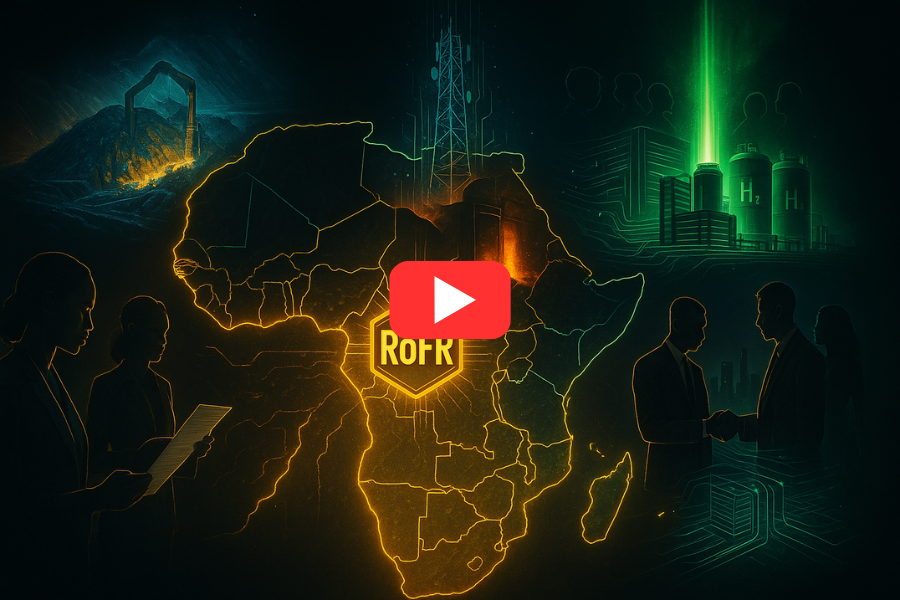
By Peter Grear, with AI assistance
December 13, 2025
For more than sixty years, African nations have negotiated from a structural disadvantage—rich in natural resources but too often poor in leverage. From mining and telecoms to renewable energy and digital infrastructure, the continent has repeatedly entered deals where profits flowed outward and ownership rarely stayed in African hands. Today, however, a rapidly rising concept—the Right of First Refusal (RoFR)—offers a powerful mechanism to rewrite the rules.
RoFR ensures that African and diaspora-owned companies receive the first opportunity to match or exceed foreign bids on major national projects. It is not an anti-investment policy. It is a fairness policy. One that places African priorities and diaspora participation at the center of development rather than at the margins.
To understand RoFR’s transformative potential, we must examine recent history—deals where RoFR’s absence cost African nations billions in lost value, autonomy, and long-term control.
The DRC–China Minerals-for-Infrastructure Deal: A Lost Bargaining Moment
In 2008, the Democratic Republic of Congo signed a landmark exchange with Chinese state-owned companies: billions of dollars in copper and cobalt for promised roads, rail lines, and hospitals. Nearly two decades later, only a fraction of that infrastructure has materialized, while mineral extraction has accelerated at unprecedented speed.
A RoFR framework would have forced transparency and competition. Diaspora mining firms, African engineering companies, and sovereign wealth funds could have matched the bid or partnered on more favorable terms. RoFR would also have mandated clearer local-content requirements, profit-sharing formulas, and oversight mechanisms. Instead of a lopsided agreement, Congo could have secured a shared-ownership model that preserved long-term national wealth.
Ghana Telecom: A National Asset Sold Without Diaspora Consideration
When Ghana sold a controlling stake in Ghana Telecom to Vodafone in 2008, many observers argued that the price tag significantly undervalued the company. What’s more troubling is that no structured pathway existed for diaspora technologists, Ghanaian professionals abroad, or African-American investors to submit a matching offer.
Under RoFR, Ghana would have been obligated to first engage its global Ghanaian family—a community with deep technological expertise and financial capacity. This could have yielded a hybrid ownership model: international partnerships for scale, but African hands on the steering wheel. Instead, Ghana relinquished control of a strategic infrastructure pillar at the dawn of the digital age.
Zambia’s Copper Privatization: A Wealth Transfer Hidden in Plain Sight
No case illustrates the cost of weakened negotiating power more clearly than the privatization of Zambia’s copper sector in the 1990s and 2000s. Mines were sold at fire-sale prices under international pressure, and foreign mining giants went on to generate enormous revenue—profit that largely bypassed Zambia’s communities, labor force, and treasury.
RoFR could have changed that trajectory entirely. Before any assets were sold, diaspora financial groups could have matched bids. Diaspora engineers could have partnered on operations and modernization. Communities could have been guaranteed equity stakes and profit participation.
RoFR would have made it impossible for world-class national assets to be transferred at bargain prices with no competitive review. Zambia’s copper belt could today be a regional engine of shared prosperity, not a symbol of forfeited opportunity.
Digital Infrastructure Deals: Africa’s New Oil Given Away Early
Across East and West Africa, governments have turned to foreign cloud, cybersecurity, and digital platform providers to store and manage national data. While these services deliver convenience, they also create dependency—and they exclude African and diaspora technologists from a booming 21st-century industry.
With RoFR, governments would first engage African-owned and diaspora-owned cloud, data-center, and AI infrastructure firms. The policy would require that African data be stored on African soil, protected by African laws, and hosted by companies with African ownership at the core. Instead of outsourcing digital sovereignty, RoFR would cultivate an Africa-centered tech ecosystem capable of powering future innovation.
Green Hydrogen Projects: The Next Frontier for Extraction—Unless RoFR Intervenes
European companies are aggressively securing long-term green hydrogen contracts in Morocco, Tunisia, and Namibia. Without policy safeguards, Africa risks repeating the pattern of exporting raw energy with minimal value capture.
RoFR would allow African and diaspora clean-energy innovators to participate early, shaping ownership, manufacturing, job pipelines, and export terms. This sector—still young, still forming—offers Africa a rare chance to avoid historical mistakes. RoFR is the tool that keeps the door open for African co-ownership before external interests cement themselves in place.
Why RoFR Must Become the Standard
Taken together, these case studies reveal a simple truth:
Africa does not lose wealth because it lacks resources; it loses wealth because it lacks negotiating leverage. RoFR restores that leverage.
RoFR is not just a policy—it is a continental strategy, a diaspora-bridging tool, and a blueprint for long-term competitiveness. It ensures deals are transparent, competitive, and aligned with national interests. It insists that Africa, and the global African diaspora, participate not as spectators but as co-owners of value chains.
As nations from Burkina Faso to Tanzania consider new development models, the Right of First Refusal stands out as a gateway to true economic liberation—a policy whose time has come.
Donate to GDN – Greater Diversity News | Subscribe – Greater Diversity News
Join the conversation—leave your take or a question.
Help grow The Economic Liberation of Africa conversation—forward to someone curious about Africa-centered opportunity.