
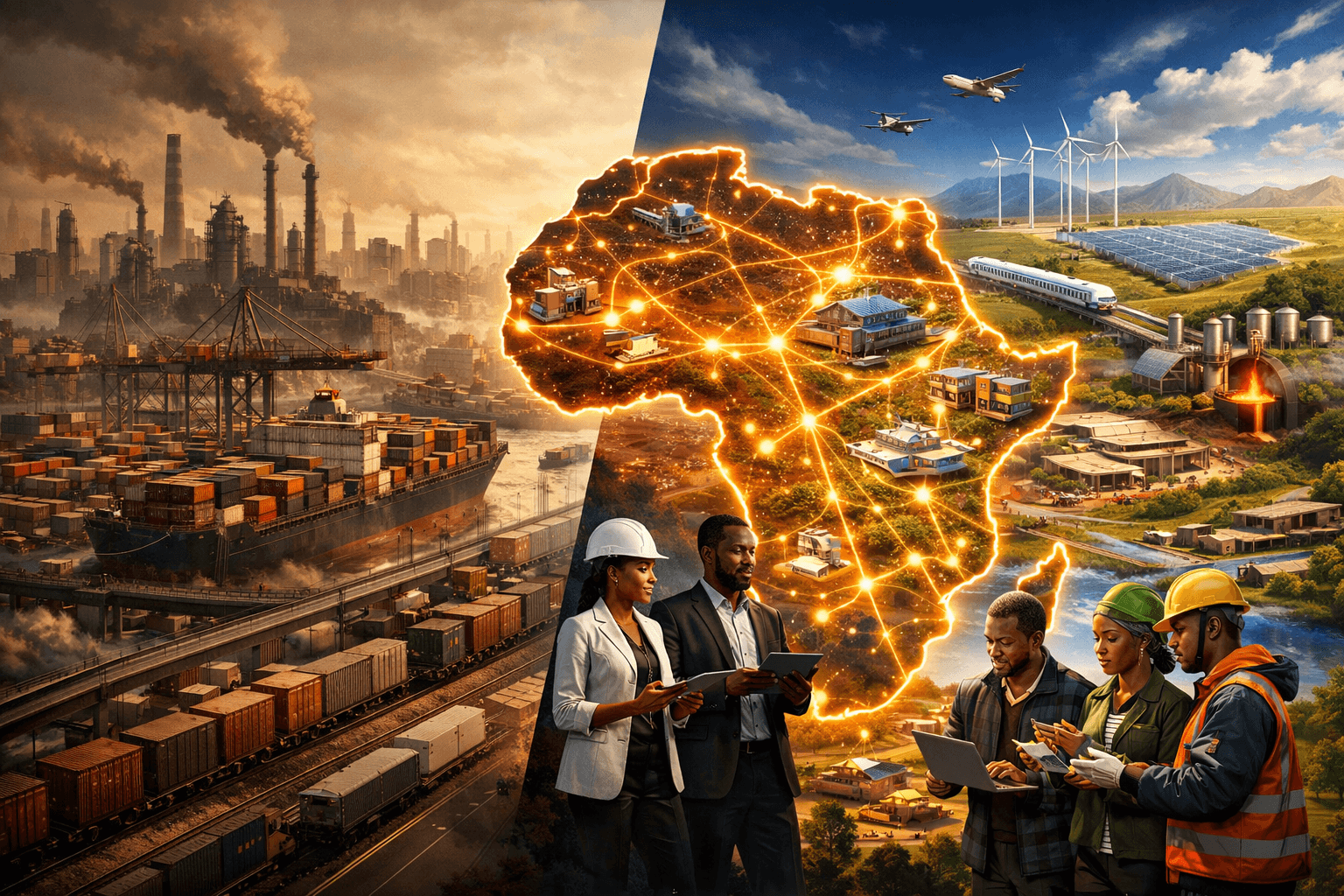
Africa’s path to industrial power will likely be more decentralized, more regional, and more networked than China’s—and that may be exactly why it can work.
By Peter Grear with AI assistance
April 3, 2026
For years, many discussions about Africa’s economic future have been framed around one tempting question: can Africa become the next China? It is an understandable comparison. China’s industrial rise reshaped the world by turning production into power. It built factories, ports, roads, rail lines, industrial zones, and domestic firms on a scale few countries in history have matched. But Africa’s industrialization, if it succeeds, will not look like China’s. The better question is whether Africa can build a different model—one better suited to its own geography, politics, and future. The World Bank’s long-running work on China describes its post-1978 transformation as “meteoric,” rooted in decades of structural change and manufacturing expansion.
China’s rise was built on concentration. It had one central state directing a broad national strategy, one vast domestic market, and one system capable of aligning infrastructure, industrial policy, exports, and firm development over time. Manufacturing was not treated as an accidental byproduct of growth. It was treated as a national mission. That concentration gave China enormous advantages: policy coherence, production scale, export discipline, and the ability to move resources quickly into strategic sectors.
Africa does not have that structure. It is a continent of more than 50 countries, different legal regimes, different currencies, different infrastructure realities, and uneven industrial capacity. On the surface, that fragmentation looks like a major disadvantage. But it may also force Africa to build something more adaptive than the Chinese model: a distributed industrial system built through regional hubs, cross-border corridors, sector-specific clusters, and coordinated trade integration rather than one national command structure. UNECA’s Economic Report on Africa 2025 frames AfCFTA as a tool for industrialization, agro-processing, digital trade, and movement up global value chains, which points to this more networked path.
That matters because the world Africa is industrializing into is not the world China industrialized into. China rose during the high era of globalization, when Western firms were rapidly offshoring production and global trade rules strongly rewarded large export platforms. Africa is rising in a more fragmented era marked by supply-chain diversification, strategic competition, energy transition, food insecurity, and digital reconfiguration of trade. That environment is less forgiving, but it also creates openings. Governments and firms now want more than one manufacturing center, more than one sourcing base, and more resilience in how goods and inputs move. Africa’s diversity of locations, resources, and regional markets may fit that moment better than a single-country model would.
There is also a practical reason Africa’s different structure may become an advantage: it encourages regional specialization. One country may become strong in battery-mineral processing, another in agro-processing, another in automotive assembly, another in logistics, and another in digital trade services. AfCFTA gives Africa a mechanism to connect those strengths into larger value chains rather than forcing every country to industrialize in the same way at the same pace. UNECA says AfCFTA could significantly increase intra-African trade and create gains in manufacturing and agro-processing, while recent UNECA regional discussions have emphasized bold action to build regional value chains and inclusive industrialization.
This is why Africa should be careful not to confuse industrial success with imitation. China’s model delivered scale, but Africa’s opportunity may lie in flexibility. China built one giant factory platform. Africa may build several interconnected production ecosystems. China concentrated power geographically and institutionally. Africa may spread it across multiple hubs, reducing overdependence on one node while allowing different regions to develop around their own comparative strengths. That is not a weaker ambition. It is a different one.
Still, decentralized industrialization only becomes an advantage if Africans can secure meaningful control over the value chain. Otherwise, Africa could still end up hosting factories without owning much of what matters most: procurement, processing rights, supplier relationships, logistics, finance, branding, and equity. That is where RoFR belongs in this discussion. A serious Right of First Refusal framework could help African firms, African states, and diaspora-linked enterprises gain first-position access in strategic sectors before key opportunities are fully captured elsewhere. In a more distributed African industrial model, RoFR could become one of the mechanisms that ties local opportunity to African participation. This is an inference from the industrial and trade dynamics UNECA and World Bank describe, not a claim made explicitly by those institutions.
The diaspora also fits this different model more naturally than many people realize. Africa may not need one centrally directed industrial machine if it can mobilize a continental network of states and a global network of African expertise, capital, and relationships. Diaspora participation can help fill gaps in investment, technical services, sourcing, trade facilitation, and market access. In that sense, Africa’s dispersed structure could actually make it easier to integrate external African talent into the industrial project—provided there are clear pathways to participate.
The numbers do not prove that industrial transformation is inevitable, but they do show the opening is real. The World Bank projects Sub-Saharan Africa’s growth to strengthen from 3.5 percent in 2024 to 3.8 percent in 2025 and 4.4 percent on average in 2026–27. UNIDO’s recent reporting also found that Africa led regional manufacturing growth in the third quarter of 2025, even though the continent still accounts for only a small share of global manufacturing value added. That combination—small current base, but visible momentum—is exactly why Africa should think boldly now.
Africa’s industrialization will not look like China’s because Africa is not China. It is larger, more diverse, more politically varied, and more continentally ambitious. But that difference does not have to be a weakness. It may be the very reason Africa can build an industrial future that is more resilient, more regionally rooted, and more open to African and diaspora ownership. The task is not to recreate China’s path. The task is to make sure Africa’s different path still leads to power.
Donate to GDN – Greater Diversity News | Subscribe – Greater Diversity News
Join the conversation—leave your take or a question.
Help grow The Economic Liberation of Africa conversation—forward to someone curious about Africa-centered opportunity.