
By Peter Grear, with AI assistance
April 13, 2026
Africa’s economic future is increasingly being written in its cities.
For decades, much of the conversation about Africa’s development focused on raw materials, national politics, rural poverty, and foreign investment. Those issues still matter. But a deeper structural shift is underway: Africa is becoming more urban, more connected, and more economically shaped by the rise of mega-cities, secondary cities, and industrial corridors that link production, logistics, trade, and labor. UN-Habitat-backed and related urbanization reporting now projects Africa to reach around 60–64% urbanization by 2050, with most of the continent’s demographic growth absorbed in cities.
That matters because cities are not just places where people live. They are where economies are organized.
The World Bank notes that urban areas already account for about 60% of Africa’s GDP, and argues that whether the twenty-first century becomes Africa’s century depends heavily on whether its cities can generate enough good jobs for a rapidly growing population. It also highlights that Africa is expected to add more than 700 million new city dwellers by 2050, while 10 to 12 million young Africans enter the labor market each year.
This is why the rise of mega-cities matters. Cities such as Lagos, Cairo, Kinshasa, Johannesburg, Luanda, and Dar es Salaam are becoming more than population centers. They are becoming giant economic zones where transport, housing, commerce, finance, services, manufacturing, culture, and digital networks collide. One recent Africa urbanization summary notes that by 2035, six African cities are expected to house more than 10 million people, while many more cities will cross the one-million and five-million thresholds.
But the real story is not only about megacities.
It is also about corridors.
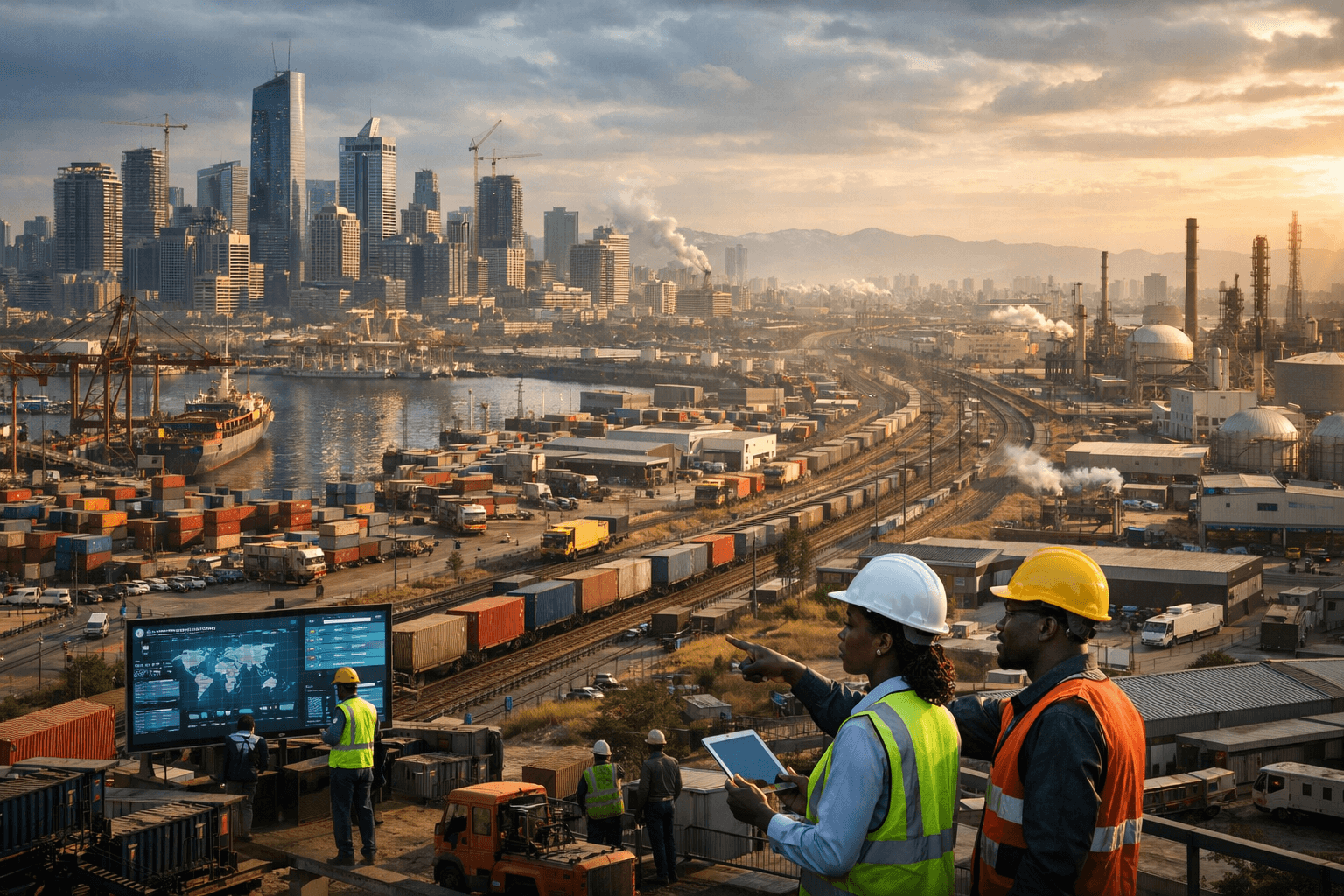
Industrial corridors connect ports to inland cities, mining zones to refineries, farms to processors, and manufacturers to regional and global markets. They turn isolated economic activity into organized systems of value creation. In practical terms, a corridor is not just a road or rail line. It is an economic spine. It can shape where factories are built, where warehouses cluster, where workers migrate, where service businesses emerge, and where governments decide to extend energy, customs systems, training infrastructure, and urban planning.
That is why the corridor model has become so important across Africa.
Take the Addis–Djibouti corridor. The World Bank states that more than 95% of Ethiopia’s import-export trade by volume uses this route, which is why improving connectivity and logistics efficiency there has become strategically important. What looks like transport infrastructure is really a larger economic architecture linking trade, industry, and urban growth.
Or take the Lobito Corridor, which has become one of the most discussed infrastructure projects on the continent. The African Development Bank said in 2025 that it would provide $500 million to support its development, linking Angola, Zambia, and the Democratic Republic of the Congo more closely into continental trade and industrial strategy. Recent reporting also describes the corridor as a 1,300-kilometer railway connecting the Copperbelt to the Port of Lobito, underscoring its importance not only for mining exports but for broader logistics and regional development.
This is where the rise of urban Africa becomes more than a demographic trend. It becomes a political and economic question.
Who will own the logistics? Who will build the housing? Who will supply the factories? Who will run the distribution fleets, food systems, payments, warehouses, repair services, and digital platforms that grow around these corridors? If Africa’s mega-cities and industrial corridors expand without strong local participation, then urbanization can simply become a bigger stage for external extraction and internal inequality. But if these systems are linked to local enterprise, regional value chains, skills development, and African-centered ownership, then they can become engines of liberation.
That is why secondary cities matter too.
The World Bank argues that Africa’s secondary cities will absorb much of the continent’s urban growth and can serve as manufacturing hubs, agro-processing centers, logistics corridors, and tourism anchors if they are planned and connected early. That is an important warning for anyone who thinks the future belongs only to the largest capitals. In reality, many of the most strategic economic battles will be won in the cities that connect farms to highways, highways to ports, and ports to regional markets.
The opportunity is enormous, but so is the risk.
Rapid urbanization without planning can intensify housing shortages, informal sprawl, congestion, and exclusion. One recent urbanization summary notes that Africa will need to build millions of housing units annually to keep up with demand, while current construction levels remain far below what is needed. If industrial corridors are not matched by public services, municipal finance, land management, and workforce systems, growth can become chaotic instead of productive.
Still, the larger direction is clear.
Urban Africa is rising not just because populations are moving, but because cities and corridors are becoming the new geography of economic power. The future of The Economic Liberation of Africa will depend in part on whether Africans merely inhabit these spaces or strategically own, shape, and govern them.
Mega-cities can become consumption traps, or they can become engines of production. Corridors can become export channels for other people’s wealth, or they can become African value chains. The difference will depend on planning, ownership, industrial policy, and whether Africa’s urban transformation is linked to African enterprise rather than disconnected from it.
That is the real significance of urban Africa’s rise.
It is not only about bigger cities. It is about whether a new urban and industrial geography can help move Africa from extraction to production, from fragmentation to connectivity, and from dependence to power.
Donate to GDN – Greater Diversity News | Subscribe – Greater Diversity News.
Join the conversation—leave your take or a question.
Help grow The Economic Liberation of Africa conversation—forward to someone curious about Africa-centered opportunity.