
By Peter Grear, with AI assistance
April 15, 2026
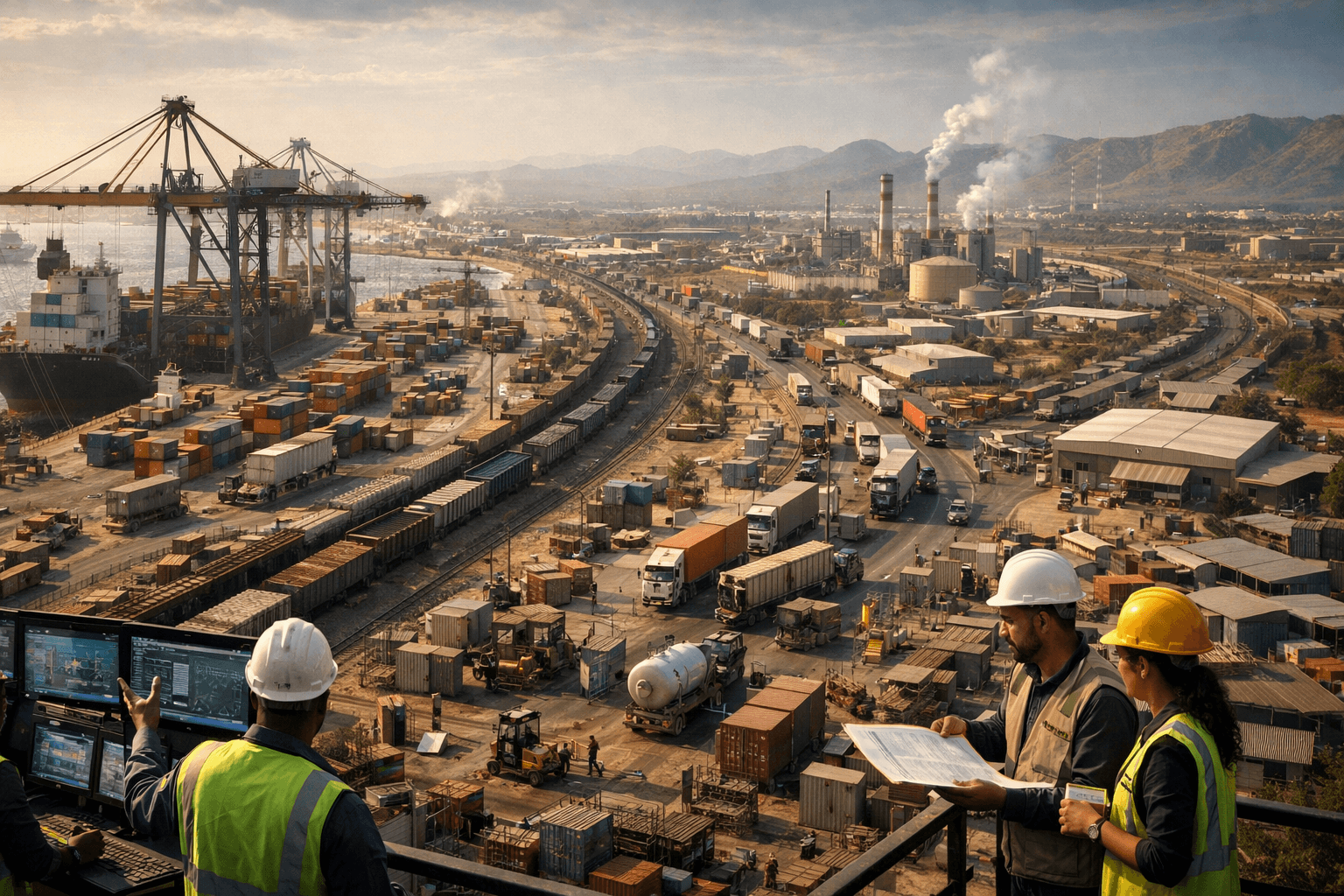
When most people think about economic power, they picture presidents, central banks, multinational corporations, or stock exchanges. But across Africa, some of the most important battles over power are being shaped somewhere less glamorous: along rail lines, highways, ports, border posts, dry ports, logistics hubs, and the industrial zones that grow around them.
That is where industrial corridors come in.
An industrial corridor is more than infrastructure. It is an economic spine. It links mines to processors, farms to factories, factories to ports, and ports to regional and global markets. It helps determine where warehouses rise, where workers move, where manufacturers cluster, where customs systems modernize, and where new cities and service economies take shape. The African Development Bank has increasingly framed regional corridors as central to continental integration because they reduce transport costs, ease the movement of goods and services, and support cross-border production systems.
That is why industrial corridors are not just transport projects. They are hidden architecture.
They shape whether Africa remains a place where raw materials leave and finished goods return at a premium, or whether the continent can begin organizing production in a more strategic way. UNECA’s recent work on AfCFTA implementation emphasizes that regional value chains are practical tools for innovation, diversification, and economic transformation, while its Southern Africa materials call for strategic development of value chains to accelerate industrialization and resilience.
This is what makes corridors so important to The Economic Liberation of Africa.
Liberation is not only about flags, speeches, or diplomatic posture. It is about whether African economies can hold more of the value created from African labor, land, minerals, agriculture, and trade. If extraction remains disconnected from processing, if ports remain disconnected from factories, and if transport routes remain designed mainly to move wealth outward, then the architecture of dependence survives. Corridors begin to matter when they help reverse that pattern—when they support processing, manufacturing, logistics services, local suppliers, workforce systems, and regional market access. AfDB and UNECA materials both connect corridor development to broader regional integration and value-chain expansion rather than to transport alone.
The Addis–Djibouti corridor is one clear example of how much power can sit inside a route. The World Bank states that over 95% of Ethiopia’s import-export trade by volume uses that corridor. That means a single transport and logistics channel affects trade costs, industrial competitiveness, resilience, and the pace of national economic activity. The same World Bank material notes that poor road conditions on one section had been forcing users onto a route 146 kilometers longer, showing how corridor inefficiency can directly shape the cost of doing business.
The Lobito Corridor is another powerful example. It is often discussed in the context of minerals, but its significance is much larger. AfDB described it in 2025 as a strategic regional corridor and announced $500 million in support linked to its development. Recent AfDB materials also describe the corridor as a driver of integration among Angola, Zambia, and the Democratic Republic of the Congo, while other reporting around the project regularly highlights its role in linking the Copperbelt to the Port of Lobito through roughly 1,300 kilometers of railway. That makes it more than an export route. It is an organizing structure for logistics, industrial policy, and regional growth.
But the real issue is not whether corridors exist. The real issue is who benefits from them.
A corridor can easily become a conveyor belt for external wealth extraction. Raw materials move faster, foreign firms profit sooner, and local economies remain thin. That is one model. The other model is harder but far more transformative: use the corridor to build local processing, supplier networks, repair and maintenance services, industrial parks, skills pipelines, storage systems, energy access, and African-owned logistics capacity. UNECA’s corridor and regional-value-chain work repeatedly points toward this second model by tying infrastructure to productive transformation instead of simple transit.
That is why industrial corridors should be seen as political economy, not engineering alone.
Who wins the warehousing contracts? Who handles freight forwarding? Who owns the trucking fleets? Who supplies food, uniforms, fuel, packaging, software, and maintenance services to firms operating along the route? Who gets industrial land near the corridor? Who gets financing to build around it? These are not side questions. They are the questions that determine whether corridors deepen dependence or spread African economic power.
This is also where the diaspora conversation becomes more practical.
If the African diaspora wants structured entry points into African economic development, industrial corridors offer one of the clearest answers. They create opportunities not only in large infrastructure finance, but also in manufacturing partnerships, logistics services, workforce training, warehousing, professional services, procurement systems, housing, commercial real estate, digital platforms, and supplier development. Corridors create economic ecosystems, and ecosystems create multiple points of entry. That is exactly why they matter to anyone thinking seriously about ownership instead of symbolism.
They also matter for youth.
Africa’s youth challenge is often framed only as a jobs problem. But industrial corridors suggest a wider lens. They can create demand for technicians, coders, mechanics, customs specialists, transport managers, engineers, warehouse operators, manufacturers, food suppliers, and service entrepreneurs. The World Bank notes that 10 to 12 million young Africans enter the labor market each year, while corridor-based and city-based growth are increasingly central to whether enough productive work can be created. Corridors are therefore not just trade structures; they are potential employment and enterprise architectures.
There is also a strategic AfCFTA dimension.
If Africa wants the continental free trade project to mean more than tariff schedules and summit declarations, it needs systems that move goods predictably, lower border friction, and help firms plug into cross-border production. UNECA’s 2025 economic reporting and related committee materials argue that regional value chains, digital customs systems, interoperable payments, and data-sharing solutions can help translate AfCFTA into real transformation. Industrial corridors are where those abstract ambitions become operational.
So, when we talk about African power, we should not look only at ministries and stock markets. We should also look at the corridor.
Because that is where a continent decides whether roads merely move goods or move history. Whether railways merely connect ports or connect African producers to African prosperity. Whether infrastructure remains a pathway for extraction or becomes the hidden architecture of liberation.
That is the real promise of industrial corridors.
They can help Africa move from isolated projects to connected systems, from raw export dependence to regional value creation, and from fragmented markets to coordinated economic power. But that outcome is not automatic. It depends on policy, ownership, procurement, training, and whether Africans claim a meaningful stake in the systems being built around them.
If they do, industrial corridors may become one of the most important engines of The Economic Liberation of Africa.
Donate to GDN – Greater Diversity News | Subscribe – Greater Diversity News.
Join the conversation—leave your take or a question.
Help grow The Economic Liberation of Africa conversation—forward to someone curious about Africa-centered opportunity.