
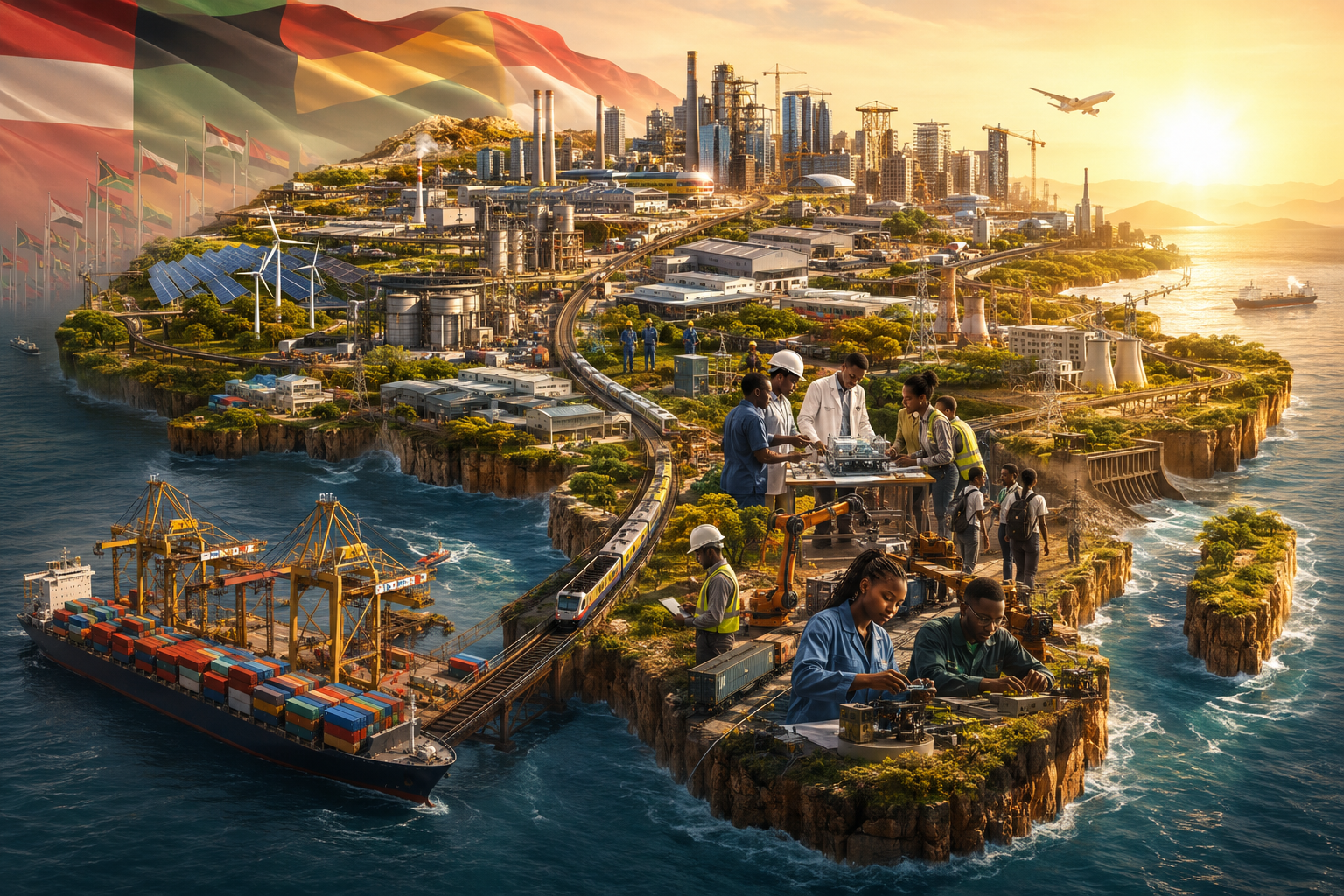
 Africa’s first independence gave the continent flags. The second must give Africa control over production, value chains, markets, technology, and wealth.
Africa’s first independence gave the continent flags. The second must give Africa control over production, value chains, markets, technology, and wealth. This anchor article introduces Africa’s Second Wave of Independence as the transition from political sovereignty to industrial sovereignty.
By Peter Grear, with AI assistance
May 22, 2026
Africa’s first wave of independence was political. It gave African nations flags, anthems, constitutions, presidents, parliaments, diplomatic recognition, and seats at the United Nations. It ended formal colonial rule and gave African people the right to govern African territory.
But political independence did not automatically deliver economic independence.
In too many cases, the colonial economic structure remained largely intact. African countries exported raw materials and imported finished goods. African minerals, crops, timber, oil, gas, and labor continued to help build wealth elsewhere. Foreign companies often controlled extraction, finance, processing, shipping, technology, insurance, branding, and distribution. Africa had flags, but much of the value created from African resources still moved through systems designed outside Africa.
That is why many now describe Africa’s current moment as a Second Wave of Independence.
This second wave is not about replacing colonial flags with African flags. That work began in the twentieth century. This wave is about something deeper: transforming political sovereignty into industrial sovereignty.
The first independence asked: Who has the right to govern African land?
The second asks: Who has the right to benefit from African value?
That is the defining question of Africa’s next era.
From Political Sovereignty to Industrial Sovereignty
Africa’s Second Wave of Independence can be understood as the continent’s effort to move from symbolic sovereignty to productive sovereignty. It is the struggle to control not only government offices, but factories, refineries, ports, railways, digital platforms, research centers, supply chains, procurement systems, and capital flows.
The African Union’s Agenda 2063 already points toward this transformation. The AU describes Agenda 2063 as Africa’s blueprint for becoming “the global powerhouse of the future” and links that vision to unity, self-determination, freedom, progress, and collective prosperity.
That language matters. It recognizes that the work of independence did not end with national liberation. The next stage is continental transformation.
Africa cannot become a global powerhouse by remaining primarily a supplier of unprocessed resources. A continent that exports raw cocoa, but imports chocolate is not fully free economically. A continent that exports minerals, but imports batteries, vehicles, electronics, and machinery is not capturing the full value of its own wealth. A continent that trains young people but cannot place them into productive industries loses both talent and time.
The Second Wave of Independence is therefore the movement from extraction to production, from dependency to capacity, from raw material exports to value-added manufacturing, and from fragmented markets to continental economic coordination.
Why Industrialization Is the New Freedom Struggle
Industrialization is not just an economic policy. For Africa, it is a sovereignty issue.
A nation that cannot produce what it needs remains vulnerable. A continent that cannot process its own resources remains dependent. A people who do not own enough of the value chain remain positioned as workers, consumers, and suppliers rather than owners, producers, designers, and rule-setters.
This is why industrialization is being described as the second independence. It is not independence from colonial governors. It is independence from a global economic order that still expects Africa to provide raw materials while others capture the highest value.
The United Nations Industrial Development Organization has warned that Africa’s manufacturing value added remains limited, with Africa’s manufacturing value added growing by 2.2% in 2024 and projected to rise to 3.2% in 2025. That reflects progress, but also the scale of the challenge.
Africa’s future cannot be secured through resource ownership alone. Resource ownership must become industrial capability. Minerals must become batteries, machinery, tools, vehicles, and technology. Agricultural output must become processed food, branded products, pharmaceutical inputs, textiles, and exportable goods. Youth talent must become engineering capacity, logistics expertise, digital enterprise, policy leadership, and manufacturing management.
That is the difference between having resources and having power.
The Role of AfCFTA
The African Continental Free Trade Area is one of the most important instruments of the Second Wave of Independence. Its promise is not simply more trade. Its deeper promise is the creation of a continental production economy.
A fragmented Africa forces each country to negotiate alone, build alone, and compete alone. A more integrated Africa can create larger markets, stronger regional value chains, shared infrastructure, and greater bargaining power.
Agenda 2063 identifies trade as an engine of economic growth and places importance on adding value to African commodities, reducing barriers to intra-African trade, and creating a larger market for African goods and services.
That is essential because factories need markets. Industrial corridors need transportation systems. Entrepreneurs need customers. Students need career pathways. Investors need scale. African countries need more than national plans; they need continental coordination.
If AfCFTA works as intended, it can help Africa move from exporting raw materials to trading finished and semi-finished goods across African borders. It can help African businesses build supply chains inside the continent instead of depending almost entirely on external systems.
But AfCFTA by itself is not enough. Trade agreements do not build factories automatically. Africa also needs financing, energy, roads, ports, rail, skills training, procurement reform, digital systems, legal protections, and strong institutions.
That is where the Second Wave of Independence becomes a practical agenda.
Where the Diaspora Fits
The African diaspora must not be treated as a ceremonial guest in this second independence. The diaspora must become a working partner.
The African Union’s Sixth Region concept gives the diaspora symbolic recognition. But the new question is whether that recognition can become economic structure. Can diaspora professionals, investors, students, business owners, engineers, lawyers, media leaders, and institutions be connected to Africa’s industrial rise in an organized way?
The answer must be yes.
The diaspora has capital, technical knowledge, institutional experience, media platforms, legal expertise, university networks, business relationships, and political influence. But without a structured entry point, diaspora participation can remain scattered, emotional, and symbolic.
That is why the Right of First Refusal — RoFR — should be part of this conversation.
RoFR can be understood as a policy tool that gives African and diaspora participants a fair, structured chance to match or beat outside bidders before major projects are awarded. It is not a demand for automatic favoritism. It is a demand that Africa-centered participation be built into the rules of development.
If Africa is building roads, ports, housing, energy systems, industrial parks, digital networks, schools, hospitals, and manufacturing zones, then African and diaspora firms should not stand outside the gate. They should have a defined pathway to participate, compete, partner, and build capacity.
In that sense, RoFR becomes more than a procurement idea. It becomes a sovereignty instrument.
African Youth and the Human Infrastructure of Independence
The first independence was led by liberation movements, student activists, labor organizers, lawyers, teachers, writers, and political leaders. The second independence will require a new generation of builders.
African youth are not merely beneficiaries of industrialization. They are the human infrastructure of it.
The Second Wave of Independence will need engineers, coders, welders, architects, agribusiness specialists, logistics managers, project analysts, journalists, compliance experts, manufacturers, financiers, scientists, and public administrators. It will also need students who understand that Pan-Africanism is not only a cultural idea. It is an economic design challenge.
This is where GDN Global’s work, The Economic Liberation of Africa, and the broader student movement can help shape the future. Students must be invited to study RoFR, AfCFTA, industrial policy, public procurement, diaspora engagement, African infrastructure, and continental value chains.
If the first independence required young people to march, organize, and protest, the second will require young people to research, build, code, manufacture, negotiate, publish, invest, and govern.
The Risks Are Real
The Second Wave of Independence is not guaranteed. Africa’s industrial future can be weakened by corruption, weak institutions, debt dependency, foreign pressure, poor infrastructure, policy inconsistency, and elite capture.
Resource nationalism without accountability can fail. Industrial policy without execution can become rhetoric. Diaspora engagement without structure can become symbolism. RoFR without transparency can become favoritism. AfCFTA without infrastructure can become aspiration without delivery.
That is why this second wave must be built on governance, standards, public benefit, youth training, legal clarity, and measurable results.
Africa does not need slogans alone. Africa needs systems.
The New Definition of Independence
The Second Wave of Independence redefines freedom.
Freedom is not only the right to raise a flag. Freedom is the ability to feed the people, employ the youth, process the minerals, manufacture the goods, move products across borders, finance development, own technology, negotiate from strength, and keep more value at home.
The first independence gave Africa nations.
The second must give Africa industrial power.
The first independence made Africa visible on the world stage.
The second must make Africa powerful in the global economy.
The first independence asked the world to recognize African sovereignty.
The second will require the world to respect African capacity.
This is the great work now before the continent and the diaspora. Africa is not simply seeking a larger share of the existing world economy. Africa is preparing to reshape its place within it.
That is why the Second Wave of Independence matters.
It is the movement from flags to factories, from recognition to production, from raw materials to real power, and from symbolic freedom to economic sovereignty.
Standard CTA
Join the conversation—leave your take or a question.
Help grow The Economic Liberation of Africa conversation—forward to someone curious about Africa-centered economic pathways.
Donate to GDN – Greater Diversity News | Subscribe – Greater Diversity News