
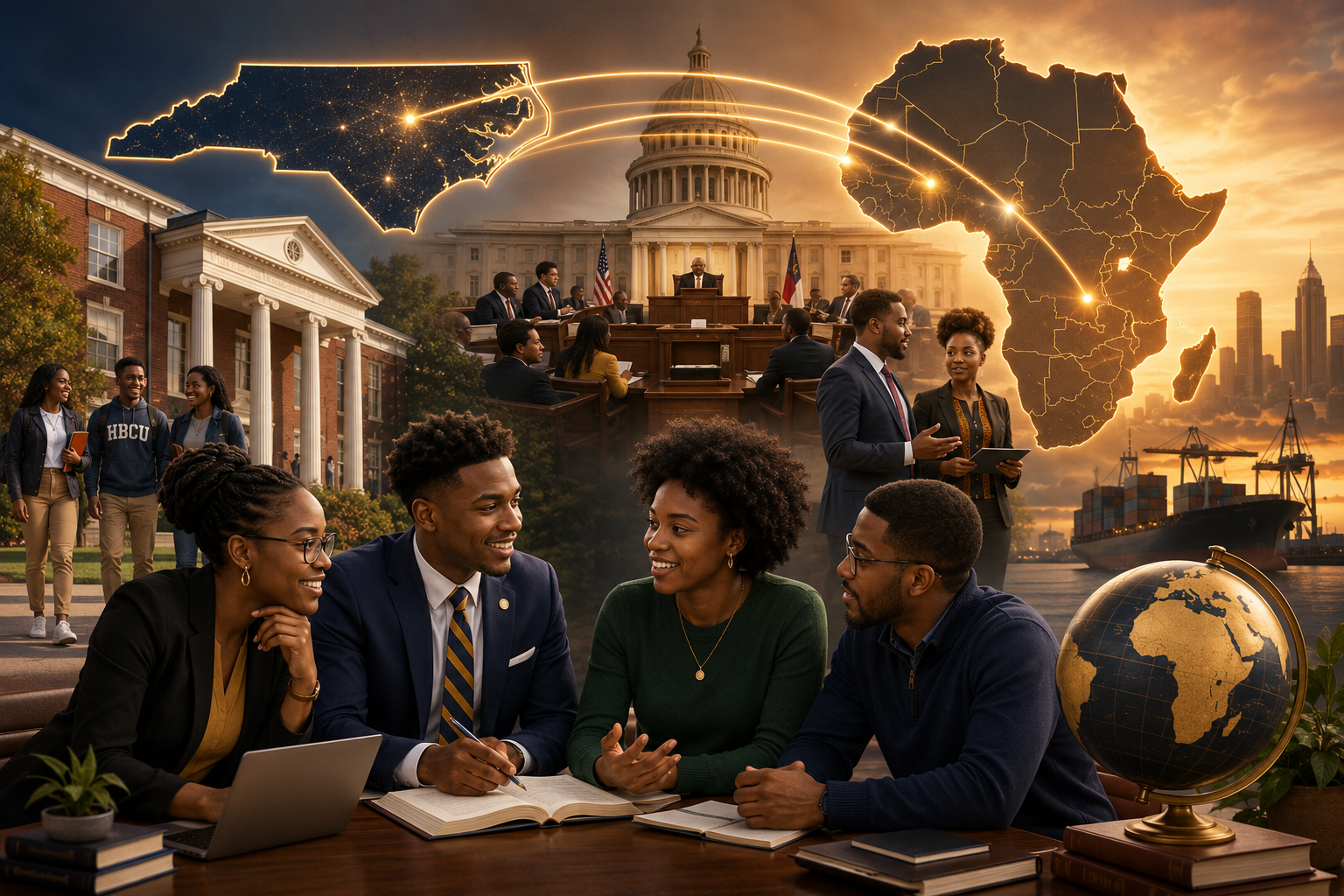
 A North Carolina-centered pathway for HBCU students, alumni, and Black communities to engage the AU Sixth Region and global Black economic development
May 22, 2026
By Peter Grear, with AI assistance
The NHBCUAAF–GDN Global partnership could give North Carolina’s HBCU students and alumni a practical pathway into AU Sixth Region engagement, RoFR education, and global Black economic development.
North Carolina has long been a battleground for Black education, civic power, voting rights, economic justice, and institutional advancement. It is also home to one of the nation’s strongest HBCU traditions. That makes the state uniquely positioned to help lead a new chapter in Black global engagement.
The partnership between the National Historically Black Colleges & Universities Alumni Associations Foundation (NHBCUAAF) and GDN Global deserves serious attention from the North Carolina Legislative Black Caucus because it connects several priorities that already matter deeply to Black North Carolinians: HBCU advancement, student leadership, workforce preparation, civic engagement, economic development, and the growing role of the African diaspora in shaping Africa’s future.
This partnership is not merely about publicity. Properly developed, it can become a working model for how HBCU alumni, students, lawmakers, media platforms, business leaders, and community organizations can collaborate to prepare Black communities for a changing global economy.
At the center of this vision is a simple but powerful question: How can North Carolina’s Black institutions help students and alumni move from awareness to participation in global Black economic development?
The answer begins with HBCUs.
North Carolina’s HBCUs have educated generations of teachers, lawyers, scientists, ministers, entrepreneurs, public servants, journalists, and movement leaders. Their alumni networks remain one of the most underused engines for Black advancement. NHBCUAAF brings an alumni-centered frame to this work. GDN Global brings a media, policy, and public education platform focused on The Economic Liberation of Africa, the AU Sixth Region, and the Right of First Refusal, or RoFR.
Together, they can help students and alumni see Africa not as a distant subject, but as a living economic, cultural, civic, and professional frontier.
That is where the North Carolina Legislative Black Caucus could play an important role.
The Caucus does not need to manage or own the partnership. Its strongest contribution may be as a convener, advocate, bridge-builder, and public champion. By encouraging dialogue among HBCU leaders, alumni associations, student organizations, Black chambers, civic groups, faith leaders, and policy advocates, the Caucus can help turn a promising partnership into a statewide movement.
The timing is important. Across the world, Africa is being courted for its minerals, markets, workforce, land, youth population, and strategic position. Yet too often, African-descended people in the United States are left outside the rooms where Africa’s future is being negotiated. The AU Sixth Region concept offers a corrective by recognizing the African diaspora as part of the African world. But recognition alone is not enough.
The Sixth Region must become functional.
That is why RoFR matters. In plain language, RoFR means that African and diaspora bidders should have the right to match or beat outside bids before major contracts, projects, or development opportunities are awarded elsewhere. It is a way to move beyond symbolic inclusion toward structured participation.
For students, this creates a powerful learning pathway. They can study procurement, media, policy, business development, international relations, public finance, communications, agriculture, infrastructure, technology, and law through a Black global lens. They can help produce articles, podcasts, videos, newsletters, research briefs, and campus campaigns. They can learn how local Black economic issues connect to global systems.
For alumni, the partnership creates a new form of engagement. Alumni associations can do more than host reunions and raise scholarship dollars. They can help mentor students, support internships, open professional networks, sponsor public education campaigns, and connect HBCU graduates to Africa-centered economic pathways.
For the Legislative Black Caucus, supporting this effort would align with its broader responsibility to help protect and advance Black communities in North Carolina. Education, voting rights, economics, housing, agriculture, justice, and workforce development are not isolated issues. They are all part of the same struggle for power, access, and self-determination.
A North Carolina student learning about RoFR today could become tomorrow’s lawyer drafting procurement policy, journalist explaining African development, entrepreneur bidding on diaspora-linked projects, technologist building a platform, or public servant shaping international partnerships.
That is the kind of pipeline Black leadership should encourage.
There are several practical steps the Caucus could take. It could host a briefing on the NHBCUAAF–GDN Global partnership. It could invite HBCU presidents, alumni leaders, student government representatives, Black chambers, and community media to participate. It could issue a public statement recognizing the value of connecting HBCU students and alumni to global Black economic engagement. It could encourage internships and policy education around the AU Sixth Region, RoFR, and Africa-diaspora development.
The Caucus could also help connect this partnership to broader North Carolina priorities. For example, Black farmers and agricultural organizations could explore Africa-diaspora food systems. Business students could study trade, procurement, and entrepreneurship. Communications students could help build media campaigns. Public policy students could examine how diaspora engagement can become a serious legislative and institutional priority.
This is not about asking North Carolina to look away from local struggles. It is about helping Black North Carolinians understand that local and global struggles are connected.
When Black communities lack access to contracts, capital, land, media, policy influence, and ownership at home, they are experiencing many of the same structural barriers that African nations face in the global economy. The NHBCUAAF–GDN Global partnership can help students and communities study those connections and build strategies for action.
The strongest case for Caucus support is this: North Carolina’s HBCUs should not only prepare students to survive the economy they inherit. They should prepare students to help build the economy Black people deserve.
That economy must include local ownership, civic power, global awareness, African partnership, and youth leadership.
The NHBCUAAF–GDN Global partnership offers a practical vehicle for that work. With the encouragement of the North Carolina Legislative Black Caucus, it could become more than a partnership. It could become a North Carolina model for HBCU-centered, alumni-powered, diaspora-connected Black economic advancement.
The next step should be a formal briefing.
Bring the Caucus, NHBCUAAF, GDN Global, HBCU leaders, students, alumni, business organizations, and community partners into the same room. Let them explore how North Carolina can lead. Let them define the roles. Let them build the pipeline.
The future of Black economic power will not be built by symbolism alone. It will be built by institutions willing to connect education, policy, media, youth, alumni, and global strategy.
North Carolina has the institutions.
The Caucus has the platform.
NHBCUAAF has the alumni connection.
GDN Global has the media and mission framework.
Together, they can help move the Sixth Region from recognition to results.
CTA:
Join the conversation—leave your take or a question.
Help grow The Economic Liberation of Africa conversation—forward to someone curious about Africa-centered pathways.
Donate to GDN – Greater Diversity News | Subscribe – Greater Diversity News