
By Peter Grear, with AI assistance
Publication Date: June 3, 2026
A new conversation is beginning around HBCU students, Africa’s economic future, and the role the African diaspora must play in shaping a new era of global Black advancement.
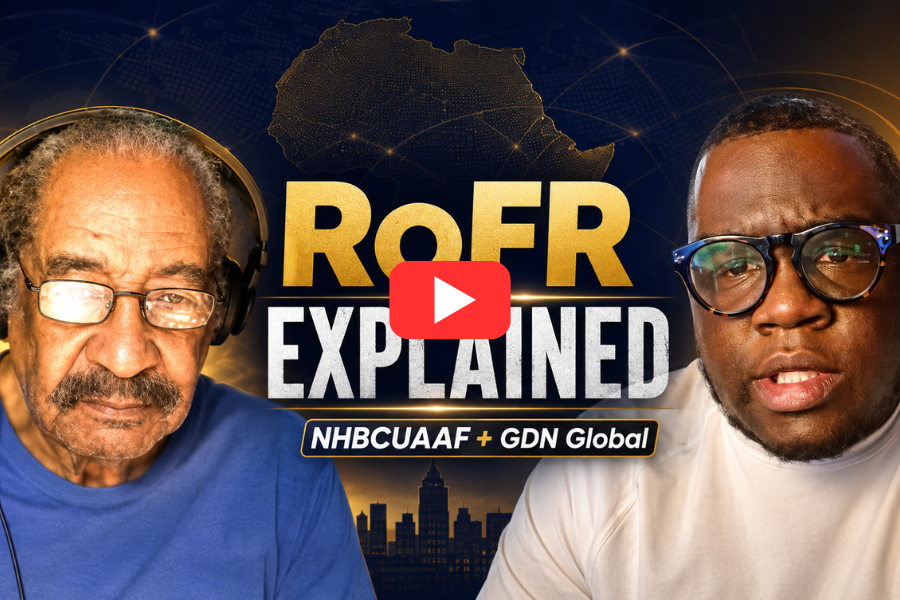
In the first episode of a new podcast conversation connected to the NHBCUAAF–GDN Global partnership, the focus is clear: Black students must not be trained only to look for jobs after decisions have already been made. They must be prepared to help design, monitor, and participate in the systems that determine where contracts, careers, businesses, research projects, media platforms, and ownership pathways are created.
That is where the Right of First Refusal — RoFR — becomes important.
RoFR may sound like a legal term, and in many settings it is. But the concept is not hard to understand. In plain language, RoFR means first access. It means that before a valuable contract, project, resource, or business pathway is handed to someone else, a designated person, group, institution, or community gets the first chance to participate — if they are qualified, prepared, and able to perform.
For GDN Global and the National HBCU Alumni Associations Foundation — NHBCUAAF — the question is not merely whether RoFR can exist in business. It already does. The question is whether a similar access framework can be used to help Black students, HBCU alumni associations, African diaspora professionals, entrepreneurs, and institutions become early participants in Africa-centered economic development.
Africa Is Rising — But Who Will Participate?
For generations, Africa’s wealth has been extracted by outside powers. The continent’s land, labor, minerals, agricultural capacity, energy resources, and strategic position have helped build economies around the world. Yet African people, both on the continent and throughout the diaspora, have too often been pushed to the margins of the wealth generated from African resources.
The podcast places RoFR in this larger historical context.
Africa’s first wave of independence produced flags, national governments, and formal political sovereignty. But political independence did not always produce economic independence. In many cases, former colonial powers retained influence over markets, resources, infrastructure, contracts, and financial systems.
Today, a second wave is emerging. African nations are increasingly focused on industrialization, value-added production, resource control, infrastructure development, technology, education, and global partnerships that serve African interests.
This shift raises an urgent question: as Africa grows, will the African diaspora remain on the outside looking in, or will it organize itself to participate?
RoFR gives that question a working framework.
It says that Black students, African diaspora professionals, HBCU communities, alumni associations, entrepreneurs, and Pan-African institutions should not be treated as an afterthought. They should be identified, trained, organized, and prepared early enough to compete for meaningful roles in Africa-centered development.
Why HBCU Students Matter
The podcast makes one point repeatedly: students are not just future workers. They are future designers, analysts, communicators, builders, organizers, researchers, entrepreneurs, and policy advocates.
HBCU students are especially important because HBCUs have historically prepared generations of Black leaders to respond to conditions of exclusion. From civil rights to public service, from education to business, HBCUs have been training grounds for movements that demanded both dignity and access.
Now, the question is global.
Are students being prepared only to function in the American job market, or are they being prepared to understand global pathways tied to Africa’s rise? Are they learning how to identify contracts, research needs, media gaps, business openings, policy changes, workforce demands, and international partnerships? Are they being taught how to help build institutions, not merely apply to them?
The RoFR conversation challenges HBCU students to think bigger.
A student studying communications can help tell the story of Africa’s industrialization.
A student studying business can help map diaspora enterprise pathways.
A student studying computer science can help build databases and digital systems.
A student studying political science can help research policy and procurement models.
A student studying public administration can help understand how governments issue contracts and manage development projects.
A student studying journalism can help explain why Africa’s rise matters to Black communities worldwide.
The message is simple: students do not have to wait until graduation to become part of the work.
NHBCUAAF and GDN Global: Building the Bridge
The partnership between NHBCUAAF and GDN Global is important because it gives the RoFR discussion an institutional pathway.
NHBCUAAF represents a network connected to HBCU alumni associations. GDN Global brings media, storytelling, advocacy, student engagement, and a Pan-African economic development lens. Together, the partnership can help introduce students and alumni to Africa-centered economic issues that many have not been taught to follow closely.
The podcast introduces this partnership as more than a symbolic collaboration. It is presented as a working relationship designed to help students understand where jobs, internships, contracts, business projects, research needs, and advocacy roles may emerge.
This is especially important during a time when DEI programs are under attack and traditional access pathways are being weakened or renamed. The RoFR framework offers a different approach. Instead of depending on institutions that may retreat from diversity commitments, it asks Black communities to build their own access architecture.
That means identifying the pathways.
Training the students.
Organizing alumni support.
Engaging African partners.
Creating media visibility.
Developing databases and research systems.
Building credibility.
And making sure that when Africa-centered projects emerge, Black students and diaspora institutions are ready.
ADDI and the Sixth Region Connection
The podcast also connects RoFR to the broader Sixth Region idea and to the African Diaspora Development Institute — ADDI.
The African Union has recognized the African diaspora as part of Africa’s extended family, often referred to as the Sixth Region. This recognition matters because it gives the diaspora more than sentimental attachment. It creates a basis for participation, responsibility, and organized engagement.
ADDI’s message of diaspora reconnection, African development, and reclaiming Africa’s birthright helped inspire the RoFR project. The podcast explains that if former colonial powers could retain first-access privileges over African resources, then Africans and the African diaspora should be able to imagine a new model — one where first access is used to support African people, African development, and Black economic participation.
That does not mean excluding the world. It means correcting a historic imbalance.
RoFR is not about unearned advantage. It is about structured preparation. It says that when African projects, contracts, partnerships, and development needs arise, qualified African and diaspora participants should have a first chance to step forward.
If they are prepared, they should not come in after the deal is done.
They should be ready when the door opens.
A Student Advocacy Pipeline
One of the most important ideas in the podcast is the student advocacy pipeline.
This pipeline should not be reduced to internships alone. It should become a system that helps students move from awareness to preparation, from preparation to participation, and from participation to leadership.
A strong RoFR student pipeline could include:
Research teams that study African industries, trade policies, procurement systems, and diaspora engagement models.
Media teams that produce articles, podcasts, videos, and social media content explaining Africa-centered economic development.
Technology teams that build databases of student talent, alumni expertise, partner organizations, African projects, and potential collaboration areas.
Business teams that study enterprise models, contract readiness, project financing, and diaspora participation.
Campus advocacy teams that help students understand the Sixth Region, ADDI, NHBCUAAF, GDN Global, and RoFR.
Alumni engagement teams that connect graduates, professionals, mentors, and HBCU associations to student-led work.
This is how students become more than an audience. They become participants in building the structure.
The Three Big Takeaways
The podcast offers several important takeaways, but three stand out.
First, RoFR must be designed by and for the next generation. The current generation can introduce the idea, but students must help build it with integrity, transparency, and accountability.
Second, Black students need more than job listings. They need access to the systems that create jobs, contracts, businesses, ownership, and leadership pathways.
Third, Africa’s rise is not only an African continental issue. It is a global Black issue. The African diaspora must decide whether it will watch from a distance or organize itself to participate.
For HBCU students, the message is direct: the world you are being educated for is bigger than the campus, bigger than the local job market, and bigger than the traditional career ladder.
Africa is industrializing.
The diaspora is being called.
The future is being built.
Students must be prepared to help shape it.
A Call to Students, Alumni, and Supporters
This podcast is only the beginning of the conversation.
Students should listen, ask questions, challenge assumptions, and begin studying how RoFR could apply to their academic fields and career goals.
HBCU alumni associations should see this as a chance to support a new generation of global Black leadership.
African diaspora organizations should help identify pathways where students can learn, serve, research, build, and participate.
Businesses and institutions should consider how first-access frameworks can help prepare Black talent for real roles in Africa-centered development.
And GDN Global, through its partnership with NHBCUAAF, can help serve as a media and organizing platform for the work ahead.
RoFR is not just a theory. It is a challenge.
If Africa is rising, who will be ready?
If contracts are coming, who will be qualified?
If ownership pathways are opening, who will be prepared?
If students are the future, who is helping them see the future clearly?
The answer must begin now.
Join the conversation—leave your take or a question.
Help grow The Economic Liberation of Africa conversation—forward to someone curious about Africa-centered opportunity.