
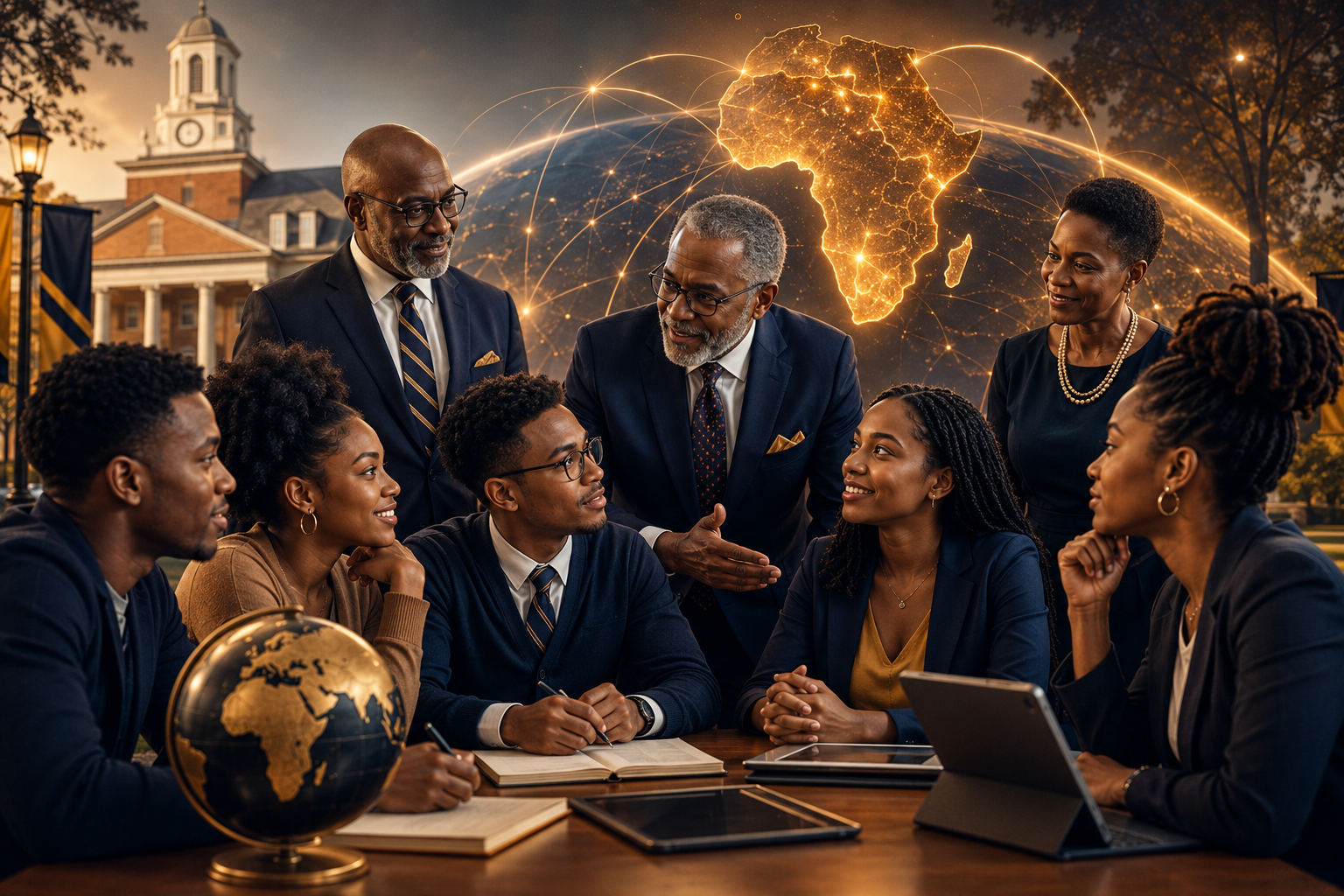
 Alumni associations can help turn HBCU legacy into student pathways, institutional support, and Black global economic leadership
May 30, 2026
By Peter Grear, with AI assistance
HBCU alumni associations should endorse the NHBCUAAF–GDN Global partnership because it gives alumni a practical way to support students, strengthen institutions, promote mentorship, and connect HBCU communities to Black global economic leadership.
HBCU alumni associations have always been more than social networks. At their best, they are memory keepers, fundraisers, recruiters, mentors, advocates, and protectors of institutions that have carried Black America through some of its most difficult and defining eras.
Now, a new moment calls for a broader role.
The NHBCUAAF–GDN Global partnership offers HBCU alumni associations a timely vehicle to help connect students, graduates, institutions, and communities to a larger mission: building pathways from HBCU legacy to Black global economic leadership.
That is why HBCU alumni associations should consider endorsing this partnership.
The endorsement is not merely ceremonial. It is a public statement that HBCU alumni are ready to help prepare the next generation for leadership in civic life, media, workforce development, public policy, entrepreneurship, international awareness, and Africa-centered economic participation.
HBCUs have produced generations of educators, lawyers, scientists, ministers, journalists, entrepreneurs, public servants, organizers, and executives. Their alumni networks represent one of the most powerful underused assets in Black institutional life. When organized with purpose, alumni associations can do what no outside institution can do: connect lived HBCU loyalty to practical support for students and graduates.
The NHBCUAAF–GDN Global partnership gives alumni associations a structure for doing that work.
The National Historically Black Colleges & Universities Alumni Associations Foundation (NHBCUAAF) brings an alumni-centered platform for engagement, leadership, and institutional support. GDN Global brings a media, public education, and policy platform focused on The Economic Liberation of Africa, the AU Sixth Region, student pathways, and the Right of First Refusal, known as RoFR.
Together, the partnership can help alumni associations expand their mission from supporting the past to building the future.
For many alumni groups, traditional service has included scholarships, homecoming support, student recruitment, fundraising, and campus advocacy. Those efforts remain essential. But today’s students also need access to internships, digital media training, policy education, global awareness, mentorship, research opportunities, and real exposure to emerging economic systems.
They need alumni who will help them understand not only how to get a job, but how to build influence, ownership, public voice, and institutional power.
That is where this partnership becomes important.
Through GDN Global’s platform, students can learn how to produce articles, podcasts, videos, newsletters, research briefs, interviews, public education campaigns, and policy explainers. They can study Africa-diaspora relations, HBCU advancement, civic engagement, procurement, business development, and the Sixth Region through a practical lens. They can see how their education connects to the broader future of Black people globally.
Alumni associations can help make that possible.
They can endorse the partnership. They can sponsor student interns. They can circulate internship notices. They can introduce mentors. They can host briefings. They can provide speakers. They can connect local alumni chapters to GDN Global content. They can help students tell the stories of HBCUs, alumni leadership, and Africa-centered economic development.
An endorsement resolution gives alumni associations a formal way to say: We support this mission. We believe HBCU students and alumni should be connected to the future of Black global leadership. We are willing to help build the bridge.
That matters because public support creates credibility. When alumni associations endorse a partnership, they send a signal to students, donors, civic leaders, educators, businesses, faith communities, and public officials that this work deserves attention.
It also gives alumni a clearer role in the NHBCUAAF–GDN Global campaign.
Alumni can become more than supporters. They can become builders.
They can help identify students who should be recruited into internships and leadership pathways. They can help retired professionals mentor young writers, researchers, organizers, and digital media producers. They can help younger alumni connect students to career networks. They can help local chapters host educational sessions on HBCU engagement, the AU Sixth Region, RoFR, and The Economic Liberation of Africa.
The Sixth Region concept is especially important. It recognizes the African diaspora as part of the African world. But recognition alone does not create power. The diaspora needs organized channels for participation, education, enterprise, media, policy, and student leadership. HBCUs and their alumni networks are well-positioned to help build those channels.
RoFR adds another layer. In plain language, RoFR means African and diaspora participants should have the right to match or beat outside bids before major contracts, projects, or development pathways are awarded elsewhere. For HBCU alumni and students, this is a powerful educational framework. It opens discussion about procurement, law, business, public policy, infrastructure, media, and economic participation.
An HBCU student who learns these ideas today may become tomorrow’s attorney, entrepreneur, journalist, technologist, public official, development strategist, or institutional leader.
Alumni associations should want their students prepared for that future.
The NHBCUAAF–GDN Global partnership also gives alumni groups a stronger story to tell potential donors and supporters. Instead of asking only for general support, alumni associations can point to specific outcomes: student internships, mentorship circles, media training, public education campaigns, campus briefings, global engagement, and leadership development.
That is a stronger fundraising message. It moves support from nostalgia to action.
The strongest alumni associations understand that legacy is not preserved by memory alone. Legacy is preserved when each generation equips the next one to go further.
That is the real reason HBCU alumni associations should endorse the NHBCUAAF–GDN Global partnership.
Because students need more than encouragement. They need pathways.
Because alumni networks need more than events. They need mission-aligned projects.
Because HBCUs need more than praise. They need organized support.
Because the African diaspora needs more than symbolic recognition. It needs working structures.
And because Black global economic leadership will not be built by chance. It will be built by institutions, associations, students, alumni, and communities that decide to organize around a shared future.
The NHBCUAAF–GDN Global partnership is building a bridge from HBCU legacy to Black global economic leadership.
HBCU alumni associations should endorse it, strengthen it, promote it, and help students cross that bridge with confidence.
Standard CTA
Join the conversation—leave your take or a question.
Help grow The Economic Liberation of Africa conversation—forward to someone curious about Africa-centered pathways.
Donate to GDN – Greater Diversity News | Subscribe – Greater Diversity News