
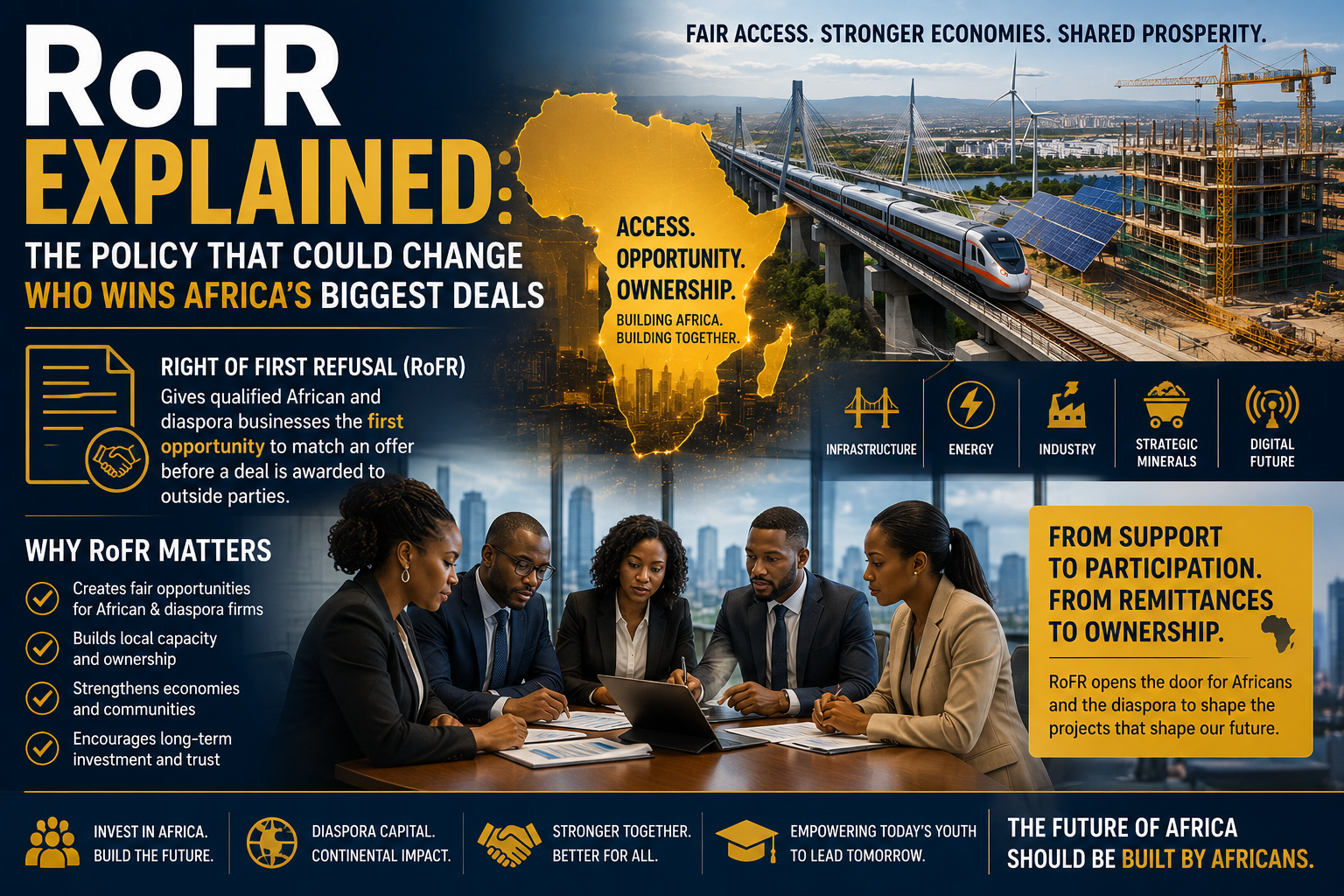
 Why Right of First Refusal May Become the Missing Link Between Africa’s Growth and Diaspora Participation
By Peter Grear, with AI assistance
June 5, 2026
As Africa enters a new era of industrialization, infrastructure development, and economic integration, one question is becoming increasingly important:
Who will benefit from the continent’s biggest economic opportunities?
Will the winners primarily be multinational corporations and foreign investors? Or will Africans and the global African diaspora have a meaningful chance to participate in the projects that are shaping the continent’s future?
For advocates of economic self-determination, the answer may lie in a concept that is both familiar and transformative:
Right of First Refusal (RoFR).
While commonly used in business and real estate transactions, RoFR is increasingly being discussed as a framework that could help ensure African and diaspora participation in major economic initiatives. If implemented effectively, it could become one of the most important policy tools of Africa’s next development phase.
What Is Right of First Refusal?
At its core, a Right of First Refusal gives a designated party the opportunity to match an offer before the opportunity is made available to others.
In simple terms:
If a government, institution, or company receives a proposal from an outside bidder, a qualified RoFR participant has the right to review the proposal and decide whether to match its terms before the deal is finalized elsewhere.
The concept is widely used throughout the private sector.
It helps:
- Protect existing stakeholders
- Encourage long-term participation
- Prevent exclusion from valuable transactions
Applied at a larger scale, RoFR could serve as a mechanism for ensuring that African and diaspora businesses have a fair opportunity to compete for projects connected to Africa’s growth.
Why RoFR Matters Now
Africa is experiencing major shifts in economic strategy.
Across the continent, governments are investing in:
- Infrastructure corridors
- Energy systems
- Industrial parks
- Manufacturing hubs
- Digital transformation projects
- Strategic mineral value chains
These initiatives represent hundreds of billions of dollars in potential economic activity.
At the same time, Africa’s global diaspora represents one of the largest untapped economic communities in the world.
The challenge is that these two realities often remain disconnected.
Many diaspora entrepreneurs, professionals, investors, and institutions support Africa’s development but struggle to identify meaningful entry points into large-scale projects.
RoFR provides a potential bridge.
Instead of relying on informal networks or isolated introductions, qualified diaspora participants could gain structured access to projects before opportunities are fully allocated elsewhere.
Beyond Remittances
For decades, diaspora engagement has been measured largely through remittances.
Those financial transfers remain important. They support families, communities, education, and entrepreneurship.
But remittances alone do not create ownership.
Ownership emerges when individuals and institutions participate directly in:
- Infrastructure development
- Enterprise formation
- Manufacturing
- Supply chains
- Technology deployment
- Strategic industries
RoFR shifts the conversation from support to participation.
Rather than asking how the diaspora can send resources to Africa, it asks how the diaspora can become part of Africa’s economic architecture.
A Framework for Economic Inclusion
One of the most significant aspects of RoFR is that it does not exclude outside participation.
Instead, it creates a process that prioritizes qualified African and diaspora stakeholders before opportunities are awarded elsewhere.
In that sense, RoFR is not about protectionism.
It is about access.
The goal is not to prevent global investment.
The goal is to ensure that Africans and people of African descent have a meaningful opportunity to participate in the growth they helped make possible.
This distinction is important.
Successful industrialization requires global partnerships, capital, expertise, and technology. RoFR does not replace those relationships. It helps balance them.
Why Students Should Pay Attention
For students and young professionals, RoFR may seem like a policy discussion reserved for governments and investors.
In reality, its long-term impact could be far more personal.
Every major infrastructure project creates demand for:
- Engineers
- Project managers
- Accountants
- Lawyers
- Communications specialists
- Technology professionals
- Researchers
- Entrepreneurs
If RoFR expands participation by African and diaspora firms, it could also expand opportunities for the next generation of professionals.
This is why workforce development and student engagement are essential parts of the conversation.
Policies create access.
People turn access into outcomes.
Building an Ecosystem, Not Just a Policy
RoFR alone cannot transform Africa’s economic future.
For it to succeed, several supporting systems are needed:
Project Pipelines
Qualified participants need visibility into upcoming projects.
Business Registries
Governments and institutions need reliable databases of capable firms and professionals.
Talent Networks
Students and emerging professionals need pathways into the industries being developed.
Financing Mechanisms
Businesses need access to capital that allows them to compete effectively.
Partnerships
Public and private stakeholders must collaborate around shared goals.
RoFR works best when it is part of a larger ecosystem designed to expand participation and ownership.
The Bigger Vision
The discussion surrounding RoFR is ultimately about more than contracts.
It is about economic architecture.
For generations, many African economies were organized around extraction and export.
The next phase of development requires systems that encourage:
- Local participation
- Regional integration
- Diaspora engagement
- Long-term wealth creation
RoFR offers one possible pathway toward that future.
Not because it guarantees success.
But because it asks a necessary question:
Should Africans and the global African diaspora have a structured opportunity to participate in the continent’s most significant economic projects?
For many advocates, the answer is yes.
The debate now centers on how that vision can be implemented effectively.
The Bottom Line
Africa’s industrial transformation is accelerating.
Infrastructure is expanding. Capital is mobilizing. New projects are emerging across the continent.
The question is no longer whether growth will happen.
The question is who will participate in building it.
Right of First Refusal may not be the only answer.
But it could become one of the most important tools for ensuring that Africans and the global diaspora have a seat at the table as the next chapter of Africa’s economic story is written.
Because the future of Africa should not simply be observed.
It should be built—and owned—by those who have the greatest stake in its success.
Support the Work
If you believe in building structured pathways for diaspora participation in Africa’s rise, consider supporting the continued development of this platform.
Donate to GDN – Greater Diversity News | Subscribe – Greater Diversity News
Your support helps expand workforce infrastructure, diaspora economic education, and institutional collaboration initiatives tied to The Economic Liberation of Africa.
Join the conversation—leave your take or a question.
Help grow The Economic Liberation of Africa conversation—forward to someone curious about Africa-centered opportunity.