
 Africa’s resource wealth sits at the beginning of global value chains. The challenge for Black students is to enter commerce before raw materials leave the continent—not after others have captured the highest-value stages.
By Peter Grear, with AI assistance
June 8, 2026
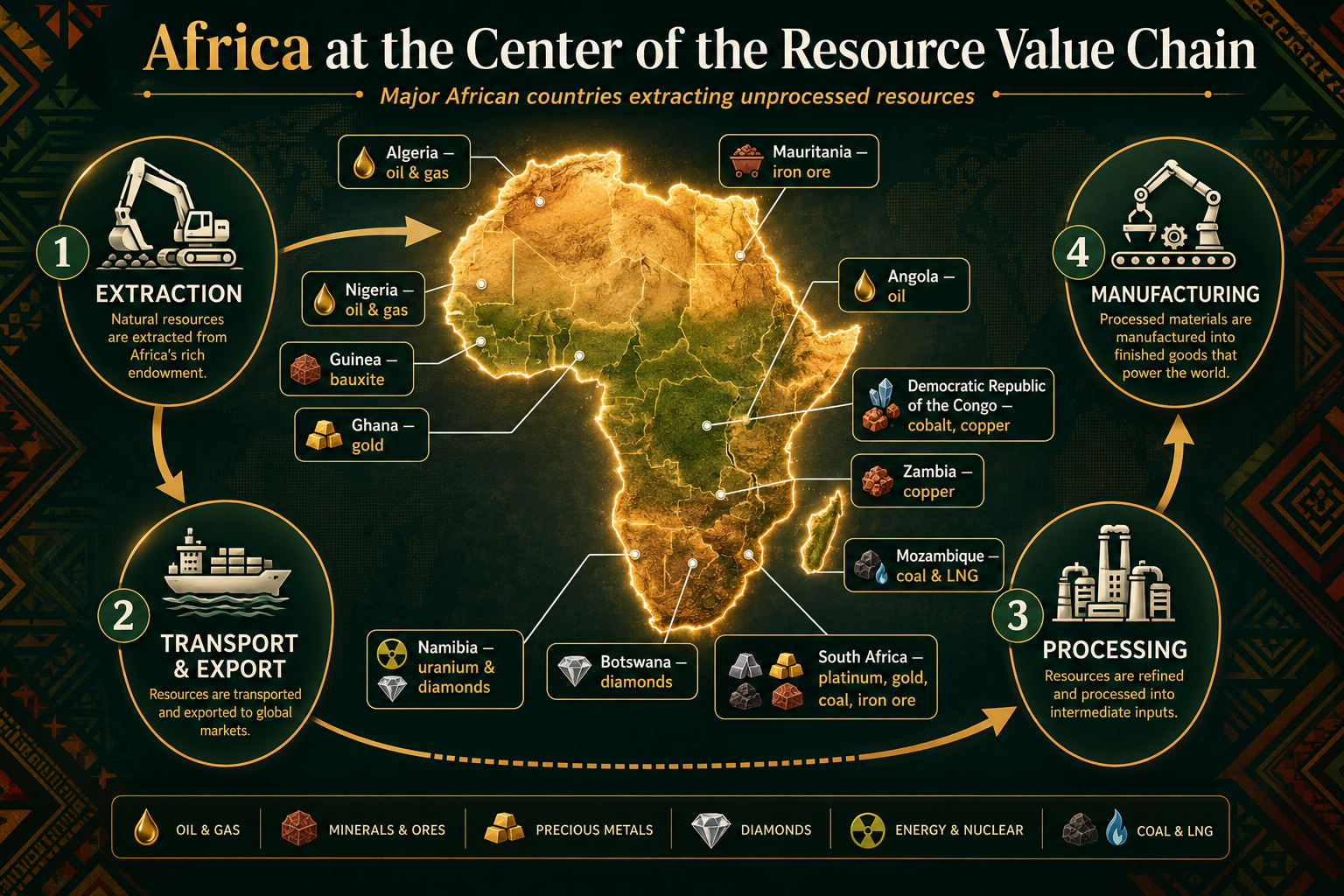
The image tells a story that every Black student, HBCU alumni leader, entrepreneur, policymaker, and diaspora investor should study carefully.
Africa stands at the center of the global resource value chain. Around the continent are the stages that determine who earns, who owns, who negotiates, who manufactures, and who merely watches wealth pass by: extraction, transport and export, processing, and manufacturing. The map identifies countries such as Nigeria, Angola, Algeria, South Africa, the Democratic Republic of the Congo, Zambia, Guinea, Ghana, Botswana, Namibia, Mozambique, and Mauritania—nations whose natural resources help power the global economy.
But the deeper question is not whether Africa has resources. The deeper question is: At what point in the value chain will Black students enter commerce?
Too often, students are trained to look for jobs after value has already been created. They are encouraged to apply for positions in finished-product industries—technology companies, manufacturing firms, banks, logistics corporations, consulting firms, and multinational brands—after natural resources have already been extracted, shipped, refined, processed, financed, insured, priced, and converted into higher-value goods.
That is late entry.
Late entry may provide employment, but it rarely provides ownership. It may provide a salary, but it seldom provides leverage. It may place Black talent inside the economy, but not necessarily at the point where the economy is being designed.
For Black students, especially HBCU students and students across the African diaspora, the challenge of this generation is to stop entering the global economy only after Africa’s resources have been transformed by someone else. The goal must be to enter at the beginning of the value chain—where access, contracts, knowledge, data, logistics, finance, compliance, and ownership rights are first being organized.
The Beginning of the Chain Is Where Power Is Negotiated
When natural resources are first identified, licensed, extracted, transported, and sold, major decisions are made. These decisions determine who gets the contract, who controls the data, who provides equipment, who finances the project, who handles shipping, who manages environmental compliance, who supplies labor, who insures the transaction, and who benefits when the raw material becomes a finished product.
That early stage is where the architecture of wealth is built.
If Black students enter only after processing and manufacturing have occurred, they are often entering a system where the most valuable positions have already been assigned. The ownership structure has already been determined. The supply contracts have already been signed. The financing has already been arranged. The logistics networks have already been established. The intellectual property, pricing power, and market relationships have already been captured.
That is why “getting a job” cannot be the full economic mission. A job is important, but it is not the same as ownership. Employment is participation. Ownership is power.
Africa’s Resources Should Become Student Pathways
The image shows Africa as a resource center, but it should also be seen as a classroom, a marketplace, and a strategic training ground.
A student looking at Nigeria’s oil and gas sector should not only think about petroleum companies. That student should ask: Who provides environmental monitoring? Who manages data systems? Who negotiates community benefit agreements? Who supplies safety technology? Who handles maritime logistics? Who builds renewable transition plans for oil-producing regions?
A student looking at the Democratic Republic of the Congo’s cobalt and copper should not only think about mining. That student should ask: Who tracks mineral origin? Who verifies ethical sourcing? Who develops battery supply-chain software? Who builds local processing capacity? Who ensures that electric vehicle companies cannot claim clean energy while ignoring African labor and ownership?
A student looking at Guinea’s bauxite should not only think about aluminum. That student should ask: Who will build African refining capacity? Who will finance energy infrastructure? Who will train engineers, accountants, lawyers, and procurement specialists to support value addition before raw bauxite leaves the continent?
A student looking at Ghana’s gold, Zambia’s copper, Namibia’s uranium, Botswana’s diamonds, Mozambique’s LNG, Mauritania’s iron ore, and South Africa’s platinum should see more than minerals. They should see research questions, business models, policy campaigns, media stories, procurement opportunities, internship tracks, and enterprise pathways.
This is how education becomes economic infrastructure.
The Mistake Is Waiting for Finished Products
The global economy often teaches Black students to enter commerce as consumers of finished goods or employees of finished industries. Buy the phone. Apply to the tech company. Use the electric car. Work for the manufacturer. Join the bank. Promote the brand.
But before the phone, there are minerals. Before the electric car, there is cobalt, copper, lithium, nickel, graphite, software, logistics, ports, contracts, and energy. Before the brand, there is land, labor, extraction, transport, processing, financing, and policy.
When students enter only at the consumer end or employment end, they meet the economy after others have already captured the greatest value.
That is why the resource value chain matters. It teaches students to ask a different question: Where does the wealth begin?
For Africa, the wealth often begins in the ground, in the port, in the license, in the contract, in the financing agreement, in the processing facility, in the transportation corridor, and in the rules governing who gets first access to participate.
RoFR and First Access Must Become Student Language
This is where the concept of Right of First Refusal, or RoFR, becomes important.
RoFR is not merely a legal phrase. In the African economic context, it can become a framework for first access. It asks whether African people, African institutions, diaspora investors, HBCU students, Black entrepreneurs, and aligned communities should have a structured opportunity to participate before outsiders capture the best positions in the value chain.
For students, RoFR means learning to think upstream.
It means not waiting until a multinational corporation announces a finished product and then asking for an internship. It means asking earlier: Who is supplying the raw material? Who negotiated the sourcing agreement? Where is the processing taking place? Are African businesses included? Are diaspora professionals included? Are HBCU students being trained for the procurement, compliance, data, media, finance, engineering, and logistics roles connected to that resource?
RoFR gives students a language of access before exclusion becomes permanent.
The Student Movement Must Train for the Whole Chain
A serious Black student movement cannot be limited to inspiration. It must train students to understand the whole value chain.
That includes research and policy students who can study resource laws, trade agreements, procurement rules, local-content policies, and community benefit models.
It includes business students who can analyze supply chains, vendor opportunities, investment structures, and enterprise models.
It includes computer science and data students who can build mineral-tracking systems, supplier databases, transparency tools, logistics dashboards, and Africa-centered market intelligence platforms.
It includes media and communications students who can explain why raw resource export keeps Africa dependent and why value addition is a justice issue, not just an economic topic.
It includes law and public policy students who can study contracts, RoFR frameworks, anti-corruption rules, land rights, environmental protections, and international trade disputes.
It includes engineering and environmental science students who can help design processing, clean energy, safety, and sustainability solutions that allow Africa to industrialize without repeating the worst harms of extractive development.
This is why HBCU students are not simply future employees. They can become builders of a new economic architecture.
Beginning-Chain Commerce Creates Better Questions
When Black students enter commerce at the beginning of the value chain, they begin to ask better questions.
Not simply: Who is hiring?
But: Who owns the license?
Not simply: What company made the product?
But: What African resource made the product possible?
Not simply: Where can I get a job?
But: Where can Black institutions build capacity, ownership, and leverage?
Not simply: How do I join the global economy?
But: How do I help redesign it so Africa and the diaspora are not permanently positioned at the bottom?
These questions change the student’s role from applicant to strategist.
The Goal Is Not Extraction Alone
Entering at the beginning of the value chain does not mean glorifying extraction. Africa’s future cannot be built on simply digging more, shipping more, and exporting more. The point is not to celebrate raw extraction. The point is to understand that the earliest stages of the chain shape everything that follows.
If Black students understand the beginning of the chain, they can advocate for better terms, more local processing, more environmental protections, stronger community benefits, more African ownership, and greater diaspora participation. They can help move Africa from raw material supplier to industrial power.
The goal is not to keep Africa trapped in extraction. The goal is to use knowledge of extraction as the starting point for value addition, manufacturing, technology, enterprise development, and economic sovereignty.
Why This Matters Now
The world is racing toward clean energy, electric vehicles, artificial intelligence infrastructure, battery storage, advanced manufacturing, and new defense technologies. Many of these industries depend on minerals and resources found in Africa.
That means Africa is not peripheral. Africa is central.
But centrality without ownership can become another form of exploitation. If the continent supplies the resources while others control processing, finance, patents, logistics, and final manufacturing, then Africa remains rich in resources but poor in captured value.
Black students must not be trained to arrive after this process is complete. They must be trained to understand the chain from the beginning.
That is where the future contracts are. That is where the policies are written. That is where procurement opportunities are formed. That is where data systems are needed. That is where accountability must be enforced. That is where value can either leave Africa—or begin to build Africa.
A Call to HBCUs, Alumni Associations, and Diaspora Institutions
HBCUs and Black alumni associations should treat Africa’s resource value chain as a strategic curriculum. Not only as history. Not only as economics. Not only as foreign affairs. But as a living pathway into commerce, ownership, public policy, media, law, engineering, technology, and entrepreneurship.
The NHBCUAAF-GDN Global partnership proposal can help frame this work as a student-access movement. The purpose is not simply to tell students that Africa is important. The purpose is to help them see where they can enter.
They can enter through research.
They can enter through media.
They can enter through databases.
They can enter through procurement mapping.
They can enter through policy analysis.
They can enter through diaspora business networks.
They can enter through RoFR advocacy.
They can enter through internships that teach them how resources become contracts, how contracts become industries, and how industries become power.
Conclusion: Do Not Arrive After the Wealth Has Left
The value-chain image is more than a graphic. It is a warning and an invitation.
The warning is that Africa’s resources can continue to move through the world while African people and the diaspora receive too little ownership, too little processing capacity, too little manufacturing power, and too little control over the terms of trade.
The invitation is for Black students to enter earlier.
Before the finished product.
Before the final brand.
Before the factory abroad.
Before the contract is closed.
Before the ownership structure is locked.
Before the wealth has already left.
Black students must learn to see Africa not only as heritage, identity, or culture, but as the starting point of global commerce. The beginning of the value chain is where the next generation must be trained to stand, think, negotiate, build, and own.
Because the future of African economic liberation will not be won by arriving late.
It will be built by those who understand where value begins—and who organize to be there first.
Support the Work
If you believe in building structured pathways for diaspora participation in Africa’s rise, consider supporting the continued development of this platform.
Donate to GDN – Greater Diversity News | Subscribe – Greater Diversity News
Your support helps expand workforce infrastructure, diaspora economic education, and institutional collaboration initiatives tied to The Economic Liberation of Africa.
Join the conversation—leave your take or a question.
Help grow The Economic Liberation of Africa conversation—forward to someone curious about Africa-centered opportunity.