
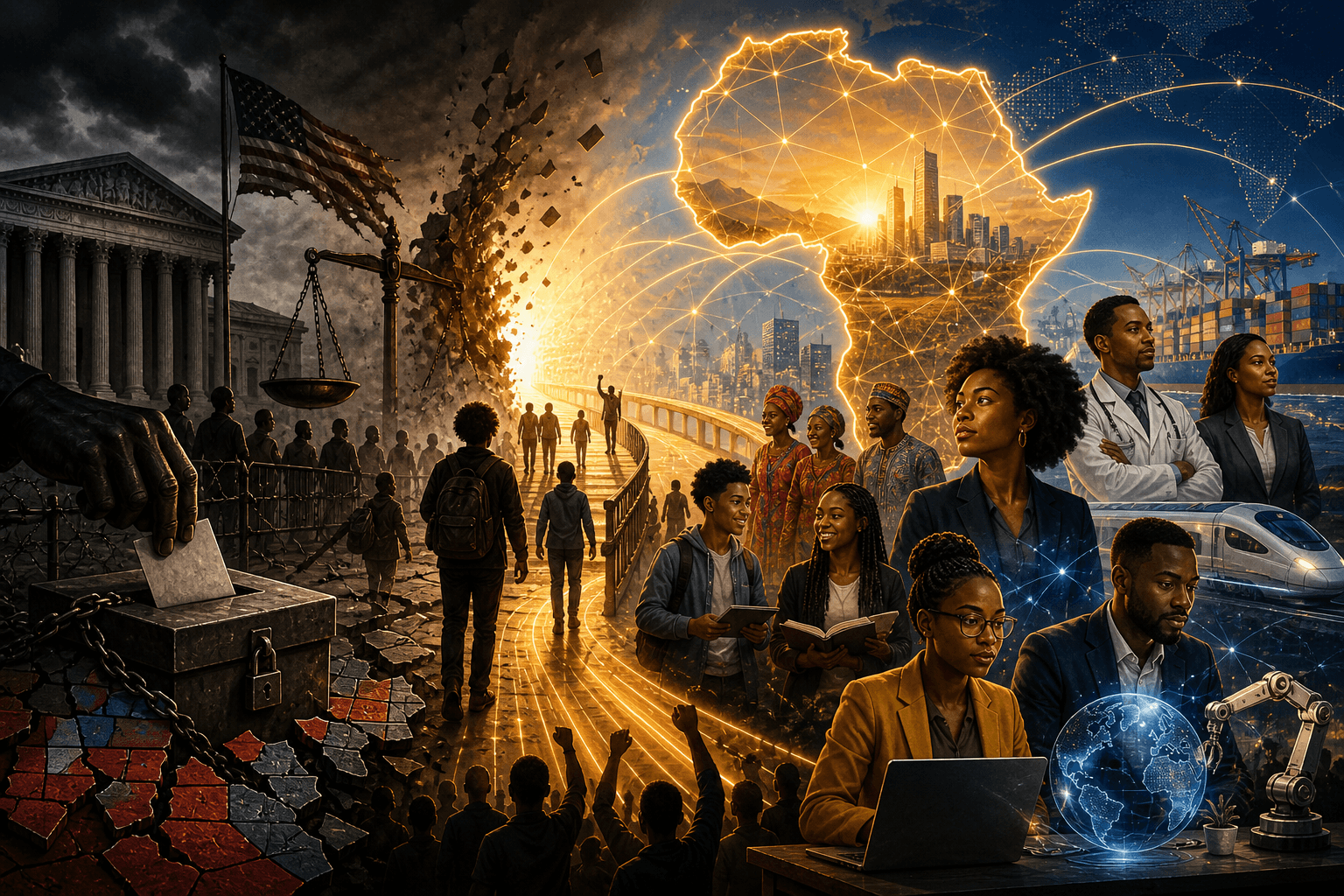
 Rev. Al Sharpton’s warning about the Voting Rights Act, Rev. William Barber’s moral call for a Third Reconstruction, and GDN Global’s case for linking voting power to global Black economic power.
By Peter Grear, with AI assistance
Publication Date: May 4, 2026
When Rev. Al Sharpton referred to the Supreme Court’s recent Voting Rights Act decision as a possible signal of the “end of the Second Reconstruction,” he gave language to a fear that has been growing across Black America: that the legal protections won during the modern civil-rights era are being narrowed, weakened, and reinterpreted at the very moment they are still needed.
The phrase “Second Reconstruction” carries deep historical meaning. The First Reconstruction followed the Civil War, when formerly enslaved Black people gained constitutional rights, political representation, access to public education, and the promise of full citizenship. That promise was later attacked through racial terror, Jim Crow laws, voter suppression, and court decisions that weakened federal enforcement.
The Second Reconstruction refers to the modern civil-rights era — the period that produced Brown v. Board of Education, the Civil Rights Act of 1964, the Voting Rights Act of 1965, and renewed federal responsibility for protecting Black citizenship. It was the era that helped convert constitutional promises into enforceable rights.
Now, civil-rights leaders are warning that one of the central pillars of that era is being weakened.
On April 29, 2026, the Supreme Court decided Louisiana v. Callais, a major redistricting case involving Louisiana’s congressional map. The Court struck down a map that had created a second majority-Black congressional district, ruling that the map was an unconstitutional racial gerrymander. The dispute followed earlier litigation over whether Louisiana’s previous map likely violated Section 2 of the Voting Rights Act because Black voters made up about one-third of the state’s population but had an opportunity to elect their preferred candidate in only one of six congressional districts.
The Court’s decision has been widely described as a significant narrowing of the Voting Rights Act’s power in redistricting. The Associated Press reported that many Black Americans see the ruling as a threat to generations of political gains made since the Voting Rights Act, while supporters of the decision argue that it promotes race-neutral districting and prevents unconstitutional racial mapmaking.
That tension is at the heart of the moment. To supporters of the ruling, the issue is constitutional colorblindness. To civil-rights advocates, the issue is whether the law can still recognize and remedy racial vote dilution in a country where race and political power have never been fully separable.
This is why Sharpton’s framing matters. He is not simply reacting to one case. He is sounding an alarm about the possible closing of a civil-rights era.
But if the Second Reconstruction is ending, the next question is not only political. It is strategic.
What comes next?
Here, GDN Global must be careful and historically respectful. Rev. Dr. William J. Barber II has already advanced the language of The Third Reconstruction. His book, co-authored with Jonathan Wilson-Hartgrove, is titled The Third Reconstruction: How a Moral Movement Is Overcoming the Politics of Division and Fear. Beacon Press describes it as the story of a modern moral movement seeking to bridge racial division and confront injustice through fusion organizing.
That matters because GDN should not simply claim the “Third Reconstruction” language as if it has no existing public meaning. Rev. Barber’s Third Reconstruction is already a recognized moral framework rooted in voting rights, anti-poverty organizing, racial justice, fusion politics, and multiracial democracy.
GDN Global can honor that framework while asking a new question:
If Sharpton is warning that the Second Reconstruction is ending, and Barber has called America toward a Third Reconstruction of moral fusion politics, is it now time for a Fourth Reconstruction rooted in global Black economic power?
That is the lane GDN Global is uniquely positioned to develop.
The Fourth Reconstruction would not replace the fight for voting rights. It would deepen it. It would say that voting power must be defended because voting power shapes economic power. The ballot determines who has influence over public budgets, school funding, infrastructure, contracts, workforce systems, appointments, courts, economic development, and public priorities.
Voting rights are not only about who gets to vote. They are about who gets represented when wealth, opportunity, and power are allocated.
When Black voting power is weakened, Black economic power is placed at risk.
That is why a Fourth Reconstruction must connect the ballot box to the boardroom, the classroom, the marketplace, and the African continent.
For generations, Black communities have been asked to fight for inclusion in systems that were not designed for their full economic liberation. The Fourth Reconstruction must go further. It must ask how Black communities build institutions, pipelines, media platforms, student networks, business ecosystems, and diaspora partnerships that can survive political backlash and court setbacks.
This is where GDN Global’s work around The Economic Liberation of Africa becomes central.
Black America is not isolated from the rest of the African world. The struggle for political power in the United States is connected to the struggle for economic power across Africa and the global African diaspora. If voting rights are weakened at home, Black communities must become even more intentional about building economic, educational, cultural, and institutional bridges across the diaspora.
Africa’s rise should not be viewed as a distant foreign-policy issue. It should be understood as part of the future of Black opportunity. The continent’s youth population, natural resources, innovation potential, cultural power, and development needs create historic possibilities for partnership — but only if the diaspora becomes organized, informed, and prepared.
That is why students must be central to the Fourth Reconstruction.
A student-centered Fourth Reconstruction would prepare young people to understand voting rights, public policy, economic development, media production, procurement, entrepreneurship, international affairs, and Africa-centered opportunity. It would connect HBCUs, Black student organizations, Pan-African networks, early-career professionals, and diaspora-minded institutions into a new pipeline of civic and economic leadership.
Students should not only be told to vote. They should be trained to research, publish, organize, build, invest, code, sell, negotiate, govern, and lead.
The Fourth Reconstruction must also include media power. Without independent Black media, communities are often left reacting to decisions after they happen rather than organizing around them before, during, and after the public debate. GDN and GDN Global can help translate complex legal, political, and economic developments into public education, action steps, and opportunity pathways.
This moment demands more than outrage. It demands infrastructure.
A Fourth Reconstruction agenda should include:
Voting-rights education and defense.
Student leadership development.
Africa-centered opportunity pipelines.
Diaspora investment literacy.
Public procurement and business-access advocacy.
Independent Black media expansion.
Partnerships with churches, HBCUs, alumni groups, civic organizations, and employers.
A stronger connection between Black civic power and Black economic power.
This is not a call to abandon the civil-rights struggle. It is a call to expand it.
The First Reconstruction sought to turn emancipation into citizenship.
The Second Reconstruction sought to turn citizenship into enforceable civil rights.
The Third Reconstruction, as Rev. Barber has framed it, calls for a moral movement against division, racism, poverty, and attacks on democracy.
The Fourth Reconstruction must ask how Black communities turn voting rights, moral witness, and global African connection into lasting economic power.
That is the work now before us.
If the Supreme Court’s decision marks a turning point, Black America cannot afford to treat it only as a setback. A turning point can also become a launchpad.
The challenge is not merely to mourn what is being weakened. The challenge is to build what must come next.
For GDN Global, that means helping create a public framework where voting rights, Black economic power, student leadership, diaspora unity, and The Economic Liberation of Africa are not separate conversations. They are parts of one agenda.
If the Second Reconstruction is ending, then Black America must not enter the future unprepared.
It is time to build the Fourth Reconstruction.
Join the conversation—leave your take or a question.
Help grow The Economic Liberation of Africa conversation—forward to someone curious about Africa-centered opportunity.
Donate to GDN – Greater Diversity News | Subscribe – Greater Diversity News.
