
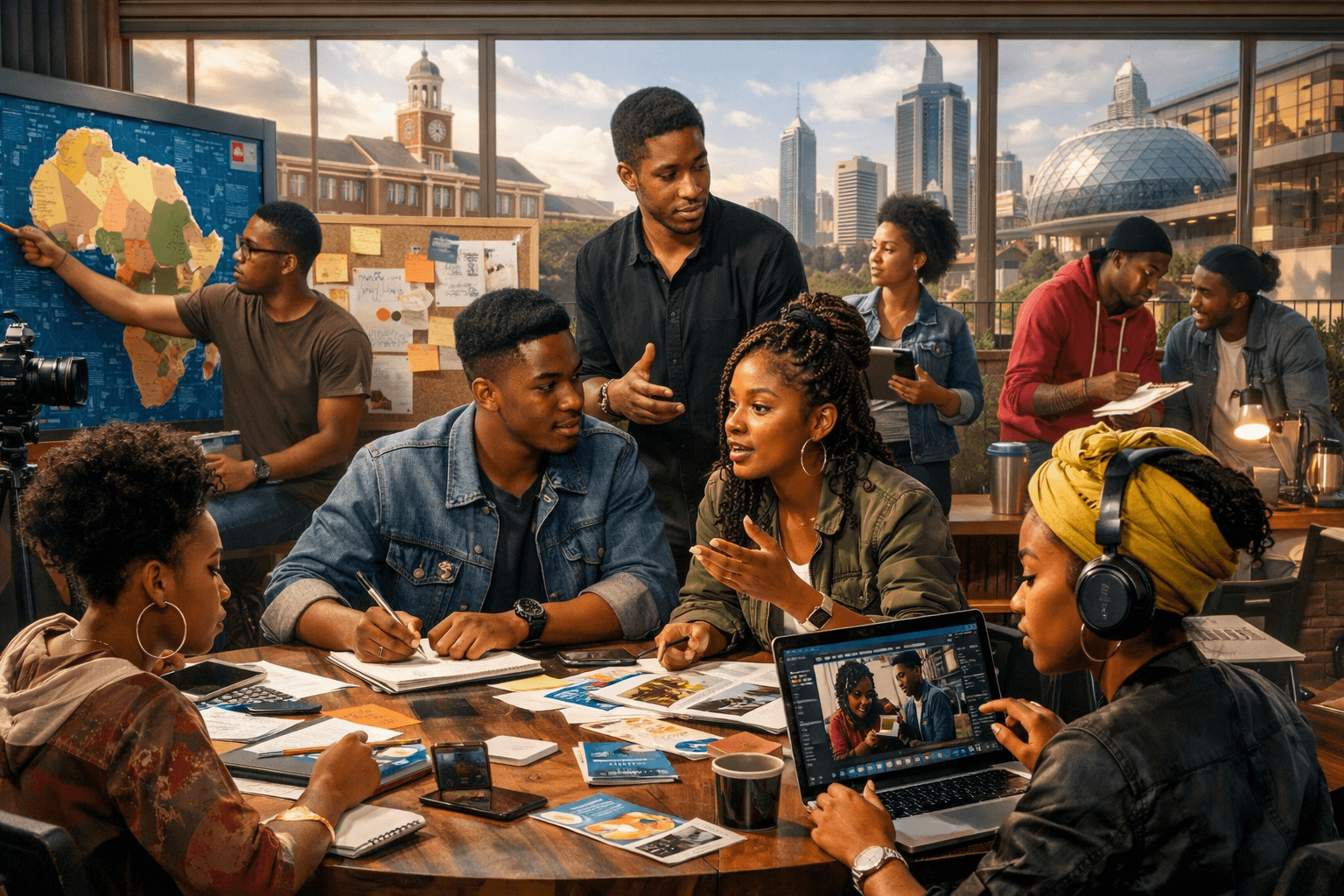
 A movement becomes stronger when students are not treated only as recipients of opportunity, but as co-builders of the systems meant to expand it.
By Peter Grear, with AI assistance
April 8, 2026
One of the quickest ways to weaken a student movement is to underestimate students.
Many institutions claim to care about young people, but what they often mean is that young people should attend, listen, support, subscribe, apply, or benefit. Students are welcomed as audiences, applicants, and future recipients. What they are less often invited to become are organizers, designers, and co-builders.
That distinction matters.
If GDN Global wants to build a durable movement around Right of First Refusal, Africa-centered opportunity, and the Jobs and Opportunities pipeline, students cannot be treated only as beneficiaries waiting for a finished system. They must also be treated as people who help shape, carry, explain, and expand the movement itself.
That is the secret to durability.
A movement built only for students will always be weaker than a movement built with them.
This matters especially in the context of RoFR because RoFR is not simply a concept that needs passive support. It is a framework that must be explained, translated, tested, and made visible across different communities. Students are uniquely positioned to do that work. They are present in institutions. They are connected to peer networks. They understand the gap between aspiration and access. They move through digital spaces quickly. And they often bring a sense of urgency that older systems have learned to bury.
But none of those strengths matter if students are only invited into the conversation after the important decisions have already been made.
That is why GDN Global should think differently about student participation. A serious student movement should not ask only, “How can students benefit from this?” It should also ask, “How can students help lead this?”
That does not mean every student becomes a policy expert or public spokesperson. It means the movement should be built in ways that create real roles for student ownership. Some students can help with campus outreach. Some can write or edit. Some can support research. Some can help organize webinars, media campaigns, partnership contacts, or student recruitment. Some can become ambassadors, cohort leaders, or early-stage project coordinators. The exact roles may vary, but the principle remains the same: students should be active contributors to the movement’s growth.
This is not just good pedagogy. It is good strategy.
When students help build a movement, several important things happen.
First, the movement becomes more credible to other students. Peer leadership often carries more weight than institutional messaging alone. Students are more likely to engage when they can see people like themselves already involved in meaningful ways. A movement that feels top-down may attract curiosity, but a movement with visible student organizers is much more likely to build trust and momentum.
Second, the movement becomes more adaptive. Students often notice problems, opportunities, and communication gaps quickly. They can tell when language is too abstract, when outreach feels stiff, when a call to action is unclear, or when a program sounds exciting but offers no visible pathway. Their feedback makes the movement more responsive. Their involvement keeps it from becoming overly polished but disconnected.
Third, student organizers help distribute the work. Durability requires repetition. It requires content, follow-up, recruitment, events, reminders, and visible activity. A movement that depends on one or two adults doing everything will struggle to scale. But a movement with student contributors across different campuses, tracks, and functions becomes more resilient. It develops more points of energy and more routes for growth.
This is especially important for a Sixth Region framework. A movement that wants to connect Black students to Africa-centered opportunity cannot rely only on elite conversations or institutional endorsements. It has to become visible in the places where students actually live, learn, share, and organize. Student organizers help make that possible. They are not only future participants in the pipeline. They are part of the infrastructure that helps the pipeline exist.
There is also a deeper reason this matters.
Students who help build a movement learn more than students who simply benefit from it. They learn how ideas are translated into systems. They learn how partnerships form. They learn how messaging works. They learn how institutions respond, where obstacles arise, and what it takes to turn vision into action. These are not minor lessons. They are part of leadership development itself.
That means organizing is not just service to the movement. It is part of the opportunity.
A student who helps recruit peers, shape messaging, coordinate outreach, or document program outcomes is gaining experience that can later support work in media, business development, policy, partnerships, communications, and enterprise. In this sense, the act of helping build the movement is already part of the jobs pipeline.
Still, this must be handled honestly.
Students should not be romanticized into unpaid overwork or symbolic leadership without support. If GDN Global wants students to act as organizers, then their roles should be clear, meaningful, and, where possible, developmental. They should gain visibility, references, credits, pathway opportunities, mentorship, or skill-building from the work. Student leadership should not become a substitute for adult responsibility. It should become a structured layer of shared responsibility.
That balance is crucial.
When students are treated only as beneficiaries, a movement can become paternalistic. It offers help but withholds ownership. When students are treated as co-builders, a movement becomes more democratic, more energetic, and more likely to survive beyond a single launch moment.
That is what durability looks like.
For GDN Global, the lesson is clear. The movement will be strongest not when students are simply invited to sign up, but when they are given meaningful roles in shaping what comes next. They should be visible not only in photos and attendance counts, but in leadership pathways, outreach systems, content creation, organizing structure, and public narrative.
RoFR is, at its core, about position. Who gets access first? Who gets invited early? Who is allowed to matter before the opportunity is already gone?
That logic should apply to movement-building too.
Students should not be the last people brought into a future that claims to serve them. They should be among the first to help build it.
Donate to GDN – Greater Diversity News | Subscribe – Greater Diversity News.
Join the conversation—leave your take or a question.
Help grow The Economic Liberation of Africa conversation—forward to someone curious about Africa-centered opportunity.