
By Peter Grear, with AI assistance
May 15, 2026
The global energy transition is accelerating, and at the center of it sits Africa.
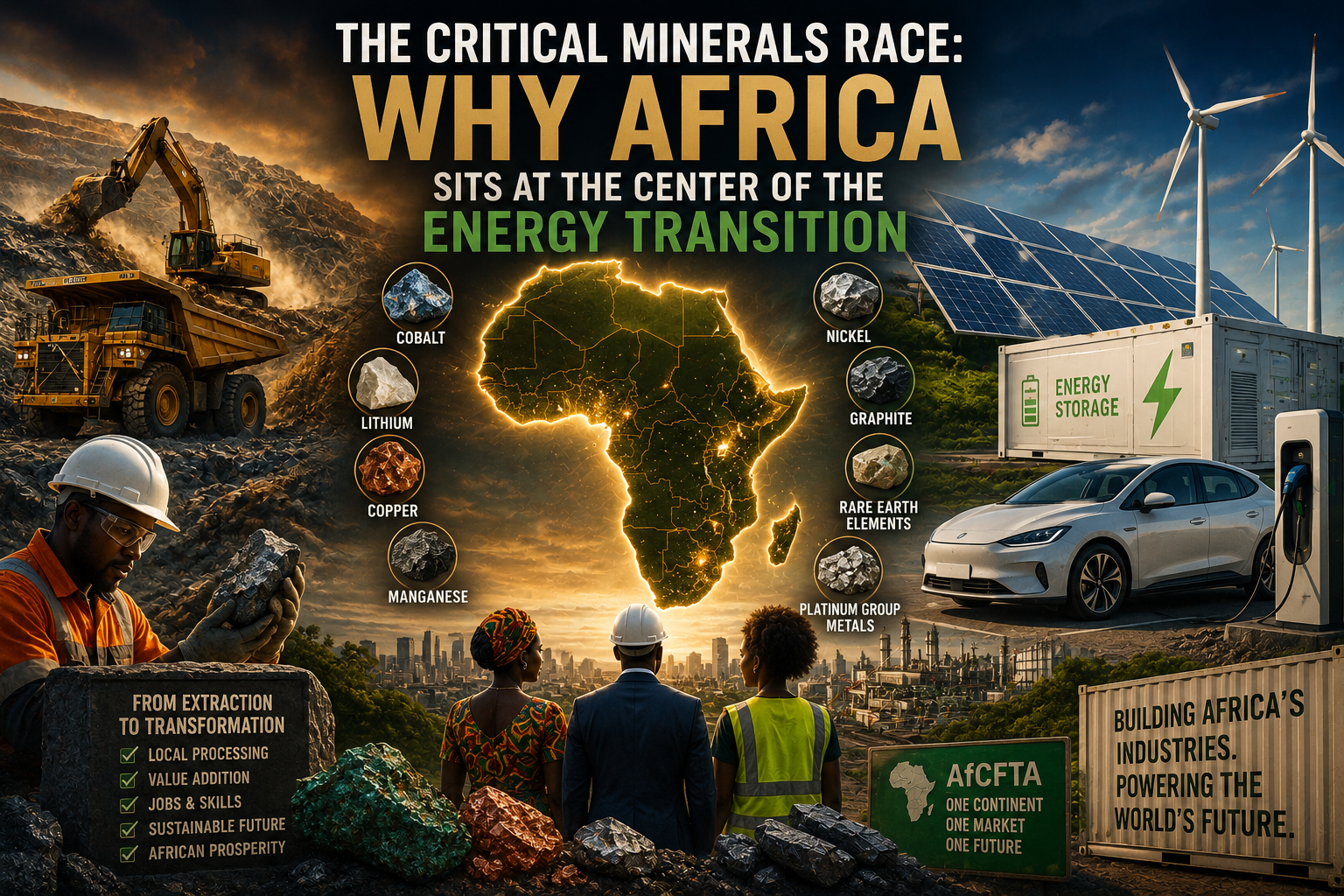
As countries race to reduce carbon emissions, expand renewable energy systems, and dominate the industries of the future, demand for critical minerals has surged dramatically. Electric vehicles, battery storage systems, solar infrastructure, artificial intelligence technologies, and defense systems all rely on a group of strategic resources increasingly concentrated in African soil.
This has transformed Africa from a peripheral player in the global economy into one of the most strategically important regions of the 21st century.
The race is no longer only about oil.
Today, the world is competing for:
- cobalt
- lithium
- manganese
- copper
- graphite
- nickel
- rare earth elements
These materials are essential to the infrastructure powering the green economy and digital future. Without them, electric vehicles cannot scale, battery systems cannot expand, and renewable energy goals become difficult to achieve.
Africa possesses a significant share of many of these resources.
The Democratic Republic of Congo (DRC) dominates global cobalt production. Zimbabwe holds major lithium reserves. Zambia is central to copper supply chains. South Africa controls significant deposits of manganese and platinum group metals. Guinea possesses some of the world’s largest bauxite reserves. Across the continent, exploration continues to reveal additional strategic deposits.
This concentration of resources has triggered a modern geopolitical race.
The United States, China, the European Union, Gulf states, and multinational corporations are all competing to secure long-term access to African minerals. Governments are investing in supply-chain partnerships, infrastructure financing, and trade agreements designed to guarantee access to the resources required for industrial competitiveness.
At stake is more than energy policy.
The transition toward electric vehicles, renewable power, advanced manufacturing, and AI infrastructure represents one of the largest industrial transformations in modern history. Countries that secure stable mineral supply chains will hold significant strategic advantages. Those that fail to do so risk falling behind economically and technologically.
This reality places Africa in a powerful—but complicated—position.
Historically, African resources have often fueled industrial growth elsewhere while the continent remained trapped in extractive economic models. Raw materials were exported, processed abroad, and sold back as high-value finished goods. Local industrialization remained limited, while much of the profit accumulated externally.
Many African leaders and economists now argue that the energy transition risks repeating this pattern unless the continent changes how it participates in the global value chain.
That concern is driving a growing wave of resource nationalism across Africa.
Governments are increasingly demanding:
- local processing
- refining capacity
- higher royalties
- domestic manufacturing
- technology transfer
- stronger local ownership
The goal is not simply to export minerals, but to capture more value inside Africa before those resources leave the continent.
This marks a profound shift in thinking.
For decades, many African economies were structured around extraction. Today, there is increasing pressure to move toward industrial ecosystems tied to those same resources. Instead of exporting raw lithium, countries want battery-processing facilities. Instead of shipping unprocessed cobalt abroad, governments are exploring regional manufacturing partnerships linked to electric vehicle supply chains.
This transition, however, is not easy.
Industrialization requires:
- infrastructure
- energy reliability
- skilled labor
- transportation systems
- financing
- policy coordination
Many African countries continue to face structural challenges in these areas. Foreign corporations often possess greater technical capacity and financial leverage than local industries. Meanwhile, geopolitical competition creates pressure for quick extraction rather than long-term development.
This is where Africa’s bargaining power becomes critical.
The continent’s strategic leverage is growing precisely because the world increasingly depends on its resources. In a multipolar global economy, African governments now have more room to negotiate between competing global powers rather than relying on a single dominant partner.
That leverage could become transformative if coordinated effectively.
The African Continental Free Trade Area (AfCFTA) adds another layer to this conversation. A unified continental market creates the possibility of regional value chains where minerals extracted in one country can be processed or manufactured into higher-value products elsewhere within Africa.
This matters because industrial economies are rarely built country-by-country in isolation. They are built through integrated systems.
The African diaspora also has a potential role in this emerging landscape.
As Africa seeks to move up the value chain, there is growing demand for:
- engineers
- researchers
- financiers
- entrepreneurs
- media strategists
- logistics experts
- technology professionals
The diaspora represents a global reservoir of skills, capital, and networks that could help support industrial growth and institution-building tied to the energy transition.
This intersects directly with growing conversations around the African Union’s Sixth Region and proposals like Right of First Refusal (RoFR), which seek to create more intentional pathways for African and diaspora participation in emerging opportunity systems.
The deeper issue is ownership.
Who will control the industries built from Africa’s resources? Who will process the minerals? Who will manufacture the batteries? Who will own the logistics networks, ports, and processing facilities connected to the energy transition?
These questions may define Africa’s economic future.
If the continent remains primarily an exporter of raw materials, the green revolution could reproduce old dependency patterns under new language. But if African countries successfully leverage their mineral advantage into industrial development, infrastructure expansion, workforce training, and technological capacity, the energy transition could become one of the greatest economic turning points in modern African history.
The world understands the importance of Africa’s minerals.
The larger question is whether Africa can transform that strategic importance into lasting sovereignty, ownership, and development.
Because in the race to power the future, Africa is no longer standing at the margins of the global economy.
It is sitting at the center of it.
Donate to GDN – Greater Diversity News | Subscribe – Greater Diversity News
Join the conversation—leave your take or a question.
Help grow The Economic Liberation of Africa conversation—forward to someone curious about Africa-centered opportunity.