
By Peter Grear, with AI assistance
May 4, 2026
For decades, Africa’s vast natural resources—oil, gas, gold, cobalt, lithium, and more—have powered industries and economies far beyond the continent’s borders. Yet the countries where these resources originate have often captured only a fraction of their value. This imbalance, rooted in colonial extraction models and reinforced by post-independence economic structures, has long defined Africa’s relationship with global markets.
That model is now being challenged.
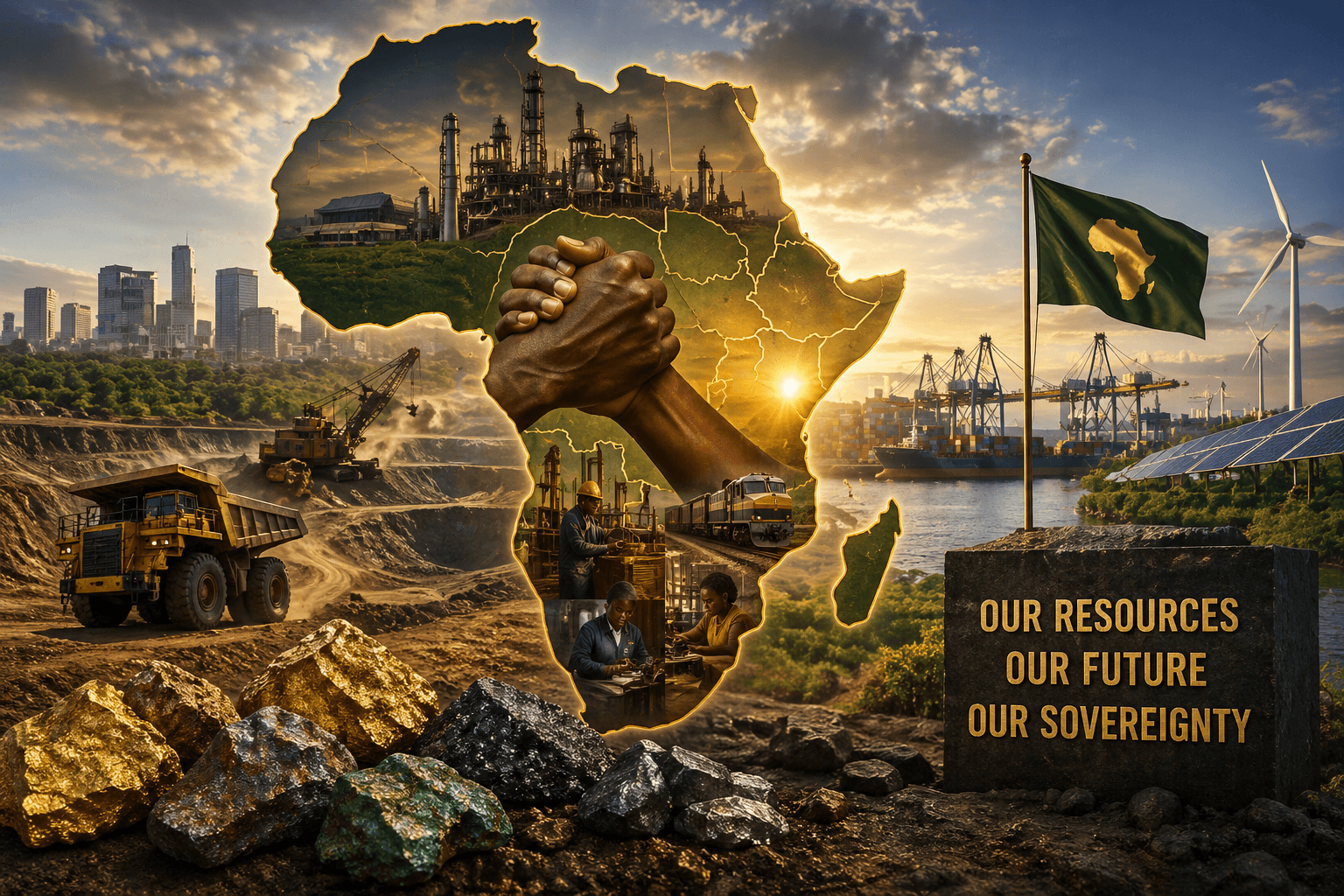
Across the continent, a new wave of resource nationalism is emerging. Governments are revisiting contracts, increasing state participation, demanding local processing, and renegotiating the terms under which foreign companies operate. While the specifics vary from country to country, the underlying goal is consistent: to shift Africa’s role from a supplier of raw materials to a co-owner of value.
This is not a sudden phenomenon. It is the result of accumulated pressures—economic, political, and generational. African populations, particularly youth, are increasingly aware of the gap between resource wealth and lived economic reality. At the same time, governments are operating in a more competitive global environment where multiple external partners are seeking access to Africa’s minerals and energy assets.
That competition has created leverage.
In a unipolar world dominated by a small number of economic powers, African countries often had limited room to negotiate. Today, the rise of a multipolar global system—featuring increased engagement from China, India, the Gulf states, Turkey, and others—has widened the field. African governments are no longer negotiating with a single bloc. They are navigating a marketplace of interests.
This shift is especially visible in the politics of critical minerals.
The global transition to renewable energy and digital infrastructure has intensified demand for cobalt, lithium, manganese, and rare earth elements—many of which are found in significant quantities across Africa. These resources are essential for electric vehicles, battery storage, and advanced manufacturing. As demand rises, so does the strategic importance of the countries that control supply.
The question facing African governments is no longer whether to participate in global supply chains. It is how.
In several countries, policies are evolving to require local value addition. Instead of exporting raw materials, governments are pushing for refining, processing, and manufacturing to occur within national borders. This approach aims to create jobs, develop technical capacity, and retain a greater share of profits.
In parallel, there has been a push for increased state ownership or equity stakes in resource projects. By holding shares in extraction operations, governments seek a more direct claim on revenues. Some countries have also introduced export restrictions or taxes designed to encourage domestic processing industries.
Contract renegotiation is another key feature of this trend. Agreements signed decades ago—often under conditions of limited bargaining power—are being revisited. Governments are seeking higher royalties, improved environmental standards, and stronger commitments to local employment and infrastructure development.
These moves have not gone unnoticed.
International investors and corporations often view resource nationalism with caution. Sudden policy changes can create uncertainty, disrupt supply chains, and raise concerns about regulatory stability. Critics argue that overly aggressive policies risk discouraging investment, slowing production, and limiting technological transfer.
These concerns are not without merit.
Resource nationalism carries risks if not carefully managed. Weak governance structures can turn increased state control into elite capture rather than broad-based development. Poorly designed policies can lead to capital flight or project delays. Without investment in education and infrastructure, local value-addition goals may struggle to materialize.
Yet focusing only on risks misses the broader context.
For many African countries, the existing system has already produced instability—characterized by dependency, limited industrialization, and vulnerability to global commodity price swings. Resource nationalism, in this light, is not simply a policy experiment. It is an attempt to correct structural imbalances that have persisted for generations.
The deeper shift is conceptual.
Africa is beginning to redefine its place in the global economy. Instead of accepting a position at the base of the value chain, there is a growing insistence on moving upward—into processing, manufacturing, and technological development. This requires not only policy change, but also coordination across sectors, investment in human capital, and regional cooperation.
Initiatives like the African Continental Free Trade Area (AfCFTA) are critical in this regard. A single country may struggle to build a full industrial ecosystem, but a connected continental market increases the feasibility of regional value chains. Minerals extracted in one country could be processed in another and manufactured into products in a third.
The role of the diaspora also intersects with this shift.
As Africa seeks to build more complex industries, there is increasing recognition of the need for skills, capital, and networks that extend beyond national borders. Diaspora professionals, entrepreneurs, and investors can play a role in bridging gaps in expertise and financing. However, this requires clear frameworks that make participation accessible and transparent.
Resource nationalism, at its best, is not about isolation. It is about recalibration.
It reflects a desire to engage with the global economy on more equitable terms—to partner rather than depend, to negotiate rather than accept, and to build rather than simply extract. The outcome of this shift will depend on how effectively African governments balance sovereignty with openness, and ambition with execution.
What is clear is that the conversation has changed.
Africa is no longer asking whether it should benefit more from its resources. It is asking how to design systems that make that outcome inevitable.
The transition from dependency to sovereignty is complex, uneven, and ongoing. But it signals a fundamental shift in mindset—one that could redefine not only Africa’s economic future, but its role in shaping the global order.
Donate to GDN – Greater Diversity News | Subscribe – Greater Diversity News
Join the conversation—leave your take or a question.
Help grow The Economic Liberation of Africa conversation—forward to someone curious about Africa-centered opportunity.