
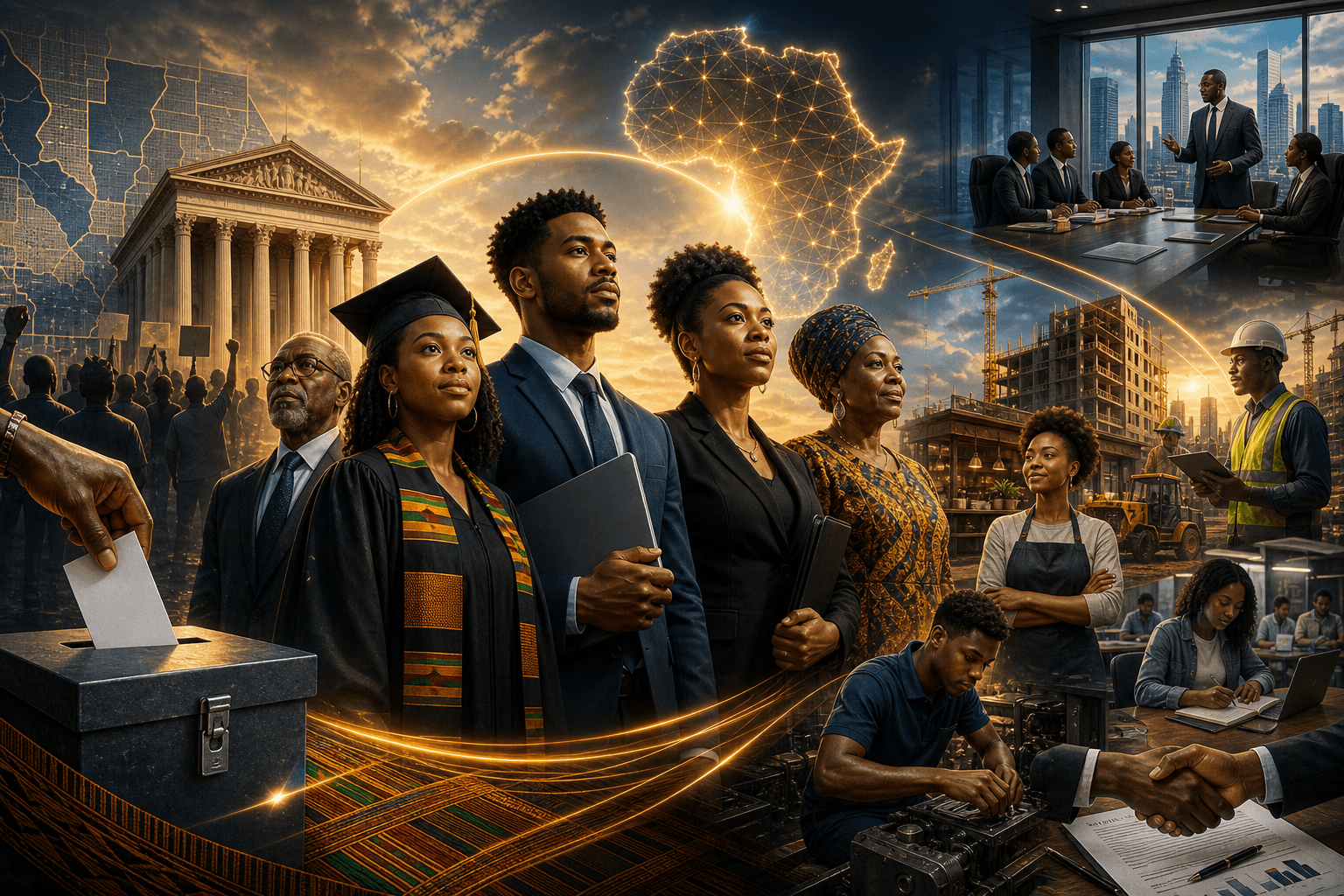
Why Black Civic Power Shapes Economic Access
By Peter Grear, with AI assistance
Publication Date: May 1, 2026
The Supreme Court’s decision in Louisiana v. Callais is being discussed as a voting-rights case, but its deeper meaning reaches far beyond congressional district lines. On April 29, 2026, the Court struck down Louisiana’s congressional map that included a second majority-Black district and significantly weakened the practical force of Section 2 of the Voting Rights Act, the provision historically used to challenge voting systems that dilute minority political power.
For Black communities, the question is not only who gets elected. The question is who has the power to influence budgets, contracts, schools, workforce programs, public investment, business development, and institutional priorities. That is why the path from the ballot box to the boardroom matters. Political power and economic access are not separate struggles. They are connected steps in the same fight for self-determination.
When Black voting strength is weakened, Black economic leverage can be weakened as well. Elected officials shape the rules that determine where roads are built, which schools receive investment, which businesses gain access to public contracts, whether HBCUs receive support, how workforce programs are funded, and whether minority-owned enterprises have fair access to opportunity. Representation affects who sits at the table when resources are distributed.
That is why voting rights must be understood as opportunity rights.
For GDN’s African Centered Opportunities initiative, this moment requires a clear message: Black civic power is one of the foundations of Black economic power. Students, entrepreneurs, professionals, faith leaders, HBCU alumni, community organizers, and diaspora advocates must understand that voting rights are not only about election day. They are about who has influence after election day.
The Supreme Court ruling has already triggered political consequences. Louisiana’s governor suspended the state’s congressional primaries after the decision, and legal challenges quickly followed. Redistricting battles are also intensifying in several states as political leaders respond to the Court’s new legal landscape. This means the ruling is not an abstract legal development. It is already reshaping the machinery of representation.
The danger for Black communities is that weakened representation can become weakened access. If communities lose the ability to elect candidates who understand their lived experience, they may also lose advocates for economic policies that support them. That can affect minority business contracting, student aid, small-business development, affordable housing, infrastructure, healthcare access, public education, and international economic engagement with Africa and the African diaspora.
The boardroom is not disconnected from the ballot box. Corporate leaders, public agencies, universities, nonprofit institutions, and economic development boards all operate within policy environments shaped by elected officials. If Black communities have reduced political influence, they may face greater difficulty pressing institutions to invest in their communities, hire their talent, respect their priorities, and open doors for business participation.
This is where GDN’s African Centered Opportunities initiative has an important role to play. The initiative can help translate civic power into practical economic action. It can show students how redistricting affects their future. It can show entrepreneurs how representation affects contracting. It can show HBCUs how voting rights affect public support. It can show the diaspora how domestic Black political power influences global Black economic engagement.
A young person entering college may not immediately connect voting rights to internship opportunities. A small-business owner may not immediately connect redistricting to public procurement. A community leader may not immediately connect court decisions to workforce investment. GDN can help make those connections visible.
The message should be simple and repeated often:
The communities that lose political voice risk losing economic choice.
That does not mean the response should be fear. It means the response should be organization. Black communities must build stronger civic education systems, stronger student networks, stronger media platforms, stronger business coalitions, and stronger institutional partnerships. They must also train young people to see themselves as future voters, future board members, future policymakers, future business owners, future journalists, and future builders of African-centered opportunity.
The Black student movement is especially important. Students are not only preparing for careers; they are preparing to inherit institutions. They must understand how law, policy, media, economics, and representation work together. They must be trained to ask: Who controls the budget? Who writes the rules? Who gets the contract? Who defines opportunity? Who benefits from public investment? Who is left out?
Those questions move the conversation from symbolic representation to structural power.
Independent Black media also becomes more important in this environment. When court decisions reshape civil rights protections, communities need trusted institutions that can explain the impact in plain language. GDN can serve as a bridge between legal developments and community strategy. It can help readers understand not only what happened, but what it means and what they can do.
The struggle from the ballot box to the boardroom is about building a full ecosystem of power. Voting helps determine representation. Representation helps shape policy. Policy helps direct resources. Resources help create opportunity. Opportunity helps build institutions. Institutions help protect the future.
That is the chain GDN must help its audience understand.
The Supreme Court’s Voting Rights Act decision should therefore become a catalyst for deeper organizing. GDN’s African Centered Opportunities initiative can help transform this moment into civic education, student engagement, business awareness, HBCU advocacy, diaspora connection, and economic mobilization.
The lesson is clear: Black communities cannot separate the fight for the vote from the fight for wealth, contracts, education, ownership, and institutional influence. The ballot box is one doorway. The boardroom is another. The future belongs to communities organized enough to walk through both.
Donate to GDN – Greater Diversity News | Subscribe – Greater Diversity News
Join the conversation—leave your take or a question.
Help grow The Economic Liberation of Africa conversation—forward to someone curious about Africa-centered opportunity.