
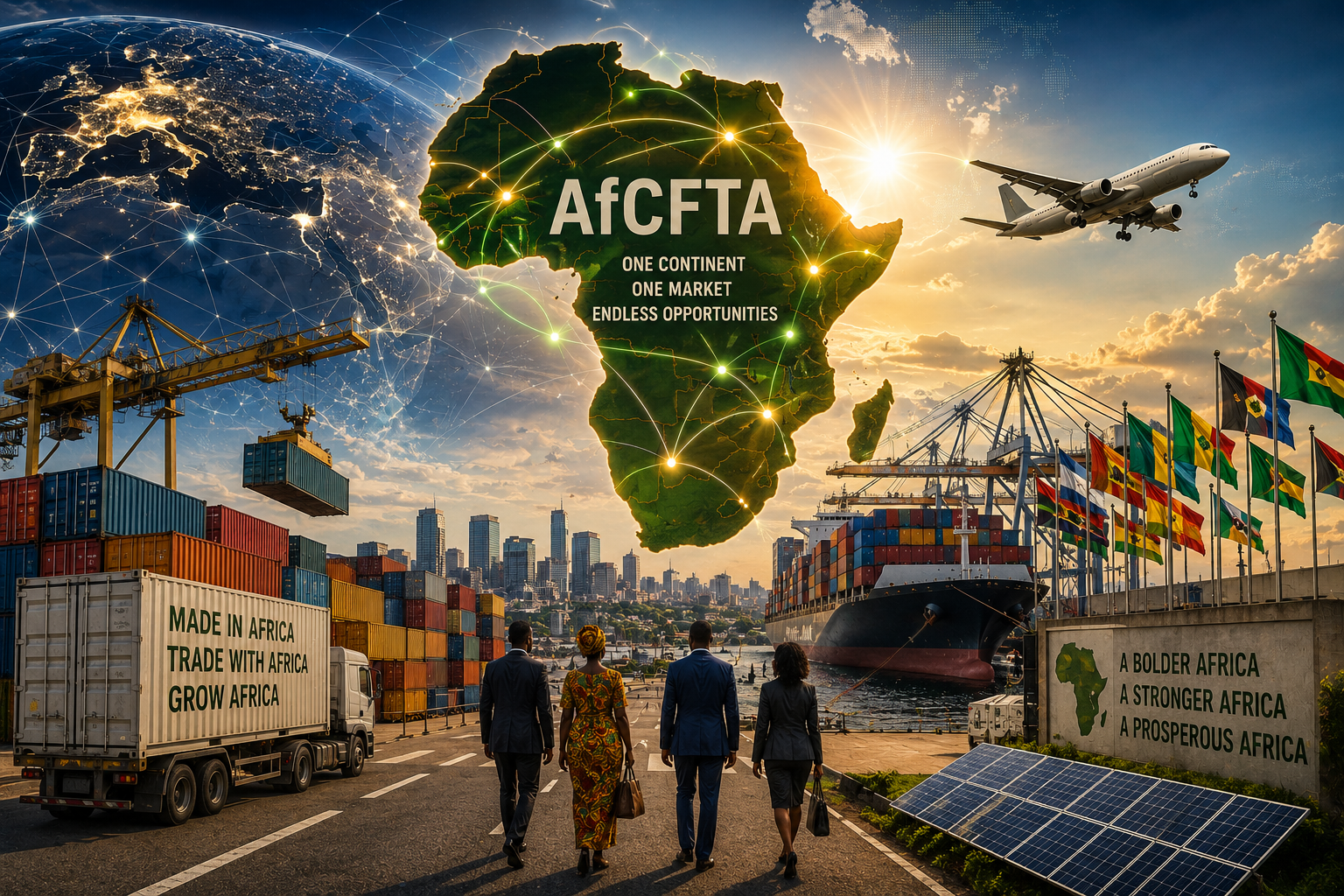
By Peter Grear, with AI assistance
May 8, 2026
For decades, one of Africa’s greatest economic contradictions has been this: a continent rich in resources, talent, and potential, yet fragmented into dozens of smaller markets that trade more with external partners than with each other. That fragmentation has limited industrial growth, weakened bargaining power, and reinforced dependency on global supply chains controlled from outside the continent.
The African Continental Free Trade Area (AfCFTA) is an attempt to change that—fundamentally.
Launched in 2021, AfCFTA brings together 54 countries into a single market of approximately 1.4 billion people with a combined GDP exceeding $3 trillion. By number of participating countries, it is the largest free trade area in the world. But its significance goes far beyond size. AfCFTA represents a strategic shift in how Africa organizes its economic future—from fragmentation to integration.
At its core, AfCFTA is designed to reduce tariffs, eliminate trade barriers, and make it easier for African countries to trade with one another. Historically, intra-African trade has hovered around 15%, compared to nearly 60% in Europe and over 40% in Asia. That gap reflects not a lack of opportunity, but a legacy of colonial-era infrastructure and trade patterns that prioritized exports to Europe and imports from outside the continent.
AfCFTA challenges that model by reorienting trade inward.
If fully implemented, the agreement could increase intra-African trade by more than 50%, according to estimates from international institutions. But the real impact lies in what that increased trade enables: the development of regional value chains, industrial ecosystems, and economies of scale that have long been out of reach for individual countries operating alone.
Consider manufacturing.
A single African country may struggle to sustain a competitive manufacturing base due to limited domestic demand. But a connected continental market changes the equation. A factory producing goods in one country can serve customers across multiple borders, making larger-scale production viable. Raw materials extracted in one region can be processed in another and assembled into finished products elsewhere.
This is how industrial economies are built—not through isolated national markets, but through integrated systems.
AfCFTA also has implications for infrastructure. Efficient trade requires roads, railways, ports, and digital systems that connect markets. As countries begin to align their trade policies, pressure increases to invest in cross-border logistics. Over time, this could reshape how goods move across the continent, reducing costs and improving competitiveness.
Yet the agreement is not without challenges.
Implementation remains uneven. Tariff reductions must be negotiated across thousands of product categories. Customs systems need modernization. Non-tariff barriers—such as regulatory differences, licensing requirements, and border delays—can be just as restrictive as tariffs themselves. Smaller economies may worry about being overwhelmed by larger, more industrialized neighbors.
These concerns are real and require careful management.
But they do not diminish the strategic importance of the initiative. In fact, they highlight the scale of what AfCFTA is attempting to achieve: not simply a trade agreement, but a reconfiguration of Africa’s economic architecture.
The timing of AfCFTA is also significant.
The global economy is entering a period of realignment. Supply chains are being reconsidered. Geopolitical tensions are reshaping trade relationships. The shift toward renewable energy and digital infrastructure is creating new demand patterns. In this context, regions that can organize large, integrated markets gain an advantage.
AfCFTA positions Africa to do exactly that.
For global investors, a fragmented continent presents risk and complexity. A unified market presents opportunity. For African entrepreneurs, integration reduces the friction of expanding beyond national borders. For policymakers, it provides a platform to coordinate industrial policy, standards, and long-term development strategies.
The agreement also intersects with the broader concept of sovereignty.
Economic independence is difficult to achieve when markets are small and externally oriented. By strengthening internal trade, Africa can reduce its vulnerability to external shocks—whether they come from commodity price fluctuations, global financial shifts, or geopolitical disruptions. AfCFTA does not eliminate these risks, but it provides tools to manage them more effectively.
The role of the diaspora fits into this evolving picture.
As the Sixth Region becomes more engaged in Africa’s economic trajectory, a larger, more integrated market creates clearer entry points for investment, partnerships, and business expansion. Diaspora entrepreneurs and professionals are more likely to engage when they see scale, structure, and opportunity beyond individual national markets.
AfCFTA helps create that visibility.
It signals that Africa is not only rising, but organizing.
Still, success is not guaranteed. Trade agreements do not automatically produce growth. They must be supported by consistent policy, strong institutions, and sustained political will. Governments must balance national interests with continental goals. Private sectors must adapt to new competitive environments. Infrastructure must keep pace with ambition.
The work is ongoing.
But the direction is clear.
AfCFTA represents a turning point in how Africa approaches its economic future. It moves the conversation from dependency to coordination, from fragmentation to scale, and from potential to structure. It is a framework for building something that has long been missing: a truly continental market.
In a multipolar world, scale matters. Coordination matters. Internal strength matters.
AfCFTA is Africa’s answer to that reality.
And if it succeeds, it will not only transform trade within Africa—it will reshape how the world engages with the continent as a unified economic force.
Donate to GDN – Greater Diversity News | Subscribe – Greater Diversity News
Join the conversation—leave your take or a question.
Help grow The Economic Liberation of Africa conversation—forward to someone curious about Africa-centered opportunity.