
By Peter Grear (with AI assistance)
May 8, 2026
RoFR is one of those terms that can sound like it belongs in a legal textbook—until you translate it into what it really is: a way of thinking about how opportunity moves.
If you’re a student trying to build a future, you already know the truth about opportunity: it’s not only about talent. It’s also about pathways—who gets seen, who gets considered, who gets a fair chance to compete, and who gets left outside the room before the conversation even starts. RoFR is a framework for widening those pathways with standards and transparency, so access isn’t based on luck, gatekeeping, or extraction.
In plain language, RoFR stands for Right of First Refusal. But in the Sixth Region framing, RoFR is best understood as an opportunity-access framework—a model for designing fair participation in the opportunity flows connected to Africa’s rise.
What RoFR is (in everyday terms)
RoFR is a principle that says:
If an opportunity is real and valuable, qualified Africa- and diaspora-linked participants should have a structured chance to compete fairly—often by matching the best offer—before opportunity is permanently closed.
Think of it like this: in many systems, opportunity “moves” through relationships and established players. New entrants—even qualified ones—often don’t get a real shot. RoFR is about designing pathways so the people who have the most at stake in Africa’s future (including the Sixth Region) are not automatically positioned last.
RoFR is also a reminder that fairness doesn’t happen by accident. It happens when rules are clear, standards are real, and decisions are transparent enough to be trusted.
What RoFR is NOT
RoFR is not a shortcut. It’s not magic. And it’s not “free wins.”
Here’s what it isn’t:
- Not automatic preference: RoFR isn’t “give it to us because we asked.” It assumes eligibility and capability standards.
- Not anti-competition: RoFR works best when it raises quality and accountability, not when it blocks better outcomes.
- Not a substitute for capacity: RoFR doesn’t replace skill-building, governance, or performance readiness—it requires them.
- Not a cover for fronting: It should never become a loophole for shell companies or fake ownership.
If RoFR is done poorly, it becomes symbolism. If it’s done well, it becomes a tool of development and inclusion that is earned and measurable.
Why the Sixth Region matters in this conversation
The Sixth Region is a way of describing the global African diaspora as more than a cultural identity. It frames the diaspora as a strategic stakeholder group—people and institutions with shared incentives to invest, build, partner, and shape systems across borders.
Africa’s economic rise is not a distant headline. It is a living reality shaping markets, labor demand, supply chains, capital flows, and digital innovation. As that reality expands, the question becomes: who is positioned to benefit, and who is positioned to lead?
RoFR matters because it forces us to think in systems. It asks:
- How are opportunities communicated?
- Who qualifies, and by what standards?
- What safeguards protect fairness and integrity?
- How do we build pathways that last beyond one political season or one set of relationships?
That is not “policy talk” for policy’s sake. It’s economic literacy.
Why students should care (right now)
If you’re a student, your relationship to RoFR is practical. It’s not about memorizing terms. It’s about understanding the economy you’re entering—and building the skills to shape it.
Here are four reasons RoFR matters to students:
1) RoFR teaches how opportunity actually moves
Most students are taught to focus on résumés, interviews, and grades. Those matter. But RoFR forces a deeper lesson: opportunity often moves through rules, networks, and institutional pathways. When you understand pathways, you can build leverage—not just chase openings.
2) RoFR connects jobs to mission
Many students need work now. RoFR is part of a broader mission: claiming African inheritance as a strategy for generational opportunity. That mission turns internships into infrastructure and portfolios into pathways. It teaches students to build for the long game while meeting today’s needs.
3) RoFR makes “fair access” a measurable design problem
Instead of vague promises, RoFR pushes concrete questions:
- What does a fair application process look like?
- What does verification look like?
- What does transparency look like?
- What outcomes should be tracked?
That thinking is valuable in business, media, law, policy, and entrepreneurship. It’s also valuable in life: it trains you to design systems, not just react to them.
4) RoFR creates real work students can do immediately
Here’s the key: you don’t need a government title to contribute. Students can build RoFR-aligned outputs right now:
- youth-facing explainers and short videos
- research briefs and source libraries
- stakeholder maps and outreach pipelines
- web pages and conversion pathways that connect people to opportunities
- a structured draft of a Uniform RoFR Plan (with professional assistance where needed)
This is why GDN Global and NHBCUAAF are treating RoFR as a program, not a slogan.
What this looks like in the NHBCUAAF × GDN Global partnership
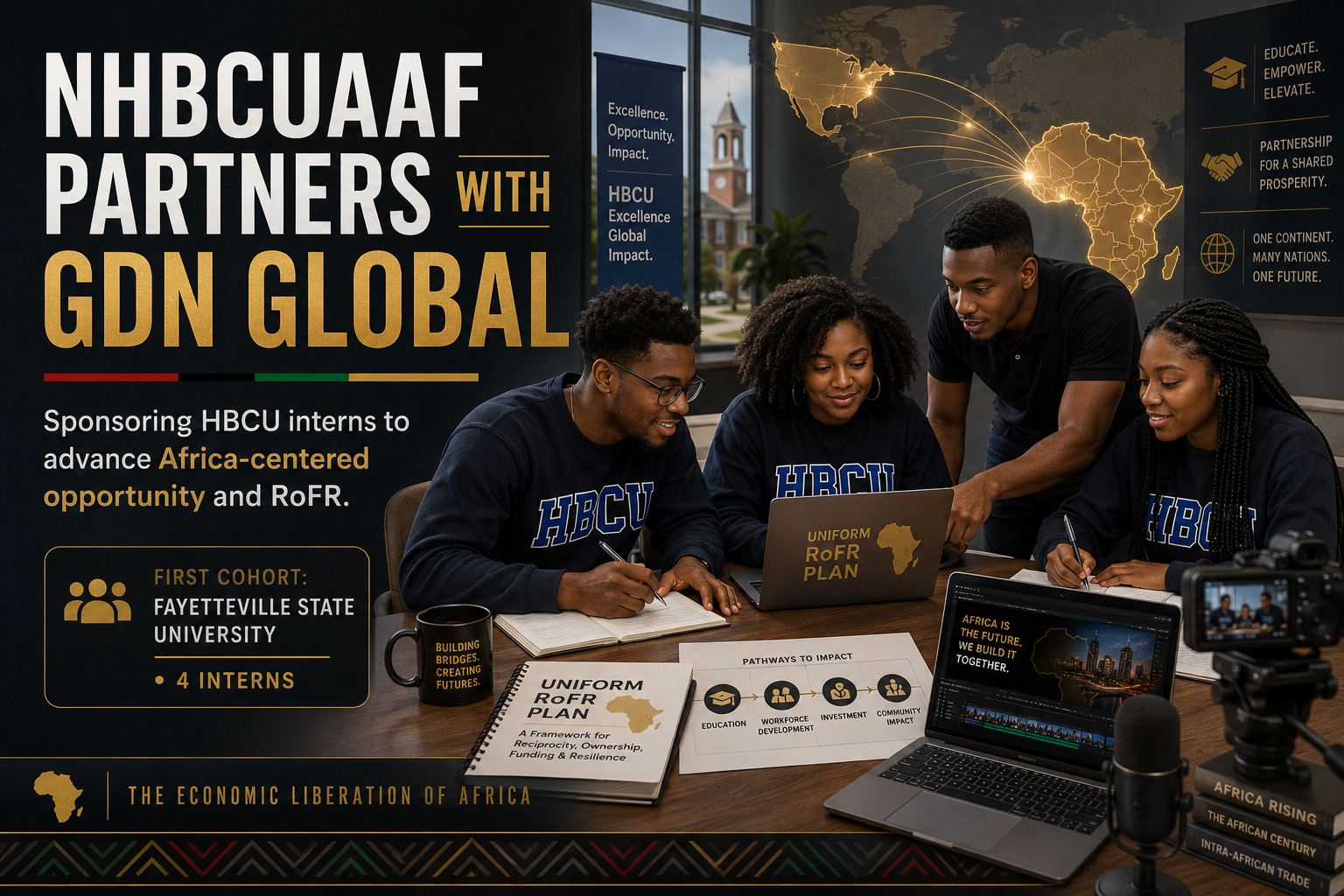
Through our partnership with NHBCUAAF, RoFR is being promoted across HBCU institutions and supported through curriculum conversations that encourage opportunity-access learning pathways. The first launch cohort is based at Fayetteville State University, projected to include four interns.
These interns are not being asked to “talk about RoFR.” They are being asked to build:
- a draft Uniform RoFR Plan (professionally supported as needed)
- videos and podcasts that translate the framework for students and stakeholders
- track-aligned deliverables that create measurable proof-of-work
This is how a movement becomes a pipeline: when students develop skills, ship real outputs, and strengthen institutional pathways that can scale.
How to join the work
If you’re a student at an HBCU, this is your invitation to move from interest to action.
Apply or ask questions: internships@global.greaterdiversity.com
Faculty/career offices: academia@global.greaterdiversity.com
Employers/sponsors: employers@global.greaterdiversity.com
RoFR, in plain language, is a way to design fairness into opportunity. For students, it’s also something bigger: a framework that helps turn African inheritance into strategy—and strategy into careers, enterprise, and generational outcomes.
Join the conversation—leave your take or a question.
Help grow The Economic Liberation of Africa conversation—forward to someone curious about Africa-centered opportunity.
Donate to GDN – Greater Diversity News | Subscribe – Greater Diversity News.