
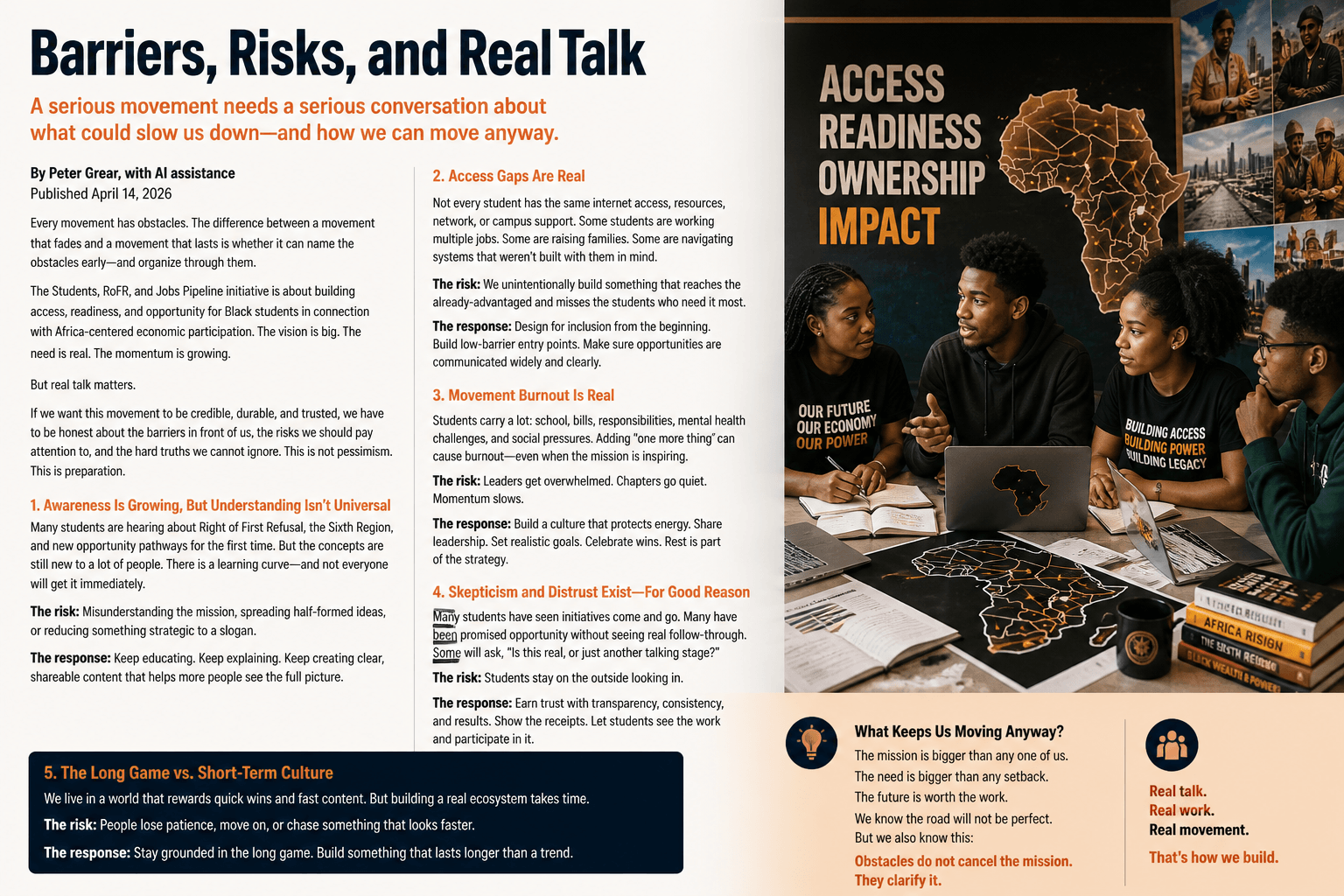
Subtitle: A serious student movement needs a serious conversation about what could slow it down—and how to move anyway.
By Peter Grear, with AI assistance
Published May 1, 2026
Every movement has obstacles. The difference between a movement that fades and a movement that lasts is whether it can name those obstacles early and organize through them.
That is why real talk matters.
The Students, RoFR, and Jobs Pipeline initiative is built on a powerful idea: Black students should not only be inspired by Africa-centered opportunity—they should be prepared for it, connected to it, and positioned to help shape it. That vision is strong. The need is real. The momentum is growing.
But if this movement is going to become durable, credible, and useful, it has to be honest about the barriers in front of it.
That is not negativity. It is preparation.
Too many initiatives fail because they confuse excitement with structure. They assume that because an idea is compelling, people will automatically understand it, trust it, join it, and stay committed to it. That is rarely how movements work. People bring different levels of awareness, different material realities, different pressures, and different reasons for saying yes or no. A serious movement has to plan for that complexity.
One barrier is simple: awareness may be growing, but understanding is uneven.
Many students are hearing about Right of First Refusal, the Sixth Region, diaspora opportunity, and Africa-centered economic participation for the first time. Some will grasp the vision quickly. Others will need time. Some may misunderstand it completely. Others may reduce it to a slogan before they understand the larger framework behind it.
That creates risk. A movement can become shallow when people repeat the language without understanding the strategy.
The answer is not to lower the ambition. The answer is to keep explaining. Keep translating. Keep building clear, shareable content that helps students understand what the movement is actually trying to do and why it matters.
Another barrier is more practical: access gaps are real.
Not every student has the same time, internet access, campus support, or personal flexibility. Some students are working multiple jobs. Some are helping support family. Some are commuting. Some are navigating institutions that were never designed with them in mind. Others may be highly interested in the movement but have limited ability to attend meetings, join events, or volunteer consistently.
This matters because a movement can unintentionally become biased toward the already-connected.
If that happens, the students who most need access may be the ones least able to participate.
So the movement has to be designed with inclusion in mind from the beginning. That means low-barrier entry points, flexible forms of participation, widely distributed information, and a structure that does not assume everyone has the same time or resources to contribute.
A third barrier is burnout.
Students already carry a lot. Academic pressure. Financial pressure. Emotional stress. Future uncertainty. In that environment, even a meaningful mission can become one more obligation. A movement that asks too much too quickly may lose the very people it hopes to cultivate.
This is especially true when student leaders are expected to carry too much of the organizing load without enough support.
Burnout does not always look dramatic. Sometimes it looks like silence. Delayed replies. Empty meetings. Quiet withdrawal. Chapters that lose momentum. Strong people who simply run out of energy.
That is why a durable movement has to build a culture that protects energy. Share leadership. Set realistic expectations. Celebrate progress. Create roles with different levels of commitment. Understand that sustainability is not separate from the strategy—it is part of the strategy.
Then there is the issue of skepticism and distrust.
For good reason, many Black students have seen initiatives come and go. They have heard bold language before. They have seen institutions make promises without follow-through. They have watched opportunities be advertised in ways that feel bigger than what is actually delivered. So when a new movement appears, some people will ask hard questions.
Is this real?
Is this lasting?
Will students actually benefit?
Or is this another round of good language without infrastructure behind it?
Those questions should not be dismissed. They should be respected.
Trust will not be built by insisting that people believe. It will be built by showing work, sharing receipts, following through, and giving students real ways to participate in the building process itself. Transparency matters. Consistency matters. Visible outcomes matter.
There is also a deeper cultural barrier: short-term culture.
We live in a moment that rewards fast content, quick reactions, and constant novelty. But movements that actually reshape access, readiness, and economic power take time. That means the Students, RoFR, and Jobs Pipeline initiative is working against a culture that often loses patience before a serious structure has time to mature.
That is a real risk.
People may want immediate scale. Immediate jobs. Immediate institutional buy-in. Immediate visibility. Some wins may come early, but the larger architecture takes longer. If the movement is judged only by short-term spikes, it may be misunderstood before it has the chance to prove what it can become.
That is why the long game has to be explained clearly. Students, supporters, and partners need to understand that this is not just a campaign for attention. It is an effort to build an ecosystem. Ecosystems take repetition, trust, structure, and time.
There is one more hard truth: not everyone will agree on the path forward.
Some will want the movement to focus on internships. Others will care more about entrepreneurship. Some will prioritize campus organizing. Others will want policy education, employer partnerships, or media visibility. That tension is normal. In fact, it may be a sign that the movement is touching real needs.
The goal is not to eliminate every disagreement. The goal is to build a framework large enough to hold different lanes of contribution while staying anchored in a shared mission.
And that mission is still worth building.
Because obstacles do not cancel the need. They clarify it. If anything, the barriers are proof that a stronger structure is necessary. Students need clearer pathways. They need more preparation. They need more visible opportunity, not less. They need a movement that is honest enough to deal with complexity instead of pretending it does not exist.
That is what real talk is for.
Not to weaken belief.
Not to drain momentum.
But to make the movement smarter, steadier, and more durable.
A serious mission deserves a serious conversation.
And if this movement can face its barriers directly, it may be better equipped not only to survive them—but to build something strong enough to outlast them.
Students, recent graduates, and supporters who want to help shape the Students, RoFR, and Jobs Pipeline initiative can Join the Movement.
Sign up to receive updates, opportunities, and ways to participate in this growing Africa-centered student network.
Help grow The Economic Liberation of Africa conversation—forward this article to a student, educator, or campus leader.